“Owning 51% Gives Founders An Illusion Of Control.” – Guy Kawasaki
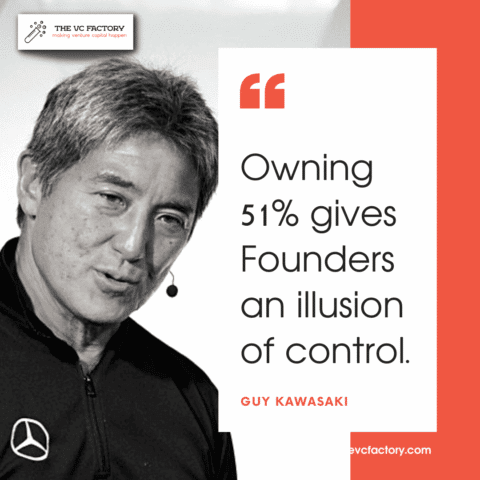
Guy Kawasaki is one of the most beloved and recognized figures in the startup world. A former Macintosh “evangelist” and Steve Jobs’s right-hand man, he tried his hand at Venture Capital at Garage Ventures, before retaking an evangelist position, this time at the online design platform Canva. While he’s primarily famous for pitch-related advice, Kawasaki has a definitive take on a mistake many Founders make, realizing only too late that they had a false sense of reality: wrongly believing they control their startup as long as they have a majority stake.
In this post, I analyze why and how entrepreneurs share operational control and ownership of their companies, how governance is organized in VC-backed companies, why Founders get fired despite controlling voting rights, and which strategy some have pursued to keep their grip on decision-making despite heavy dilution. Finally, I leverage Nobel Prize-winning research to defend a win-win approach to negotiations in Venture Capital.
Explore our VC reports for data‑driven deep dives into venture trends. Each report pairs rigorous analysis with candid insights from top LPs and GPs, giving you perspectives you won’t find elsewhere.
In This Post
- Why Do Entrepreneurs Share Control of Their Companies?
- Why Guy Kawasaki Claims That Majority Ownership Does Not Guarantee Control
- Dual Class Shares: The Ultimate Founder Control Weapon
- Why Win-Win Agreements Are Crucial in Venture Capital
- How To Resolve Guy Kawasaki's Illusion: The Power of Cooperation
- Conclusion: tl;dr
Guy Kawasaki claims that entrepreneurs do not immediately realize that they should share ownership of their companies. Many don’t. Some manage to form large enterprises, but the overwhelming majority create a lifestyle business or a small mom-and-pop operation.
Research shows that many become entrepreneurs because they desire to control their destinies. Entrepreneurship allows them to make decisions, be their own boss, manage their time and resources as they see fit, and create value for themselves. These Founders want to shape a company according to their vision, with limited or no outside interference.
However, as the initial idea grows into a full-fledged company, two external developments may occur with a dilutive impact on Founder control:
- They hire senior executives to take charge of entire business aspects
- They raise funds with financial Investors
Few companies grow tremendously or raise Venture Capital. Some become successful without VC money. In what follows, I zoom in on tech startups and scaleups to discuss how control is shared.
This one can be difficult to swallow, as entrepreneurs typically want to remain in complete control of their ventures. However, sharing day-to-day management is often necessary to achieve growth. Most entrepreneurs lack expertise in areas required for running a successful business.
To compensate for this gap, they either band with co-Founders possessing complementary skills, or hire senior executives highly skilled in those domains. By doing this, entrepreneurs can benefit from the expertise of these proven achievers, but have to share decision-making control with them. This combination of additional insights, experience, and knowledge often leads to exceptional results for the business.
Two recent examples illustrate this point:
- Google’s Founders, Larry Page and Sergey Brin, hired Eric Schmidt to help them grow the company. VC firms had flagged the duo’s lack of business experience.
- Facebook’s Founder, Mark Zuckerberg, hired Sheryl Sandberg from Google to run the social media’s monetization strategy.
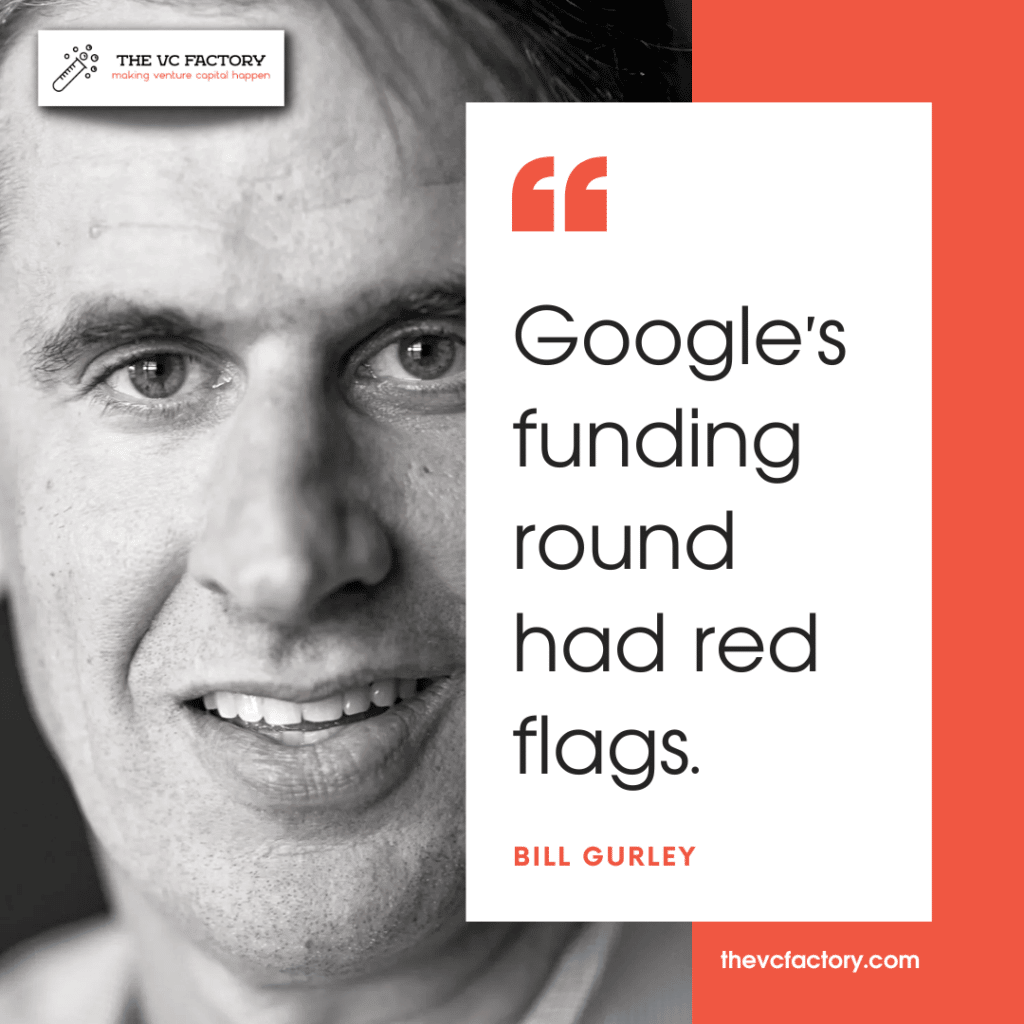
These two examples represent outliers. Nevertheless, sharing some control is necessary for any entrepreneur who wants to build a successful venture. Read the post below for why top VC firms passed on Google’s Series A round.
By allowing Investors to take ownership through equity investments, Founders can obtain the capital they need to develop their business further. Investors sometimes also bring invaluable experience and connections that can help startups accelerate their growth.
Ultimately, the goal for entrepreneurs is to find a balance between retaining sole ownership and access to resources. Equity dilution is seen as a necessary evil. The trade-off is clear: the Founders’ share of the pie is smaller, but they may increase the total size of the pie thanks to the additional capital injected.
VC firms also typically require Founders to set aside a minimum percentage of the equity for employees—up to 15% of the fully diluted shareholding. A startup ESOP (Employee Stock Ownership Plan) is a program through which startups offer employees an ownership stake. This type of plan allows employees to purchase shares at a discounted price, and provides them with options for when to exercise their rights to buy or sell shares.

The goal of a startup ESOP is to incentivize employees, increase loyalty, and give them a sense of ownership. By becoming shareholders, employees are more likely to take pride in their work and better align their interests with the company’s success.
ESOPs further increase the number of shareholders. Having multiple part owners requires business partners to organize governance, i.e., how decisions are made.
Why Guy Kawasaki Claims That Majority Ownership Does Not Guarantee Control
In VC-backed startups, governance is shared between Founders and Venture Capitalists. This means that Investors have a say in the company’s decision-making process. They will try to influence key decisions throughout the life of the venture. The Board of Directors is the forum where such decisions are debated.
What Is A Board And What Does It Decide?
A Board is a group of individuals who guide and oversee a startup. It typically consists of the Founders, senior executives, Investors, and other advisors.
Board members review the progress and performance of the organization on an ongoing basis by reviewing financials and other information provided by the management team. They also discuss and make decisions about strategy, investments, operations, staffing, and other matters impacting long-term success.
Having a strong Board can help a startup better navigate challenging times and ensure it will remain successful. Recent Board-related failures such as Theranos and FTX showed how damaging it could be not to have a proper Board in place.
A great board is a highly-engaged group who knows your business intimately.
Mark Suster – Upfront ventures (Source: Managing your startup board)
Even in VC-backed companies, Founders and their managers retain control of the day-to-day operations. They present a yearly budget to their Investors and do not need to get Board approval as long as they are within budget.
However, VC Board directors must approve critical strategic decisions, especially when they impact the value of their stake in the company.
Although the term sheet offers a summary of governance terms, the shareholders’ agreement (SHA) is the document laying out each party’s prerogatives after the closing. The objective is to make sure things go as smoothly as possible. Like every contract, the SHA also serves as a reference and negotiation point when things start going awry.
In order to protect their interests, VCs secure veto rights over certain strategic decisions, such as hiring or firing key personnel or changes to capital structures.
Examples of veto rights include:
- Change in bylaws, articles of association, or the principal business of the company
- Dissolution
- More debt, capital expenditures, or spending than previously budgeted (with preset thresholds)
- Issuing new stock on parity with, or senior to, the preferred stock
- Dividend payment
- Changing the composition of the Board
The list varies depending on the jurisdiction, the stage the company is in, and sometimes the state of the VC market. In recent times, Founder-friendly operators such as Tiger Global and other crossover funds routinely offered money without strings attached.
Founders need to understand these rights when negotiating contracts with Investors as they can determine the level of control over their businesses. VCs must also master term sheet clauses to adequately negotiate terms with entrepreneurs.
Guy Kawasaki Warns Founders of Their Moral Obligations
Guy Kawasaki points out in his presentation The Top 10 Mistakes of Entrepreneurs (where this quote originates) that he never saw anything come down to a vote in a Board meeting.
Not only do disagreements tend to be hashed out beforehand, but it is also rare for Founders to outvote their VCs. Veto rights skew decision-making, as VCs have a de facto blocking vote on critical decisions.
The moment you take outside money, you have lost control of the company.
Guy Kawasaki
Additionally, Venture Capital is a small industry, and VC firms often invest together in deals. On many occasions, such as a strategic pivot or an early exit proposition, Founders’ and Investors’ interests diverge entirely.
A Founding team systematically acting against the advice of its Investors or trying to outmaneuver them may get “burnt” for future financing rounds. Or, as we will see in our case studies below, be forced to resign the moment they need fresh capital for the startup’s survival.
Founders should be aware of the additional dimensions they sign up for when they take outside money—particularly their moral obligations. Over time, some Founders devised new strategies to retain control even as their equity ownership got diluted.
Savvy entrepreneurs soon realized that if they wanted to weigh in on their company’s decisions and secure their jobs, they had to resort to other means as they raised more money.
Who Fires Startup Founders?
One piece of advice I often repeat to entrepreneurs when we structure their funding rounds or M&A operations is that, beyond the evident impact on wealth, dilution only matters to preserve their jobs.
In practice, it is valid only as long as the Founders perform well enough that the company doesn’t need more money; if it does, and no new Investors are willing to inject more cash, Founders will need to cut a new deal with their Investors. It can include a change in the leadership team.
WeWork: How Neumann “Got Resigned”
A highly visible textbook case illustrating this point is Adam Neumann’s fall from grace as CEO of WeWork after its planned IPO crashed.
When it became clear that WeWork’s main Investor, Japan-based Softbank, would have to bail it out because no one else would finance its immense cash burn, Masayoshi Son worked hard to take control of the beleaguered portfolio company where he had sunk billions out of the behemoth Vision Fund.
Adam Neumann was officially fired from his role as CEO in September 2019. Neumann, who said he was becoming “a significant distraction,” voted for the move. Despite being ousted as CEO, Neumann kept his board seat and shares, although he had to give up his majority control.
Uber: Minority-Owner VCs Oust Travis Kalanick
Another high-profile case illustrating how Founders get fired despite VCs owning a minority stake is Travis Kalanick’s departure as CEO of Uber.
Kalanick was forced to resign after a tumultuous six months of scandal. This came after an internal inquiry found widespread sexual harassment and gender discrimination.
Kalanick’s departure was prompted by a letter from VC firm Benchmark, which had invested in Uber and held a seat on its Board. In the letter, Benchmark accused Kalanick of failing to change the company’s culture and demanded that he step down as CEO. After growing pressure from public reports of unethical practices, Kalanick resigned from Uber in June 2017.
Venture capital isn’t for everyone. It has its costs: One is that you lose the illusion of control—and illusion is what it is. But when it hits, it hits spectacularly.
Guy kawasaki (Source: Forbes)
Are Uber and WeWork outliers?
The Uber and WeWork situations are extreme. In most cases, Founders get diluted below 51% equity ownership and safely remain at the helm of the company they founded—provided they can become a Founder-CEO.
Most Investors recognize that entrepreneurs are paramount to the company’s success and will not try to fire them. In today’s Founder-friendly market, a VC firm with a quick trigger would ruin its reputation with future entrepreneurs it may want to back. (Note: Benchmark was in both WeWork and Uber’s Boards and seems to have escaped unscathed, showing their handling was not deemed inappropriate.)
However, some Founders are reluctant to leave too much say to Investors. They seek protective measures to retain control even as they take more external funding. They achieve their goals through the issuance of dual-class shares.
Retaining Control Despite Dilution
Dual-class shares are a type of stock structure where a company issues two classes of shares. The two classes of shares typically have similar cash flow rights but different voting rights, with one class having superior voting power over the other.
This type of stock structure is often used to ensure that Founders and sometimes other “insiders” (early Investors) maintain control over the company, even if they own a minority stake.
Google, Facebook, and Snap are all examples of companies that have adopted dual-class share structures:
- Google has Class A and Class B shares, with Class B shares having 10 votes per share compared to Class A’s one vote per share. Page and Brin have joint control of Google’s parent Alphabet despite owning less than 12% of its shares
- Facebook also has two classes of stock, with Class A having one vote per share and Class B having 10 votes per share. Despite owning 12.5% of Facebook, Zuckerberg controls 58% of the voting power
- Snap shocked analysts when it went public in 2017. It has three classes of stock: Class A (one vote per share), Class B (10 votes per share), and Class C (no voting rights). Snap’s co-Founders still own majority voting control despite heavy dilution from 10 funding rounds before the IPO
While many analysts call out dual-class shares as an unfair practice, they are enforced when Founders have enough bargaining power to do so.
Tesla’s supermajority vote
Another way for Founders to retain control is to reverse the dynamics: no significant changes in the strategic direction can be taken without them.
This is how Elon Musk purportedly controls Tesla. The electric car company’s bylaws require a supermajority vote of 66.7% of all shares to pass resolutions on strategic matters such as mergers and acquisitions, and changes to the Board’s compensation.
Given that Musk directly controls 22% of Tesla’s shares and indirectly (with insiders) controls an estimated 25.5%, a supermajority resolution would require c.90% of all other shareholders’ vote to pass—a near-impossible hurdle in a public company.
Why Win-Win Agreements Are Crucial in Venture Capital
How did we get here? The dynamic described above is a losing proposition for all parties involved. In this last section, I present an alternative way to strike deals in VC using Nobel Prize-caliber research in contract theory.
Win-Lose Deals Don’t Work In “Repeated Games”
The mistake many Investors make is approaching Venture Capital deals with a Mergers & Acquisitions (M&A) mindset, where parties conduct negotiations with a win-lose mindset—driven by the understanding that once the deal is closed, their paths may seldom cross again.
This contrasts sharply with the dynamics in Venture Capital, where VCs and Founders embark on a journey that can span years, often seven to ten years from the time of the first investment, before an exit is realized. Here, the relationship is not a one-shot game but a repeated one, where the quality and nature of interactions over time can significantly impact the venture’s success.
The concept of one-shot versus repeated games in game theory provides a valuable framework for understanding these interactions. In a one-shot game, like many M&A deals, parties negotiate aggressively to maximize their gain, knowing they may not have to deal with each other in the future.
Think of a one-shot game as like going to the flea market: You probably won’t see your trading partner again, so if you’re a jerk to them, the risk of facing the consequences is low.
Kate Vitasek – University of tennessee (Source: The Conversation)
Contrast this with a repeated game, typical in Venture Capital relationships, where VCs and Founders interact over multiple financing rounds, product development milestones, and strategic decisions. The long-term nature of these interactions incentivizes parties to pursue strategies that sustain and enhance the relationship, recognizing that mutual gains today can lead to greater opportunities tomorrow.
While negotiating toward zero-sum thinking, where one party’s gain is seen as another’s loss, may prove effective in one-shot games, research showed that in repeated games, when one party uses their power in a negotiation, it creates the urge for the other party to retaliate.
One form of such retaliation can be illustrated by the Lightspeed Venture Partners / Snapchat spat.
Retaliation: Snap vs. Lightspeed Ventures
In the early stages of Snap’s (formerly Snapchat) development, Lightspeed’s partner Jeremy Liew made a significant investment in the company. As is common in early-stage investments, the terms of this investment gave Lightspeed specific controls and protections. However, as Snap grew and its Founders, Evan Spiegel and Bobby Murphy, became more familiar with Venture Capital norms and practices, they realized that some of the terms negotiated by Lightspeed were not standard and placed an unusually high degree of control in the hands of the VC.
This realization led to a sense of unfairness or dissatisfaction from Snap’s perspective, given the evolving understanding of what constitutes standard and fair terms in Venture Capital financing. The Founders felt that the early terms negotiated with Lightspeed did not align with the more balanced approach seen in later financing rounds or with the norms they learned about as they became more experienced in dealing with Venture Capitalists.
In response to this perceived imbalance, Snap’s Founders undertook efforts to adjust the power dynamics and control mechanisms in their relationship with Lightspeed and other early investors. This included renegotiating terms in later financing rounds, implementing structural changes within the company to ensure greater autonomy from Investor control, and eventually leading to the controversial decision to issue non-voting stock at the time of Snap’s IPO. This move ensured that new Investors would not have the same level of control or influence over the company’s direction, a significant shift from the terms initially agreed upon with Lightspeed.
I’m obsessed with this idea of “no standard terms”. Ask why, and why and why until you really understand how the deal is structured.
Evan spiegel – Snap (Source: ET Now)
This case highlights how perceived inequities in contractual relationships can lead to subtle shifts in behavior and strategy by the aggrieved party, aimed at restoring a sense of fairness and balance in the partnership.
This scenario underscores the importance of aligning expectations and terms from the outset in Venture Capital relationships and the need for flexibility and adaptability in contracts to account for the evolving nature of startups and the landscapes in which they operate.
Another way parties retaliate is underperforming, a behavior called “shading” in contract theory.
“Shading” Turns Guy Kawasaki’s Illusion Toward Investors
Shading, a concept developed by Oliver Hart, who received the 2016 Nobel Prize for Economic Sciences, refers to a situation where one party to a contract adjusts its behavior in response to perceived unfairness or dissatisfaction with the terms of the agreement. These adjustments may not constitute a direct breach of contract.
In scenarios where one party feels that the other has not acted within the spirit of the agreement, or if external conditions change in a way that makes the original terms feel unjust, the aggrieved party may engage in shading. Shading behaviors can include reducing effort, withholding information, or otherwise not performing in a manner that fully aligns with the partner’s expectations or the partnership’s intended spirit. These actions are typically subtle and may not directly violate contractual obligations, making them difficult to challenge legally.
Shading arises because all contracts, to some extent, are incomplete; they cannot anticipate every future event or specify every obligation. As circumstances change, what was initially perceived as a fair division of responsibilities, risks, and rewards might no longer seem equitable. When one party feels disadvantaged by these shifts, shading can occur as informal, passive resistance to the perceived imbalance.
A party’s ex post performance depends on whether he gets what he is entitled to relative to outcomes permitted by the contract. A party who is shortchanged shades on performance.
Oliver Hart and John Moore (Source: The Quarterly Journal of economics, 2008)
While Hart and Moore studied shading in the context of the employer-employee relationship, such dynamics can be found in Venture Capital.
The session dedicated to VC Term Sheets in the VC Career Accelerator dives into major asymmetries in Venture Capital, including the asymmetry of outcome. When the Founders realize that their economic outcome in a probable exit scenario is low—for example, due to a large preference stack (see the article below)—they are likely to convince Investors to put more money into their company to keep their social status and perks.

How To Resolve Guy Kawasaki’s Illusion: The Power of Cooperation
The winner-loser mindset can poison Venture Capital relationships, leading to a cycle of retaliation and mistrust that undermines the partnership’s potential. Researchers have long shown that in repeated games, cooperation leads to optimal outcomes.
The Prisoner’s Dilemma
Robert Axelrod, a political scientist at the University of Michigan, illustrated the downside of aggressive, short-term tactics through his “Tit for Tat” strategy based on game theory. This strategy involves initially cooperating, then replicating an opponent’s previous move, whether cooperation or defection.
Axelrod’s exploration of the prisoner’s dilemma delves into a classic game theory scenario where two individuals, acting in their self-interest, face a choice between cooperation and defection. In this setup, each participant must decide whether to cooperate with the other or betray them (defect), with the outcomes determined by the combination of their choices.
- If both cooperate, they receive a moderate reward;
- If one defects while the other cooperates, the defector receives a high reward while the cooperator gets a low payoff (or punishment);
- If both defect, they receive a lesser punishment than if one cooperated and the other defected, but less than the reward for mutual cooperation.
Axelrod’s work, mainly through the iterated version of this dilemma, demonstrates that when this game is repeated over time, “tit-for-tat”—starting with cooperation and then mirroring the other player’s previous move—emerges as a robust strategy for fostering long-term cooperation, highlighting the importance of reciprocal behavior in promoting mutual benefit.
We are used to thinking about competitions in which there is only one winner, competitions such as football or chess. But the world is rarely like that. In a vast range of situations, mutual cooperation can be better for both sides than mutual defection.
Robert Axelrod (Source: The Evolution of cooperation, 1984)
In repeated games, a strategy of cooperation followed by reciprocal actions (rewarding cooperation and punishing defection) proves more effective. This approach encourages parties to consider the long-term implications of their actions, fostering a collaborative rather than adversarial relationship.
Leaving Money On The Table
Another Nobel laureate, the U.S. economist Oliver Williamson, further demonstrated the benefits of “leaving money on the table.”
Oliver Williamson’s concept refers to the intentional act of not extracting all possible gains or advantages in a negotiation or contract, in order to build and maintain a long-term, cooperative relationship with the other party. This approach challenges the conventional wisdom of maximizing short-term financial outcomes. Instead, it emphasizes the strategic value of fostering trust, goodwill, and partnership. By willingly foregoing immediate profits or benefits, a party signals its commitment to fairness, reliability, and mutual success.
Williamson suggests that this behavior can lead to more sustainable and profitable collaborations over time, as it reduces opportunistic behavior, encourages reciprocal cooperation, and decreases transaction costs associated with negotiating and enforcing strict contractual terms.
By not squeezing every possible concession out of a deal, VCs and Founders signal their commitment to a partnership that values long-term success over short-term gains. This approach aligns with the notion of a nonzero-sum game, where the focus shifts from dividing a fixed pie to collaboratively making the pie bigger for everyone involved.
In practice, VCs and Founders should seek arrangements that share risks and rewards more equitably, encourage open communication, and adapt to changing circumstances. Examples of such practices include aligning incentives through equity arrangements that reward long-term value creation, establishing governance structures that ensure transparency and joint decision-making, and adopting flexible contracts that can evolve as the startup grows and its needs change.
Conclusion: tl;dr
Founders often share control of their company with outside Investors, but, as Guy Kawasaki argues, they can be fooled into thinking they still have full control even when taking outside money. To maintain a grip on the governance, some Founders use dual-class shares to ensure their voting power is not diluted by dilutive rounds.
However, despite the advantages that dual-class shares offer, Founders need to remember that ultimate control of a company is never truly theirs if outsiders with veto rights own a stake—especially if the startup needs more cash to grow, as it will have to turn to its current Investors if things don’t go as planned. As Guy Kawasaki says, Founders can’t raise outside money and be “control freaks.”
One solution resides in win-win approaches. Both parties should approach their contractual relationship transparently and flexibly to adapt to changing circumstances.