Why Venture Capital LPs Should Fund Flying Cars
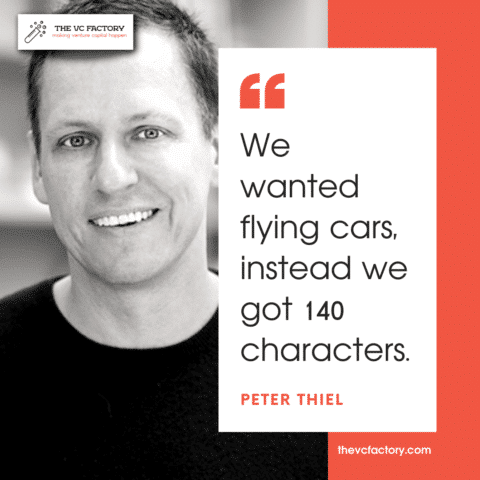
In 2011, Peter Thiel gave Venture Capital one of its most memorable complaints: “We wanted flying cars, instead we got 140 characters.”
Thiel was attacking an industry that had drifted away from its daring company-building roots. Instead, Investors had become good at pattern matching: recognizing companies that looked like previous winners, joining fashionable rounds, and asking who else was investing. As the asset class grew, most VCs became money managers.
In short, they focused on capital instead of venture.
I believe that we’re now closer to funding “flying cars” again, a metaphor for bold innovations carried by mission-driven Founders backed by visionary VCs.
Since the 2022 reset, Venture Capital has split into two distinct segments. On one side, large platforms compete for big LP commitments and concentrate capital in the most obvious winners. On the other, smaller firms (including Emerging Managers) fight to prove they can identify the next outlier before the rest of the market agrees.
But size is not the real distinction. Some large firms still make bold, early, non-consensus bets, while some small funds merely copy fashionable themes with less capital. The deeper divide is in the mindset. It separates promotion-focused Investors, who focus on what can go right, from prevention-focused Investors, who strive to avoid being wrong.
That distinction matters most for allocators in VC funds (Limited Partners or LPs).
LPs aiming for superior returns should back VC managers investing in flying cars. Risk and illiquidity are so high in VC that only top-quartile, and even top-decile performance makes financial sense.
However, there’s a catch. Instead of requiring VC managers to shorten the liquidity horizon, LPs should recognize that it takes time to build category-defining companies. They must mirror the mindset of GPs with sufficient risk appetite and patience to make bold bets — or stay out of the asset class altogether.
In this article, I show how the current environment favors promotion-focused Investors, those who are mentally equipped to make conviction-oriented, pre-consensus investment decisions, and how LPs can discern them from the pack.
It’s time to start building those flying cars.
In This Article
The VC Market’s Dichotomy Favors Flying Cars Again
The main narrative these days about the asset class is that Venture Capital has changed beyond recognition, in the wake of several of the largest VC firms moving beyond classic early-stage partnership structures.
Sequoia created an open-ended fund structure to hold public positions longer. Andreessen Horowitz, Sequoia, Lightspeed, Thrive, General Catalyst, and other large platforms became Registered Investment Advisers (RIAs), giving themselves more flexibility to invest across stages, public equities, crypto, secondaries, and other assets.
Critics looked at this shift and concluded that classic VC was dead. The best-known Venture Capital firms had become private-market asset managers.
My analysis is different.
As I demonstrated in an earlier essay, large VC firms now operate like “multi-stage capital machines”. They can invest early, double down heavily, hold longer, and use structures that offer greater flexibility than traditional 10-year VC funds.
They are both adapting to and shaping the new VC market’s paradigm:
- At the top of the pyramid, a select group of mega-funds able to absorb LP checks in the hundreds of millions
- At the bottom, a long tail of smaller funds (below $100 million in size), among which a few nimble, specialist, value-add-oriented firms
This essay argues that the second group is where LPs writing 5- and 6-figure checks should focus.
But size is not the key criterion; instead, LPs are better off selecting GPs who fund flying cars, the long-shot, improbable bets that produce outlier performance.
A close look at the latest VC market’s dynamics reveals where the opportunity lies. Now’s the time to invest in the Venture Capital asset class, provided you know how to find the future gems.
LPs Either Sit It Out Or Hide In The Herd
From a fundraising standpoint, the Venture Capital market has changed sharply since the 2022 peak: funds raised by VC firms in 2025 were a third of 2022’s total — back to 2019 levels.
However, a wider lens shows that 2021 and 2022 fundraising amounts were exceptions anchoring a false sense of subsequent doom. The US Fed’s monetary easing started in 2019 and accelerated during the pandemic led to near-zero rates, abundant liquidity, and a temporary rush of crossover capital (hedge funds, mutual funds, asset managers, and other public-market investors) into private markets.
In that environment, VC fundraising exploded, and the “tourists” flocked in, but they were badly hurt when the deployment landscape changed sharply in 2022. Tiger Global is the poster child for that dramatic swing: after capturing market share with a low-friction approach built around speed, light diligence, and limited Board involvement, the crossover investment firm marked down its venture portfolio sharply, cut its deal pace, and returned to market with much smaller, more concentrated funds.
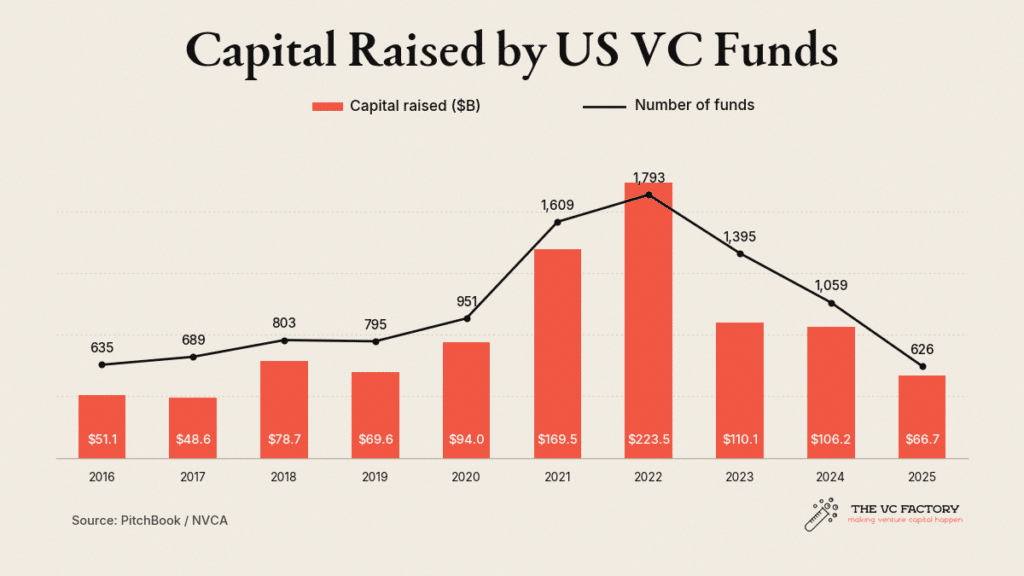
The 2020-2021 easy-money cycle made many different strategies look good. Fast follow-on rounds, huge markups, and rising valuations created the impression that Investors had unusual judgment. Three times more VC funds raised capital in 2022 than in 2016.
The inevitable correction, which has been called a market reset by VC veterans, removed part of that illusion. It forced LPs to ask who had real investment insight and who had been carried by market momentum.
The result is a more concentrated market, a typical “flight to quality” in down times.
While many capital allocators who invested in 2020-2021 reduced their exposure to the asset class, those who are still willing to invest focus on VC firms with brand, scale, existing relationships, and access to the most obvious AI winners — even if returns are lower.
As I shared in a recent post, in Q1 2026, 73% of all VC funding raised went to five firms. Andreessen Horowitz ($12B), Thrive Capital ($10B), Founders Fund ($6B), Kleiner Perkins ($4B), and Battery Ventures ($3B) announced new funds totaling a staggering c.$35 billion in the period. For comparison, the entire US Venture Capital asset class never raised more than $34 billion in a single year between 2004 and 2013.
Such “flight to quality” is unlikely to produce flying cars. Multibillion-dollar funds don’t need a 100x fund returner to move the needle. A few good bets at late stage will do. At this level, performance is measured in absolute amounts: a $5 billion returning 1.8x net to LPs generates the same net gains as ten top-decile $100 million VC funds returning 5x net (which is hard to do).
The implication is clear: the post-2022 VC market is not dead, but increasingly divided between scaled consensus capital and smaller firms forced to search for asymmetric opportunities.
A closer look at capital deployed shows that a similar dynamic, consensus vs. conviction, is afoot in the field.
VC Firms Are Deploying Again, But Not In Flying Cars
In dollars deployed, VC is strong again. The recovery is real, but narrow.
US VC firms resumed deploying capital aggressively in 2024, accelerated further in 2025, and, by Q1 2026 alone, had already deployed more capital than in 2016-2024 except 2021.
Dry powder, the amount of committed capital that has not yet been called, remains near record levels at roughly $280 billion. That capital creates pressure: funds cannot sit indefinitely on aging commitments without facing expiring investment periods, LP questions, or weaker positioning in the next fundraising cycle.
It helps explain why activity has resumed. But dry powder is only part of the story. The bigger driver is renewed conviction around AI and frontier-technology category leaders. Investors are no longer spreading capital broadly across the market. They are concentrating it in a small number of companies they believe can define the next platform shift.
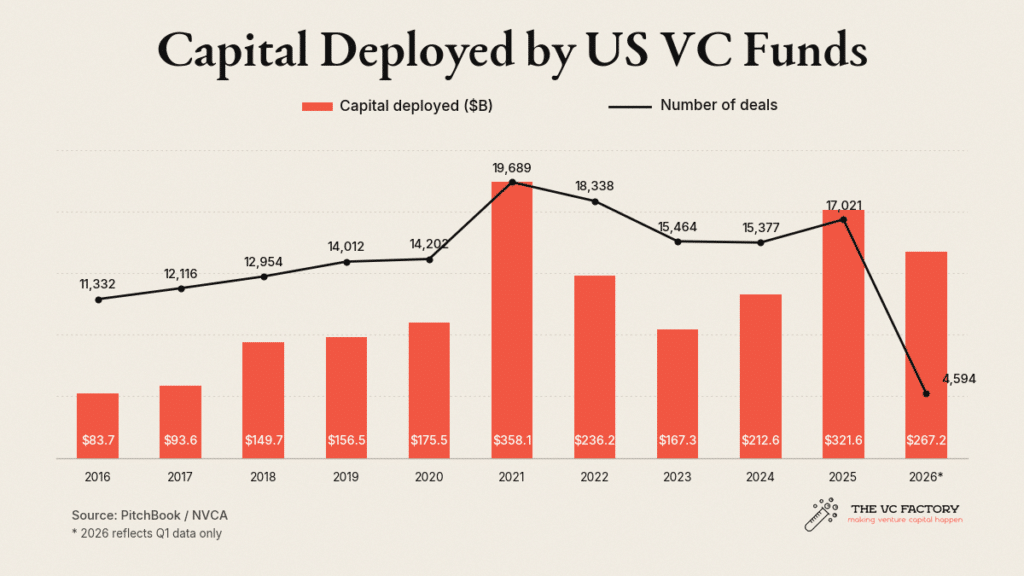
However, the same “flight to quality” has occurred at the startup level. In an unprecedented concentration of capital, nearly three-quarters of VC capital was deployed in just five tech companies in Q1 2026.
OpenAI raised $122 billion, Anthropic $30 billion, xAI $20 billion, Waymo $16 billion, and Databricks $7 billion. Together, these five companies absorbed $195 billion of VC capital, more than the total capital deployed across 13,000 startups in 2020.
The recovery in VC deployment is real, but it was overwhelmingly concentrated in a handful of consensus frontier-technology winners. One data point reveals this: while VC Investors deployed $236 billion across 18,000 companies in 2022, only 4,500 startups received a comparable $267 billion in Q1 2026.
VC has entered the era of consensus deals, and that dynamic will likely persist.
Pitchbook / NVCA
At the top of the pyramid, a few mega-funds invest in a few mega-startups. But it doesn’t mean it’s the only viable strategy for LPs who want exposure to the asset class, especially if they’re looking for outlier returns.
LPs Should Focus On Smaller, Nimbler VC Firms
At the other end of the spectrum, smaller VC firms and Emerging Managers face the opposite constraint. The best of them turn it into an opportunity for agile LPs willing to take some risk to make a buck.
Smaller VC firms can’t win by outbidding large platforms in obvious rounds. If they behave like undercapitalized versions of big funds, they have no reason to exist. Their only credible path is to identify the next outlier before the rest of the market agrees.
A string of street-smart, specialist, value-add-oriented VCs is making magic with funds under $100 million. Micro-funds in particular are killing it.
Recent Carta data showed that in the top-decile category, funds in the $1-$10 million range outperformed their $100+ million counterparts in the 2017-2019 vintages. While TVPI can be gamed, these funds’ age and a comparative IRR analysis including distributions confirms the conclusion.
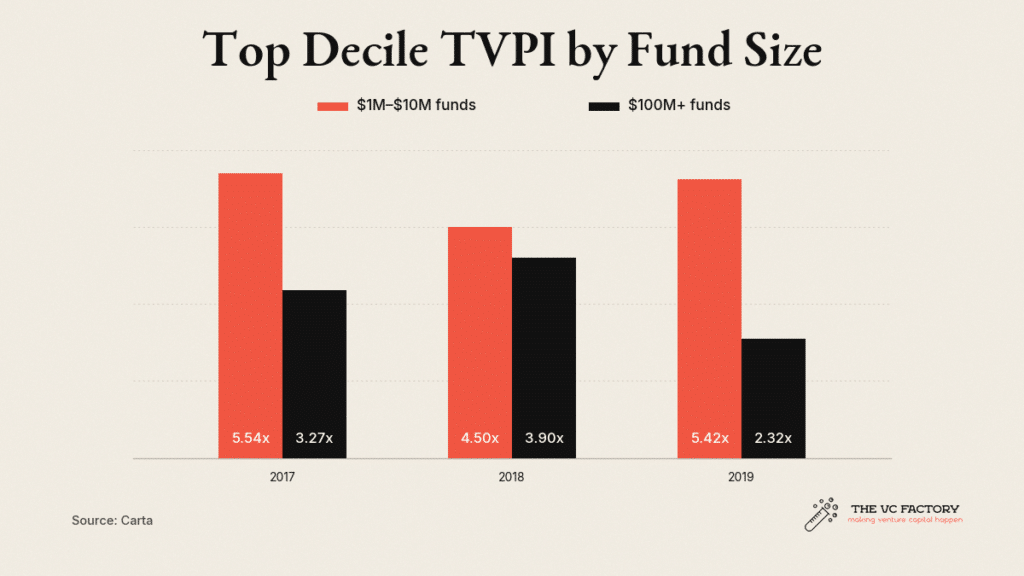
For LPs seeking genuine Venture Capital alpha, smaller funds are the most compelling segment of the market today. In particular, longitudinal data show that Emerging VCs, in particular, over-perform established VC managers.
First, these funds remain accessible to LPs deploying in the five- or six-figure range, unlike multibillion-dollar funds.
Second, their economics force discipline. A sub-$100-million fund cannot build an exceptional outcome by following consensus late-stage rounds. It needs one or two investments with the potential to return the fund, and ideally several times the fund. It pushes these fund managers toward flying cars: strange, ambitious, category-creating companies that can still produce 100x outcomes from the entry point.
In a sense, smaller funds today are rediscovering the old Venture Capital blueprint. The first great waves of Silicon Valley investing were built by Investors who backed companies before the categories were obvious: Genentech, Apple, Intel, Cisco, and others.
Are we going back to the future laid out for VC in the past? If so, how can LPs today better select future winners?
Back To The Future: When VCs Funded Flying Cars
To understand what smaller funds may be rediscovering today, it helps to go back to the first great waves of Venture Capital.
In contrast to what most Venture Capitalists have done since the mid-2000’s, the first and second generations of Investors were not merely allocating capital to promising startups. They were helping create companies, categories, and sometimes entire industries.
Hall of Fame Venture Capitalists such as Arthur Rock, Eugene Kleiner, Tom Perkins, and Don Valentine operated in a market with fewer playbooks, fewer benchmarks, and much less social proof.
They funded startups founded by unlikely entrepreneurs carrying a crazy vision. VCs who met Apple’s Steves famously said that “they were very unappealing, they didn’t smell good, they dressed funny.”
But these VCs, as the 2011 documentary “Something Ventured” claims, had an eye for the next big thing.
It’s the old “flying cars” blueprint: find an ambitious Founder, underwrite a non-obvious market or technical insight, help shape the company, and stay close enough to matter.
Genentech, The First Biotech “Flying Car”
The textbook case is Genentech, a biotech company founded in 1976 and widely regarded as one of the pioneers of modern biotechnology.
Genentech was an improbable candidate for Venture Capital money. It was co-founded by Herbert Boyer, a brilliant UCSF scientist, and Robert Swanson, a young Investor with a chemistry background from MIT. Swanson was one of the early hires at Kleiner Perkins, which had been founded only a few years earlier and was still closer to a startup than to an institution.
When Swanson started pushing the idea to Tom Perkins in 1976, there was no company in any meaningful sense. The scientific breakthrough still looked far from commercial. Boyer himself reportedly warned that it might take years of basic research before recombinant DNA could become useful in a business setting.
Despite these risks, Tom Perkins decided to invest. He chaired the Board from the company’s earliest days and helped with crucial aspects of its trajectory, including the business model, financing strategy, and early partnerships.
I spent a lot of time at Genentech. One afternoon a week, year in and year out.
Tom Perkins (Source: Bugos, 2002)
Perkins helped Genentech decide what kind of company it should become, how it should manage production, how it should license technology, and how it should preserve enough ambition to become a fully integrated biotechnology company.
In 1980, Genentech went public at a $300 million valuation, making it one of the biggest VC winners of the time. In 2009, Roche acquired the company for $47 billion.
The Kleiner-Perkins-Genentech story shows what Venture Capital looked like when it created industries. Genentech was not a consensus software deal with a clean market map. It was a company built around new science, technical risk, skeptical incumbents, and long product cycles. In other words, it was a flying car.
What Gives Top-Performing VCs The Midas Touch?
I’ve met with hundreds of VCs over the last few years and have examined their decision-making processes in depth. The trend that I and others see is that the current market conditions have pushed resilient, creative, and value-add-obsessed GPs to the fore.
The dichotomy I described earlier has given rise to a new crop of VCs who map well to the old cohort. The main challenge for LPs is how to select them, as only the top performers in the asset class justify the risk and illiquidity.
The thesis I defend through my approach, Mindset-Based Investing, is that mindset is the real differentiator, across generations, between top VC performers and the rest.
It’s not a mainstream idea.
Many industry practitioners and commentators believe that educational and professional backgrounds predict success as a VC. While such analyses have some merits, they don’t show the full picture.
Let’s look at how the profiles of successful VCs have changed over time. Given the limited sample size for the 1950s-1990s cohort, the observations remain largely anecdotal.
Legendary Venture Capitalists of the earlier era came from engineering, sales, manufacturing, science, or company-building roles.
- Eugene Kleiner co-founded Fairchild Semiconductor before co-founding Kleiner Perkins
- Tom Perkins was an engineer at Hewlett-Packard and helped build HP’s computer business
- Don Valentine started as a sales engineer at Raytheon, then helped build the sales force at Fairchild Semiconductor and later became a senior sales and marketing executive at National Semiconductor.
- Arthur Rock is a useful exception. He came from finance, but he did not behave like a passive allocator. He helped launch Fairchild Semiconductor, backed Intel, served as Intel’s first chairman, invested in Apple, and spent time with Founders before writing checks.
The common thread is proximity to the entrepreneurs and the process of building a company from scratch.
These Investors understood markets, products, technical risk, industrial customers, company formation, and the painful early work of turning a strange idea into a functioning business. They were not all operators in the same way, but many had spent time working closely in the industries they funded.
VCs who previously worked at a VC-backed startup are much more likely to become partners.
Ilya Strebulaev – Stanford GSB (source: His Awesome Substack)
Likewise, success in the 2000s+ cohort seems to be correlated with prior operational experience.
Recent analysis of more than 12,000 VC careers shows that startup experience matters: people who worked at VC-backed startups are more likely to become partners, whether they were Founders, C-suite executives, or rank-and-file employees. That makes sense. Time inside a startup teaches how companies break, scale, hire, miss, recover, and fail.
However, it seems that top performers in VC break the mold.
For example, my analysis of the 2019 Midas List laureates, the Forbes ranking of the 100 best VCs worldwide, showed that a whopping 37% had no prior operational experience, and only 25% had entrepreneurial experience (a proportion that rose to 42% in the 2024-2025 Midas List batch).
Likewise, Social Capital’s Chamath Palihapitiya revealed that few of the twenty VCs who returned one billion dollars more than once (those I called the Power-Law Masters) had any operational experience. Many in that top tier came from banking and other careers, like journalism. Chamath sees these Investors’ “commercial mind” as the common trait, not what they’ve done before.
If pedigree and prior work experience do not correlate with excellence in VC, what does?
After analyzing the decision processes of Power-Law Masters for a decade, I concluded that their success lies in large part in their mindset, in how they see the world. It echoes a wisdom gem Don Valentine delivered a few years ago.
What makes a great VC is the ability and willingness to be different. The key to make a great investment is to do something entirely differently.
Don Valentine – SEquoia (Source: Techcrunch)
In the last section, I describe the mindset of potential Power-Law Masters and explain how LPs can select them for outlier performance.
Flying Cars Are Funded By Those Who Try To Win, Not Those Who Try To “Not Lose”
My work on Mindset-Based Investing over the past decade has shown that two major types of VCs coexist: promotion-focused and prevention-focused. Their decision-making processes differ starkly, as does their performance.
The framework is based on E. Tory Higgins’s Regulatory Focus Theory, a proven, 30-year-old psychological theory. Promotion-focused individuals pursue advancement, gains, and upside. They are trying to win. Prevention-focused individuals pursue safety, accuracy, and protection. They are trying to avoid losing.
Both mindsets can produce excellent Investors. In public markets, credit, private equity, and late-stage growth, a prevention focus can be a major strength. Oaktree’s Howard Marks built an extraordinary career around discipline, skepticism, and downside protection.
Early-stage Venture Capital is different.
The asset class is governed by the power law. Most investments fail or return little. A tiny number of companies create most of the value. In that environment, the costliest mistake is the missed outlier, the error of commission I’ve called VC’s “capital sin.”
I don’t mind a 90% probability of failure if there’s a 10% chance of changing the world.
Vinod Khosla – Khosla Ventures (Source: Bloomberg wealth)
Promotion-focused VCs focus first on what can go right. They can tolerate the discomfort of being early and alone. They are not blind to risk, but they do not let risk analysis kill imagination.
Prevention-focused VCs operate differently. They rely more on social proof, clean metrics, known patterns, and institutional validation. They are often intelligent, rigorous, and well-trained. But their mental processes tend to reject the strange company before it has time to become obvious. They feel more comfortable in the herd.
I’ve written extensively about this divide, and illustrated it with concrete examples.
Masayoshi Son shows both sides of the promotion focus. His $20 million investment in Alibaba after one meeting with Jack Ma looks insane until it becomes one of the greatest investments in Venture Capital history. However, the same mindset later produced WeWork, where optimism outran discipline.
Bill Gurley’s Google miss illustrates the opposite risk. Benchmark passed on Google’s Series A for reasons that looked reasonable at the time: search was crowded, the Founders were young PhDs, and the valuation felt high. Years later, Gurley called it the biggest mistake of his career and turned it into a lesson: in Venture Capital, the right question is often “What can go right?” because you can lose only 1x your capital but you can make 10,000x from a non-obvious startup.
My recent research into these Power-Law Masters shows that they are not reckless, but disciplined optimists. They delay intuition, collect evidence, test assumptions, and still preserve enough imagination to back what looks unreasonable.
That’s the mindset required to fund flying cars.
Why The Mindset Test Matters
This distinction matters to Founders, aspiring VCs, and LPs. It matters most to LPs.
Founders raising Venture Capital need to know which type of Investor sits across the table. Promotion-focused VCs can make up their own mind. They think from first principles and don’t care what others think. They are the ones most likely to lead a round when the company still looks strange, early, or hard to explain. They look for pre-consensus startups.
In contrast, prevention-focused VCs rarely move first. They wait for external validation, a credible lead, a trusted brand, or enough market momentum to make the decision feel safe. They can still be useful once the train is leaving the station, but they are unlikely to be the first domino.
By far the biggest influence on investors’ opinions of a startup is the opinion of other investors.
Paul Graham (Source: his awesome blog)
As I noted in my report on the role of intuition in VC decision-making, prevention-focused Investors are easy to spot: their favorite question is “Who else is looking at this deal?”
Aspiring VCs face a similar issue.
A young Investor who develops independent judgment will struggle in a firm where every investment decision depends on external validation. It is mentally exhausting to build conviction through research, insight, and Founder work, only to see the Investment Committee ask, “Who else is in?”
I’ve experienced this dissonance firsthand and now advise those who want to break into VC to carefully due diligence the firms they apply to.
For LPs, the stakes are higher.
LPs pay fees and carry, accept illiquidity, and take blind-pool risk because Venture Capital promises exposure to outlier companies. If an LP backs prevention-focused managers who mostly follow consensus, the portfolio may still contain good logos. But good logos are not the same as Venture Capital alpha: Consensus ideas come at a consensus price.
The current market makes this test even more crucial.
Many LPs active today make the wrong tradeoff. They want outlier returns but underwrite for comfort. They ask for DPI too early, require institutional polish too soon, and penalize Managers who still look raw, strange, or early. The result is predictable: they select GPs who are good at fundraising, not necessarily at making non-consensus investment decisions.
Data on fundraising by Emerging VCs, defined as GPs raising funds I-IV, clearly show that the market is closed to fund managers who lack institutional credibility, strong signaling, or an obvious LP comfort factor.
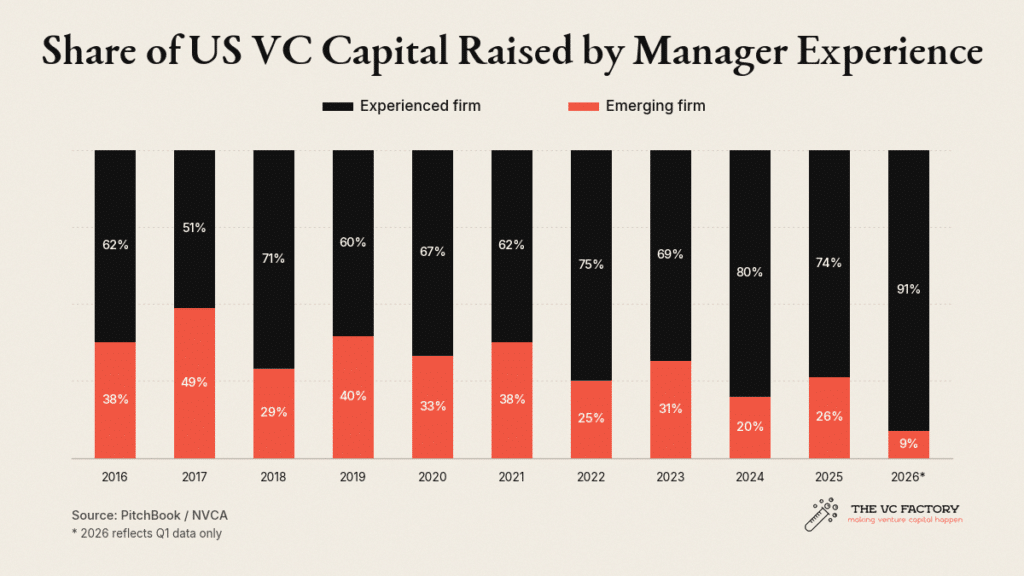
Experienced firms captured 90.9% of capital raised in Q1 2026, the highest share on record, while fundraising conditions for genuinely new managers have become materially more difficult. In practice, this means that LPs increasingly reward familiarity, institutional lineage, and perceived safety precisely at a time when differentiated, non-consensus thinking should matter most.
In my report on Emerging VC selection, I called this the Emerging VC Conundrum. First- and second-time funds can produce some of the best returns in Venture Capital, but they are hard to select because the usual evidence arrives too late. LPs must decide before the data feels comfortable.
That’s why mindset matters.
A GP’s mindset shows up before the track record does. It appears in how they perceive risk, how they build a thesis, how they react to rejection, how they talk about missed deals, how they construct the portfolio, how they behave when a Founder looks strange, and how they form conviction without the market’s permission.
LPs who want flying cars must select VCs with a promotion-focused mindset.
Learn how top LPs use mindset to select Emerging GPs: read my free report now!
Conclusion: tl;dr
When Peter Thiel said, “We wanted flying cars, instead we got 140 characters,” he was pointing to a deep drift in Venture Capital.
The issue was not Twitter itself. The issue was that too much of Venture Capital had moved away from the company-building model that helped create Genentech, Apple, Intel, Cisco, and other category-defining companies. Too many Investors had become skilled at pattern matching, joining fashionable rounds, and managing capital. They had become better at recognizing what was already working than at funding what could work next.
I believe this is starting to change.
The “VC is dead” narrative misses the point. Venture Capital is alive and well, but the market has split. LP capital is concentrating in a handful of mega-fund capital machines. Startup capital is concentrating in a handful of AI and frontier-technology winners. At the top, consensus dominates.
That’s not where the opportunities lie for LPs who deploy 5- to 6-figure checks. They must focus on fund managers who base their decisions on conviction to find the outliers that justify the risk and illiquidity inherent in early-stage VC investing.
Smaller, nimbler funds cannot win by copying the mega-platforms. Their economics force them to search for asymmetric outcomes. A sub-$100-million fund needs one or two companies that can return the fund, ideally several times over. That pushes the best of these Managers back toward the old Venture Capital blueprint: fund the strange company early, help shape it, and hold long enough for the market to catch up.
How can LPs select future winners funding flying cars, the bold, improbable startups that’ll make most of the asset class’s returns in ten or fifteen years? Mindset-Based Investing proposes a new approach that focuses less on pedigree, prior experience, and network than on the decision-making process of GPs who make bold bets.
Based on decade-long research on how Power-Law Masters make investment decisions, paired with a time-tested, proven theory in psychology, this framework helps LPs determine whether GPs are trying to win or just to “not lose.” The promotion or prevention foci express themselves differently in how VCs make and defend their allocation decisions.
Promotion-focused VCs ask what can go right. They can lead before consensus forms. They tolerate the discomfort of being wrong, as long as the upside is large enough. Prevention-focused VCs wait for external validation, known patterns, and social proof. They may join the round later, but they rarely create the outlier.