Emerging VC Fund Math: Build The Portfolio LPs Will Back
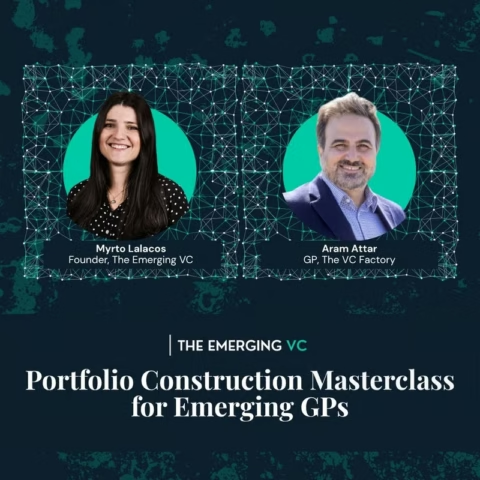
I recently joined Myrto Lalacos at The Emerging VC for a masterclass on Emerging VC Fund Math. I explained how VC fund managers should use the VC Portfolio Construction Matrix I built to help them ensure their fund math makes sense, and will win LPs’ approval.
I feel for Emerging GPs on this topic. Portfolio construction is one of those areas where everyone has a view, and nearly every answer ends with “it depends.” Fund size matters. Reserves matter. The number of initial investments matters. Entry ownership matters. Dilution matters. Exit values matter. The power law matters.
At the same time, portfolio construction can make or break credibility with LPs. Spend too little time on it, and you won’t convince LP digging into the numbers. However, spending too much time on it may distract GPs from talking to entrepreneurs to test the investment thesis and raising the fund.
The purpose of the masterclass was to help Emerging GPs understand how they can very simply verify that their fund model assumptions make sense given their investment thesis. I showed the online participants how top LPs and GPs think about it, and how they stress-test the model.
I’ve already written a full guide on VC Portfolio Construction, including the downloadable VC Portfolio Construction Matrix. You can read it here:
In this article, I’m insisting on a few elements that surfaced in the masterclass. Scroll down to watch the video.
Topics Covered In The Masterclass
- 00:00 – Why portfolio construction can make or break LP credibility
- 00:21 – Myrto introduces The Emerging VC and the purpose of the session
- 02:17 – Why the VC Portfolio Construction Matrix exists
- 04:00 – Aram introduces Mindset-Based Investing and the LP/GP angle
- 06:14 – The LP question: “run the math”
- 08:02 – The Emerging GP conundrum
- 08:55 – How the Matrix turns fund assumptions into one number
- 11:09 – “Fund size is strategy”
- 11:43 – The power law and fund winner math
- 13:42 – Why Emerging GPs should not size a fund around management fees
- 15:02 – J-curve, DPI, and why VC takes time
- 18:30 – Reserves and follow-on strategy
- 19:42 – Why small Fund I managers may use SPVs instead of reserves
- 21:52 – Initial deal count and diversification in VC
- 23:39 – When 12 deals or 50 deals can still make sense
- 27:30 – Entry ownership and why GP assumptions need data
- 29:31 – Dilution and ownership at exit
- 30:00 – Matching fund math to stage, geography, and vertical
- 31:00 – Exit benchmarks and what LPs need to believe
- 32:23 – Feedback on using the Matrix with institutional LPs
- 32:49 – Q&A
- 33:18 – Closing remarks
Full Transcript
Below is the slightly edited transcript of my masterclass with Myrto Lalacos at The Emerging VC.
Myrto Lalacos [00:00]: In the Emerging VC space, portfolio construction is one of those areas where 90% of the managers trying to launch a fund either spend way too little time on it or too much time on it.
Both are detrimental.
Myrto Lalacos [00:21]: My name is Myrto Lalacos, and I’m the founder of The Emerging VC.
I spent the last four years running the program that launched around 60% of the world’s new VC funds globally. During that time, I became a top voice on LinkedIn for amplifying content related to starting a VC fund or scaling a VC firm.
These two things, in combination, resulted in me becoming first-degree connected with 20% to 25% of the active VC firms worldwide, which is a crazy number to think about.
I now launched The Emerging VC, which is an independent resource for Emerging VCs, where I curate and amplify the latest insights on launching and scaling Venture Capital funds.
I’m going to swiftly jump to today’s session.
We are talking about portfolio construction today.
Before I introduce our amazing speaker, I just want to say a few words on portfolio construction.
In the Emerging VC space, this is one of those areas where 90% of the managers trying to launch a fund either spend way too little time on portfolio construction or too much time on portfolio construction. Both of these things are detrimental.
If you spend too little time on it, most likely your fund model is not going to make sense to Limited Partners. The story may sound right when you present it, but when you are an LP and you start digging into the numbers, they won’t add up, and the GP loses credibility.
On the contrary, if you spend too much time on portfolio construction, then you are overengineering. You are not out there fundraising, which is what you should be doing in the first few steps of launching a VC fund.
Both of these things can slow you down, if not severely impact your fundraising, either by losing Limited Partners or by not fundraising and doing models instead.
That’s why I’m so excited that we have Aram Attar here with us today, who is going to deliver a masterclass on portfolio construction for Emerging GPs.
Aram put together the clearest and most comprehensive guide I have seen on VC portfolio construction. It also includes a downloadable fund model.
It really clearly demonstrates how every single factor of portfolio construction, and every variable that is taken into account under the umbrella of what we call portfolio construction, can impact what needs to happen on the ground to generate the required returns you are going after when launching a fund.
Just by way of introducing Aram a little bit further, he is the founder of The VC Factory and creator of the Mindset-Based Investing framework.
He spent 20 years in LBOs, growth equity, and Venture Capital. He has completed more than 50 transactions across the three continents that he is moving around between, before founding The VC Factory in 2018 to amplify the Mindset-Based Investing method for how LPs should think about investing in Emerging GPs.
So, big supporter and cheerleader of Emerging GPs to LPs. I also understand you are an LP yourself, so you are seeing things from that perspective as well.
Aram, such an honor to have you here today. Thank you for joining us. I’ll pass it over to you at this stage so you can further introduce yourself and go through the material you prepared for everyone.
Aram Attar [04:00]: Thanks so much, Myrto. A lot of pressure.
I also love what you’re doing. I attended the last two sessions, really loved them, and I’m super happy to do this here today.
Hi everyone.
The way I run things, usually, I don’t do a PowerPoint anymore, because I think when you have a PowerPoint, people stop coming in. I’d love to hear from you as we go along.
I just want to add one thing.
Myrto talked about what Mindset-Based Investing is. It’s true that it can help you convince LPs to invest in Emerging GPs. That’s one of the angles.
The other angle is to help you as GPs invest in Founders.
As Myrto said, I invested in a couple of funds. I usually sit on the investment committee, and I also invested in a fund of funds. So I’m trying to use my framework to guide my investments and hopefully put my money where my mouth is, or where my brain is, as I say.
What I want to talk about today is very simple.
First, why should you care? Myrto did a great introduction on that.
I’m going to show you one of the best Investors in Emerging VC funds, Beezer Clarkson from Sapphire Partners, and how she thinks about it.
That’s the way I’ve been training VCs for eight years now, online and in person.
Most of what I do today with The VC Factory is conduct workshops based on VC decision-making. We are three, four, or five people, and we talk about investment committees, biases in decision-making, and the psychology of investment.
When I do that, I always show videos from people who are much smarter and more experienced than me.
The “why” section is going to be around Beezer Clarkson. Then I’ll introduce the VC Portfolio Construction Matrix, which is what Myrto was alluding to.
It’s a very simple one-pager. It took me three months to do, because I wanted to train the GPs I was investing in, and it was really hard.
It has a lot of problems, of course. But it’s a good place to see how every aspect of portfolio construction works.
If we don’t get to the end, because one hour is short, the post is on my website. You can download the one-pager for free. There is a whole guide. It says 16 minutes to read, though sometimes it takes longer.
You have the spreadsheet there. It should be very easy. Even my students can do it, so you guys will do it without any problem.
Without further ado, I want to go into the why.
I want to introduce you to Beezer Clarkson.
[Video clip: Beezer Clarkson explains that LPs look at the full “soup” of fund strategy, GP-Founder fit, ownership, check size, market, fund size, and portfolio construction. Her point is that many managers do not run the math of what needs to be true for the fund to work.]
Aram Attar [06:14]: As you heard, Beezer was asked how she makes decisions.
She did the whole thing with the soup. Frankly, I feel for you, because someone here said, “I have multiple thoughts on portfolio construction.” You are going to hear a lot of people talk about it.
But then she was asked what is the thing that, if you don’t do it, you’re not going to raise.
She came up with portfolio construction.
I don’t know how much you have heard about it, but we’re going to unpack it today.
The idea is that if your success depends on reaching outcomes that statistically have never happened, I’m not saying you are not going to raise. But it is going to be a tough sell.
The whole thing I want to talk about today is how to make sure that all your separate assumptions on reserves, fund size, and so on lead to one number that LPs look at to see if the fund makes sense.
Then you have to compare that number, which is the biggest exit you need, to your investment strategy and investment thesis.
If you need a $1 billion exit to make your returns, do you have billion-dollar exits in your investment strategy in the last 10 years?
That’s really the gist of the message today.
What is the one number LPs look at? How do they compare it? What do you have to convince them of?
You have to convince them that it is doable.
Aram Attar [08:02]: I was very curious when I started investing in Emerging GPs.
I was wondering how you can circumvent the problem I call the Emerging GP conundrum.
The conundrum is that some of the best funds ever are Fund I and Fund II. But you don’t have a track record, so it is really hard to invest in you.
What I did is I worked with a team of three researchers and my MBA students. We looked at what Beezer Clarkson, Michael Kim from Cendana, and Samir Kaji say about how they pick winners.
We came up with an analysis of the top six criteria they look for.
One of the six criteria was portfolio construction.
We looked at hundreds and hundreds of blog posts, videos, and podcasts. That is where we came up with the Portfolio Construction Matrix.
It is very easy to see on the website. It is just a one-pager.
What is difficult is not the modeling. What is difficult is getting the right assumptions.
I’m not going to go into every detail now. I just want to give you a feel for how it works, so that when you go back on your own, you can use it.
The idea is to start with a very limited number of inputs: fund size, reserves, initial deals, entry ownership, target return from entry, dilution, and so on.
Then the soup gives you the biggest exit you need to have, given the power law and the statistics we see on Emerging funds.
I’m sure many of you don’t believe in the power law, or think it is a bug and not a feature. We can have a chat on that. But it is a statistical reality.
What the spreadsheet gives you is the one number: the exit value of your fund winner.
If you have a $40 million fund with this strategy, and the Matrix says you need a $1.28 billion exit, your job is to show LPs that, in your strategy, given your geography, stage, verticals, and so on, there were 20 of those exits in the last five years.
Then it is doable.
That is the most effective way to convince LPs, because you are using numbers. You are not using opinion.
If you use opinions, you are on the wrong side of the checkbook. So you are probably going to lose.
Many of you are going to say, “But Aram, I’m in a new strategy, a new market.”
Okay. But you need to find reasons for why it is doable. Maybe you take an adjacent market. Maybe you do some consulting-style work to show LPs it is doable.
The point is not that the Matrix has all the answers.
The point is to make the discussion rational.
Now I want to show how top LPs think about those assumptions.
The first thing I want to show you is that all these LPs say the same sentence:
Fund size is strategy.
Aram Attar [11:09]: If you have heard it before, hopefully it is clear. If you haven’t, it means that if you choose a $5 million fund or a $40 million fund, the exit you need is going to be very different.
Mike Maples is a very smart guy, one of the best Investors in the game. I met him in Austin a few months ago. He is a very nice guy, and he recently wrote a book. He is the one who came up with the sentence “fund size is strategy.”
[Video clip: Mike Maples Jr. explains that the power law is a continuous curve. If 20% of investments generate 80% of returns, then 4% can generate 64%. In a 25-company portfolio, one company can drive most of the fund. That is why fund size is strategy: it sets the height of the bar the fund must jump over.]
Aram Attar [11:43]: I want to unpack that, because when I played that to Emerging GPs the first time, it was hard to understand.
Basically, what he is saying is that 64/4 is the new 80/20.
If you look at the power law, the idea is that 20% of investments generate 80% of your returns.
What he is saying is that if you square it, you get 4% generating 64%.
There is an analysis from Horsley Bridge, a fund of funds, covering 30 years, from 1984 to 2014. It shows something very similar: around 6% of investments in US funds over 30 years returned about 60% of the returns of the industry.
So if you have a portfolio of 25 startups, one company is 4% of 25. That one company has to generate 64% of the returns you are promising.
If you have a fund and you are saying, “We are going to make a 5x return on invested capital,” then one investment, the fund winner, statistically has to return about 3.2x the fund.
This is the number I use in the VC Portfolio Construction Matrix to give you the big exit you need.
So I want to pause here.
Is it clear that fund size is strategy means that the bigger your fund size, the bigger the exit you need to make the returns you are promising LPs?
By the way, I have a twin brother, so I have been debating all my life. I’m very happy to have people disagree with me and argue. I have one version of the truth, but I certainly don’t think I know everything.
Myrto Lalacos [13:42]: I just want to add something.
If you use Aram’s tool, it becomes very clear. You will hear this often: it is easier to generate returns on smaller funds.
That is why so many people who want to launch funds make this error. They work backward from management fees.
They say, “If I want to make this much in management fees, then my fund has to be this big.”
But they are optimizing for the wrong thing.
As an Emerging VC, you should work backward from the returns you can generate to LPs.
Because guess what? If your fund does not perform, you blow up. You likely get pushed out of the market. You need to do something else with your life.
As an Emerging VC, you cannot work backward from management fees. You need to work backward from carry.
Aram is going to make clear why smaller funds can generate larger returns.
We also have a question here: where does the J-curve come into this?
The J-curve is different. You call capital into the fund, then there are management fees and operating costs of the fund that take value out of the fund. Then you start seeing markups in the portfolio, and the value of the fund and returns for LPs start going up.
That is the J-curve. But it is not so much about fund size.
Aram Attar [15:02]: I have an article on DPI that I really encourage you to read. It is going to distress you guys.
I talked to 120 Emerging GPs in the last few months, and everyone comes in and says, “Aram, I have a 0.6x DPI,” or something like that.
Just before this, I was talking to former colleagues who have billions in assets under management, and everyone is scared about DPI.
Every time an LP asks you for DPI, they are probably 90% the wrong Investor for VC.
Maybe don’t insist too much.
It takes time to build great companies.
If you go to that article, you will see why. You also have the J-curve, which is that your portfolio is going to be negative in the beginning.
If you are wondering, go to my website and type “J-curve” or “DPI.” Or ask ChatGPT, which is faster.
It takes a lot of time to build great companies.
When I went through what LPs were saying about how they invest into Emerging GPs, they said, yes, you need to have a conversation about exits. Are you going to do secondaries? Are you going to take money off the table?
But I work on biases in investment decision-making.
I’m biased. I don’t need exits. Actually, I’m biased against quick exits. If someone tells me they have quick exits, I don’t believe them, because I have been doing this for 20 years and I think it takes time to build great companies.
Just like Myrto was saying, I’m also biased against people who want to raise a $50 million fund because they need to make a living.
I understand that you may need to make a living. But I 100% underwrite what Myrto said.
I don’t think your fund size should be chosen based on how much money you need to make.
Unfortunately, if this is the first time you are doing this, you need to prove that you are a good Investor.
It is probably not this fund where you make money. Probably not the next one. Probably the one after that.
That is why Emerging Manager status can last several funds.
Myrto Lalacos [17:11]: For those who download the Excel file, if you double-click on the values at the bottom, in the second half of the table, you see the calculations.
The first part of the table is the inputs. The second part is the outputs. That is where you find the calculations.
Aram Attar [17:30]: I think the formulas are blocked because some people start changing them, and then they send the file back to me and say, “It doesn’t work.”
If you read the post, you will see the formulas in the post. If it is really a problem, I can send you the unblocked version.
The formulas are just pluses and minuses.
It is just that I don’t want people to break the model, because every time I have done that, someone sends it back and says, “I added one line.”
Of course, then it does not work.
So far, we covered why you need to do portfolio construction.
First, it is a credibility test for many LPs.
Second, it helps LPs understand if you know how to make money and if your investment thesis makes sense with the assumptions you are making in terms of number of deals, average ticket, and so on.
Hopefully now you are on board with the idea that there is a power law. It is a statistical fact.
Most LPs will want you to show whether your fund winner, which can be 64% of your returns, is likely to happen.
The exit you need for that fund winner, whether it is $1 billion or $200 million or whatever, depends on your fund size.
Now I want to keep going down the lines of the Matrix, starting with reserves.
Reserves are something you really have to decide early on, and they are tied to your fund size.
If you have a $5 million fund, it is hard to do reserves. I am an Investor in a $5 million fund and a $25 million fund. They do not have the same reserves.
At $25 million, you can start having a little bit of reserves.
I want to share a video from Michael Kim from Cendana. Michael Kim is one of the OGs. He is one of the best LPs in Emerging funds.
[Video clip: Michael Kim explains how he thinks about portfolio construction, ownership, check size, number of companies, and reserves. He says that managers should not simply do pro rata in every follow-on round. They should modulate follow-ons, sometimes doing a small check for signaling, sometimes doing super pro rata where conviction is highest.]
Aram Attar [18:30]: I want to unpack that because every time I run this, it can be hard to follow.
What he is saying is that 25 to 35 companies kind of makes sense. That is what you hear from most LPs.
I have talked to GPs who have 12 companies. I have talked to GPs who have 50.
All I tell them is: great, do it, just make sure you can defend it, because you are outside the average.
I am not saying you should not do it. I am saying that if you do it, make sure you know it is not the average.
The other important thing he says is about reserves.
Every time I sit with other LPs in juries or we talk to GPs, one of the first questions is: how do you think about reserves?
Even people at big fund of funds ask that.
I never really know how GPs should answer it. But I think one good answer is: “We are not going to invest in everyone. We are not going to do it programmatically. It depends on valuation, the opportunity, and so on. We will probably do super pro rata when we can, and less than pro rata when that makes sense.”
So I want to pause here and hear your perspective on reserves.
Myrto Lalacos [19:42]: I can jump in with an alternative perspective, and this is very much The Emerging VC approach.
We advise against having reserves in the fund altogether.
The point of Fund I is to get you to Fund II. The point of Fund II is to get you to Fund III.
Why? Because you are trying to get rid of the scarlet letter on your chest that reads “Emerging Manager.”
No big institutional LP with big checks wants to invest in an Emerging Manager. So basically, you are trying to get out of that bucket.
The way you do that is you launch a small Fund I, no reserves, deploy that, get markups as fast as possible, and then go back to market with a good story to sell Fund II, and so on.
The way you handle reserves and doubling down on winners is through SPVs.
You allow the LPs of the fund to fill their pro rata through SPVs, and it keeps you from having this big fund you are stuck deploying for a long time.
Aram Attar [20:41]: I love that.
There is an article I wrote on the investment thesis, which really should be something you do before the model.
I totally agree with what Myrto said.
When you have a small fund, or Fund I or Fund II, you are optimizing for traction.
What you are trying to get is momentum. You are trying to prove you are an Investor.
So you are probably better off making more investments. It does not mean spray and pray. But maybe it is better that you make those investments, have some winners on paper at least, and then raise Fund II.
That is optimizing for traction.
When you are bigger, then you can optimize for dilution, or really for ownership. Then you can play the game with reserves.
That being said, I have met people who successfully raised $40 million Fund Is, and they chose to have reserves from day one.
But most people are what Myrto is saying: they raise 5, then 25, then 50, then 100, and the whole thing is to get traction, get momentum, and show the world that they are a good Investor and that their investment thesis makes sense.
If we go back now to the VC Portfolio Construction Matrix, I know this is a bit technical. It is not as nice as saying, “Hey guys, we have reserves.” It is technical.
What we have done so far is say why fund size is important.
It is your pole vault bar. It determines how high you need to jump.
Fund size will decide what your big exit needs to be.
Reserves will eat into your average ticket. You can put zero there if you want.
The number of initial deals is next.
We talked about 20 or 30. Myrto, it is great to have your perspective because you have seen so many funds.
I want to talk about diversification, quote unquote, because it is not really diversification.
I come from an LBO background, so diversification meant we have a 2x deal and a 4x deal, and hopefully we make 2.5x on the total.
In VC, everything is super risky, so there is no diversification in terms of risk. It is diversification in terms of number of investments.
What is your take on diversification, Myrto?
Myrto Lalacos [22:58]: We typically say that you want to have as many shots on goal as possible.
Obviously, you do not want to overstretch it, because it goes back to what we were saying about ownership.
Typically, Fund Is would aim between 25 and 35 hits for Fund I.
I also had a question, because I was reading through your article, and you said sometimes you get GPs who try to convince you that going lower than that, like a 15-company portfolio, or much higher, like a 100-company portfolio, can be the right approach.
There have been times where you have been swayed or persuaded that this was the right approach.
Can you give a high-level example of when that happened?
Aram Attar [23:39]: Two examples.
One is a really smart guy in Germany, with a micro fund of a few million. Two guys had worked at a VC firm before, and they chose logistics, something unsexy, which I love.
They convinced me that it made sense for them to have maybe 50 or 70 companies. I cannot remember the exact number.
In that industry, there are a lot of small companies. They wanted to get the whole market. It made sense. I cannot remember all the arguments, but I remember being swayed because they could defend it. There was an argument behind it.
At the other end, someone had 12 deals.
Again, this is Mindset-Based Investing. I know my biases. I am biased in favor of small portfolios because I come from a world where we used to have small portfolios and be very hands-on. That does not necessarily make sense in VC.
But what made sense is that there were two or three of them, and they had a way to help companies in advance before investing. They were happy having a small portfolio and being very hands-on. They did not need money for a few years because they had made some money.
I am not saying it works. But there was an argument behind it.
They were doing a lot of work in advance. They knew how to add value. They kind of reduced the risk at the moment they invested, so they were happy having a small portfolio.
Again, I am not saying it works. But there was an argument.
Participant [25:23]: What I mean is that the strategy of going from $5 million, to $10 million, to $25 million does not really work, because in nine years’ time the type of companies we will be backing, we probably cannot even imagine today.
Therefore, this idea of saying, “I am going to leverage my investment track record from four years ago,” may not hold. There is a high chance we will not be able to leverage it, because the type of fund we want to raise six years down the line will be very different.
In my opinion, it requires agility from one fund to the next. We cannot really guarantee that the track record will be relevant to Fund II and Fund III as it used to be when it was all B2B SaaS.
Aram Attar [26:05]: Thanks for the comment. I do not have a strong point of view on that.
The stats I have come from Horsley Bridge and were shared by Andreessen Horowitz. You can find them online or on my LinkedIn.
The 5x-plus funds have more losses than the 2x funds. But their winners are 70x on average, whereas the fund winner for the 2x funds is 20x.
What I have seen is not that they have more winners. It is that the winners matter more.
Myrto Lalacos [26:35]: Andy is asking whether the strategy changes for a starter fund under $1 million today.
Andy, you can actually use the Matrix to see how you should structure your sub-$1 million starter fund portfolio. You should probably be doing very small investments, and it will help you figure out how many investments to make.
Aram Attar [26:54]: I have not checked if it works if you put less than one in the fund size, but the logic is the same.
One thing I want to say is that most of what Michael Kim is saying is true for $50 million or $40 million funds.
That is why I built the Matrix.
When I was doing training with GPs last year, everyone was saying the same thing: “How does it relate to us? We have a $5 million fund. We do not have a $50 million fund.”
That is why I built the Matrix. It works at $5 million. I am not sure it works below $1 million, but the logic is the same.
For Andy, the good news is that you do not need a big exit. It depends on ownership, but you do not need a big exit.
Let’s go back to the next bucket: ownership.
Ownership is super important.
I’m French, so I can be rude: you do not have an excuse for ownership.
There is a lot of data. There is data on ownership by stage, by geography. Carta is one source. There are others.
This is where your portfolio construction needs to be backed by real external data.
Some people may not like Carta data. Fine. Find the data source you like.
But on ownership, you should know, in your market, for your vertical, stage, and geography, what ownership you should go for.
Michael Kim also talks about ownership.
They noticed a correlation between ownership and fund size.
At seed, they saw that you should have roughly 1% ownership per $10 million of fund size. So if you have an $80 million seed fund, you should aim for around 8% initial ownership.
At pre-seed, it is closer to 2% per $10 million. So if you have a $10 million pre-seed fund, you should have around 2% ownership.
I am not sure it works that well for us, which is why in the Portfolio Construction Matrix I mention the ownership heuristic but do not apply it.
Still, ownership needs data. You should be very convincing.
Sometimes I see Emerging GPs tell me, “I am going to have 15% of a pre-seed company for $50,000.”
I am super happy to believe it.
But please show me the data.
Same thing for dilution from entry to exit.
There is a lot of data on that. You can use Carta data or another source. Ballpark, it is often 30% to 40% dilution between seed and an exit at Series C or D.
At the end, you multiply your exit value by your ownership at exit to get your returns.
That is why ownership and dilution are so important.
Myrto Lalacos [30:00]: This taps into some of the questions in the chat.
A very important thing here, and what Aram is very clear on in the article, is that people are asking, “What is the right fund size?” or “What is the right number?”
The point of this is for you to find the sweet spot depending on the investment thesis, the space you are going after, and the stage you are going after.
The type of exits you are likely to have in deep tech may be different from climate tech or fintech, and different again from funds backing underrepresented Founders.
So what you need to be doing is checking and validating that whatever you are saying your strategy is going to be in your portfolio is grounded in the sector you are going after.
Aram Attar [30:48]: Exactly.
If you read the post, that is what you will see.
This probably does not work for everyone, but it helps you convince LPs that you have the data to back up your strategy.
Because everything is all over the place, the Matrix is a way to have a rational discussion.
These are my assumptions.
This is the result.
This is the exit I need.
And by the way, I can have these exits.
Let me share the last video for today on exits, because Michael Kim has a good point there.
[Video clip: Michael Kim explains that a fund should have portfolio construction that can work with modest exits, not only multi-billion-dollar unicorn outcomes. The question is what percentage of the fund a $500 million exit would return, based on ownership, reserves, check size, number of companies, and fund size.]
Aram Attar [31:00]: Hopefully you understand now why I built this thing.
Everyone says all these variables matter. Fund size, ownership, reserves, check size, number of companies, exit values.
I tried to build a tool to make sense of all these dimensions.
What Michael Kim says is different for each strategy, as Myrto was saying.
Deep tech in Germany, fintech in the US, climate tech in France, whatever it is, you need to compare your required exit to your actual market.
If you are using exit value in the US, there is data.
David Clark, who is a great fund of funds Investor at VenCap in Oxford, has data out there. For example, the median exit may be around $85 million, the top 10% around $400 million, and the top 1% around $1.4 billion, depending on the data set and the segment.
If you are going for a middle-of-the-road strategy and you need a $9 billion exit for your strategy to work, because you went with a big fund size and promised a huge return, make sure you are still in the realm of what is statistically possible.
Once you have done all your assumptions, do it bottom-up.
Run all the numbers.
Then look at the number it gives you.
If you can back that number with, “There were 15 exits in my investment strategy in the last 10 years,” then good.
If it is a stretch, be ready to defend it.
If you cannot defend it, LPs are probably going to pass, because you cannot convince them that your strategy makes sense.
Participant / Samir [32:23]: I used it, and it was very useful for me to make sure that my assumptions about my portfolio were robust enough to present to sophisticated LPs.
People investing for the first time in VC did not even raise the question. But as soon as you go to a fund of funds or an institutional LP, they really go deep into these questions.
So it was super useful. Thank you very much.
Aram Attar [32:48]: Thank you.
Participant / Brian [32:49]: How does it apply to biotech?
Aram Attar [32:56]: It does not. Sorry, Brian.
Biotech is a different pocket.
You have clinical trials. The valuations are huge to start with. You probably do not have an exit in the same way. You do not need a product that works in the way software does. You need the molecule to work, and so on.
I should have prefaced it.
This is really more for AI, digital, and software-style startup investing.
Myrto Lalacos [33:18]: Aram, do you have any closing remarks or advice for Emerging Managers before we wrap?
Aram Attar [33:23]: I love what you do.
On my website, I have a lot of webinars and articles. If people think there is a topic they want, for example investment thesis, we can talk about that.
Reach out to Myrto and tell her, “I would love to have a session on this or that.”
I’m sure she probably has sessions planned for the whole of 2026 and 2027, because she is very active. But if she has a spot, I’m super happy to come back.
Myrto Lalacos [33:47]: I would love to do something together again, for sure.
Thank you, Aram. Thank you everyone so much for showing up, and hopefully see you next time.
Bye bye.
Aram Attar [33:58]: Ciao.