Startup Valuation: How Venture Capitalists Value Early-Stage Companies

Startup valuation, often seen as more art than science—and sometimes even as black magic—is a process fraught with ambiguity. Unlike mature businesses with years of historical data and steady cash flows, early-stage startups lack substantial track records and have uncertain future prospects. This makes valuation more of an informed speculation rather than a precise calculation, as traditional valuation methodologies often fall short (spolier alert: nobody uses DCF in VC).
Venture Capitalists have to rely on a mix of metrics, market trends, intuition, and experience, making the craft of startup valuation a delicate balance between analytical rigor and speculative judgment.
In this article and its companion webinar, I discuss the key dynamics in VC valuation, the two methods VCs use, and the internal, external, and human-related factors impacting startup valuation. I also provide data on the current market's valuation, updated regularly.
Explore our VC reports for data‑driven deep dives into venture trends. Each report pairs rigorous analysis with candid insights from top LPs and GPs, giving you perspectives you won’t find elsewhere.
In This Article
for detailed explanations, sources, and quotes.
Key Dynamics in Venture Capital Valuation
Venture Capital valuation is a complex, often subjective process that relies on a multitude of factors. Let's examine some of the key dynamics that shape this process, from the dualistic approaches of Venture Capital investing to the unique rules governing startup valuation.
Two Approaches: Fundamental-Driven vs. Land Grabbers
Two distinct approaches have prevailed in the last two decades.
Fundamental-driven VCs focus on performance and market fundamentals, taking into account a startup's market size, potential for profitability, and growth rates. These VCs are attached to unit economics analysis and tight metrics to measure product-market-fit. They are meticulous, preferring to invest when they can clearly see a path to substantial returns.
Land Grabbers, on the other hand, recognize that there will be a limited number of unicorns every year and focus on getting "unicorn real estate", regardless of valuation.
While some VC firms pride themselves on valuation discipline, others point to missing outlier outcomes due to too much emphasis on the price.
Mayayoshi Son, the flamboyant SoftBank Founder who is known for making billion-dollar bets in the blink of an eye, echoed this sentiment in an interview about his regrets. Interviewed in the midst of the WeWork debacle, he chose to focus instead on missing investing in AirBnB and regretted having been deterred by the elevated price tag.
The influence of each group over startup Founders fluctuates with market cycles, especially during periods of market bubbles and bursts. Haystack Founder Semil Shah suggested in March 2021, in a frothy VC market, that the dichotomy between fundamental-driven and land-grabbing VCs created a market dislocation. He used different terms, but I believe these ones are clearer.
According to Shah, fundamental-driven Investors are willing to pay a premium, but only within the framework of public and exit comparables. Their aim is to back startups whose unit economics show promising growth.
FOMO around limited real estate for VC ownership in those earliest rounds is very real and warranted.
Semil Shah - Haystack (Source: website)
On the other hand, Land Grabbers are opportunists who quickly adapted to the rapidly evolving startup funding cycle. Tiger Global and other crossover funds exemplify this land-grabbing trend. They view early-stage investments as finite, highly coveted pieces of real estate.
The stakes are high, as the opportunity of securing a meaningful ownership stake in an outlier startup is rare. For the Land Grabbers, the fear of missing out on the next Snowflake, Zoom, or Airbnb can be a powerful motivator, overriding traditional valuation metrics.
This approach is especially prevalent among billion-dollar funds that require high-value outcomes to have a significant impact on their portfolio. They need to "move the needle," meaning that only investments returning their fund at least once are worth considering.
I explained this fundamental criterion for VC investing in the article below.
Related: The 7 Secret Evaluation Criteria Venture Capitalists Use To Make Investment Decisions
The Only Rule That Matters in Startup Valuation
In traditional investment theory, as popularized by Investors like Oaktree Capital's Howard Marks, the age-old mantra is "Buy Low, Sell High."
This strategy is a tried-and-true method for generating alpha in the public markets. It entails holding on to the stock when it made more sense, instead of selling due to "the fear of making mistakes, experiencing regret and looking bad."
However, in Venture Capital, this principle loses relevance due to the power law dynamics and the potential for extraordinary returns. Venture Capitalists invest in startups with the hope of massive growth, which could result in exponential returns.
This approach differs from traditional investing, as its primary focus is not on buying at a low price, but on identifying potential unicorns that could deliver outsized returns.
Valuation is a mental trap.
Peter Fenton - Benchmark (Source: 20VC)
Peter Fenton, a general partner at Benchmark, and an early Investor in huge successes such as Twitter, Yelp, and Elasticsearch, stresses that valuation is just one factor to consider when investing in a startup. The team, the market, and the product are all more important.
If a VC firm identifies a startup as a potential winner in its market due to its fundamentals, it should be willing to pay a premium even if the valuation seems high.
The high risk, high return rule is a better guiding principle in Venture Capital than buy low, sell high. Startups, particularly in their early stages, are highly risky ventures. They operate in uncertain markets, often with unproven business models, untested products, and inexperienced teams. They may face stiff competition, regulatory challenges, or technical hurdles. Many of them fail. Even the best VC firms have failure rates as high as 50%.
However, the potential returns on successful startups can be extraordinary. When a startup succeeds, it can generate 50 times or even 100 times the initial investment. These "home run" investments can more than compensate for the many losses in a VC's portfolio.
I’m often wrong. But when I’m right, I’m f*cking right.
CHRIS SACCA – LOWERCARBON CAPITAL (read more here)
This potential for outsized returns in the face of high risk is what makes the Venture Capital asset class appealing to certain types of Investors.
Institutional entities, such as endowments and pension funds, or high-net-worth individuals, are willing to accept the high risk associated with Venture Capital investing because of the potential for achieving high returns.
Read the article below for more data on the power law and an analysis of how elite VCs like Chris Sacca drive outlier returns fund after fund.
Related: Understanding the Power Law: Do Venture Capitalists Take Enough Risks?
State of The Startup Valuation Market (Update: June 2025)
I regularly update this section with fresh data, as valuation cycles change rapidly in VC. I keep historical numbers below to provide some background.
The valuation snapshots pull from four complementary sources:
- Carta’s State of Private Markets (full-year 2024 review and the fresh Q1 2025 update)
- PitchBook’s Q1 2025 US VC Valuations & Returns, and its companion European VC Valuations report
Each uses a different lens—proprietary cap table data for Carta vs. disclosed deal terms for PitchBook—but they still land on the same storyline: Median US prices continued to climb into early 2025 (especially at Series A and later), while Europe kept its historical discount yet followed the same upward curve.
General Trends
The data presented below is U.S.-centric, except indicated otherwise.
Deal Value & Volume
In terms of value versus volume, Q1 2025 showed consistency in value compared to Q4 2024 ($21 billion raised), but deal volume is considerably down (-33% vs. Q4 2024, as expected, but -17% vs. Q1 2024).
The number of funding rounds in Q1 2025 has reached the level of Q1 2019.
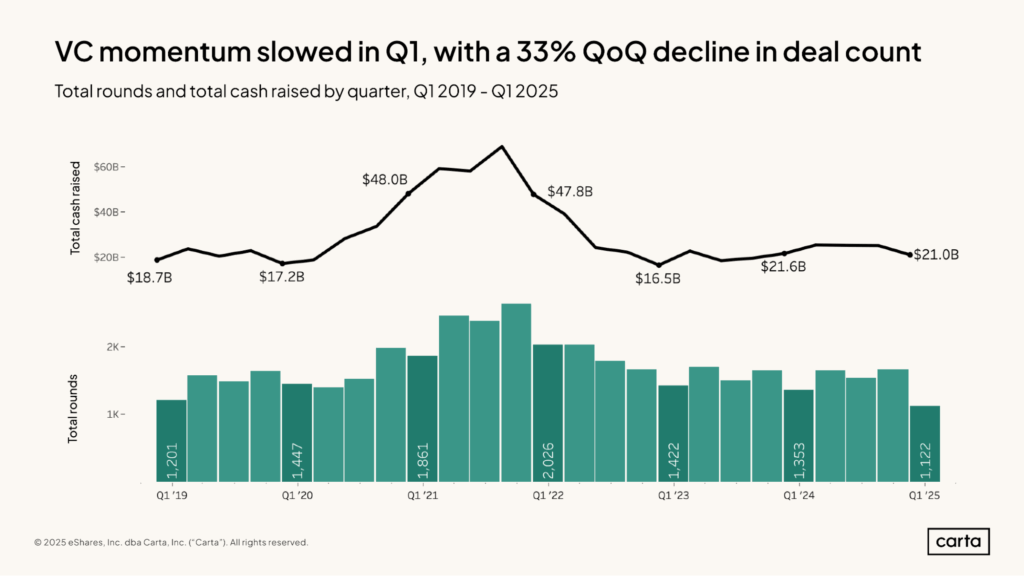
Seed and Series A rounds lost the most momentum and pulled total VC transaction counts to a six-year low.
- Seed rounds account for the single biggest absolute decline (-156 rounds YoY) and the steepest percentage drop.
- Series A piles on with another double-digit fall, bringing the combined seed + A shortfall to more than 200 missing deals versus a year earlier.
- Mid- (Series B) and late-stage (Series D) softness is real but smaller in volume; Series C actually held steady.
Valuations
The startup valuation landscape has undergone significant shifts since 2023, driven by a confluence of market dynamics, Investor sentiment, and economic factors.
After a tumultuous period marked by dramatic declines, valuations showed signs of recovery and stabilization in Q1 2024, albeit with varying impacts across different funding stages. While Q1 2024 median valuations were higher than Q1 2021 for Seed, Series A, and Series B rounds, they remained well below at Series C.
However, data from Carta shows that Priced Seed (excluding SAFEs), Series A, and Series B valuations remained significantly below their 2021-2022 peak.


Q1 2025 data show that all round types rebounded in the 12 months since Q1 2024, albeit with high volatility. The data also shows that Investors concentrated capital among a smaller number of startups.
A round-by-round analysis follows, based on Carta's data. As it seems skewed towards “VC super users”—companies raising lots of equity—it’s worth recouping with other sources.
I focus on primary valuations because they show the true clearing price that new lead Investors are willing to pay, unskewed by follow-on bridge extensions. These are typically led by financial shareholders who often feel incentivized to stretch funding to help the startup reach the following stage.
Seed
The story at Seed stage is the same as when I last updated this article in June 2024: even fewer startups are receiving funding, but those that do are maintaining strong valuations. This typical "flight-to-quality" scenario is frequent in market rebounds. Investors prefer piling money into tested companies.
Median pre-money valuations rose from $12 million in Q1 2024 to $16 million in Q1 2025, while deal count plunged by 36% (from 336 to 216).
Nearly half of those deals (46%) are now bridge rounds, not fresh money, which underlines how cash-strapped early-stage Founders are leaning on existing backers. Many lack traction to attract a new lead VC firm.

For context, primary Seed valuations have climbed to levels we haven’t seen since the boom. In Q1 2025 the median sits at $16 million, above the $14 million peak of early 2022 and twice the $8 million median at the start of 2020.
As mentioned below, the surge is largely attributed to AI startups commending much higher valuations than others.

In plain terms: the bar for getting funded at Seed has never been higher, and only the most convincing startups clear it.
Note: The data between graphs from different Carta reports doesn't always reconcile, but is close enough that it doesn't change the overall message. This is likely due to the various universes considered (including the number of startups in the analysis).
Series A
At Series A, Investors keep paying up, in a stabilizing market in terms of volume. Median primary pre-money valuations climbed from $40 million in Q1 2024 to $49 million in Q1 2025, while deal volume remained stable (-5% to 212 rounds closed, vs. -14% between Q1 2023 and Q1 2024).
Bridge rounds still represent a large proportion of total Series A rounds, but they are slighly down (40% vs. 43%) showing that follow-on extensions command nearly the same rich pricing as fresh Series A financings.
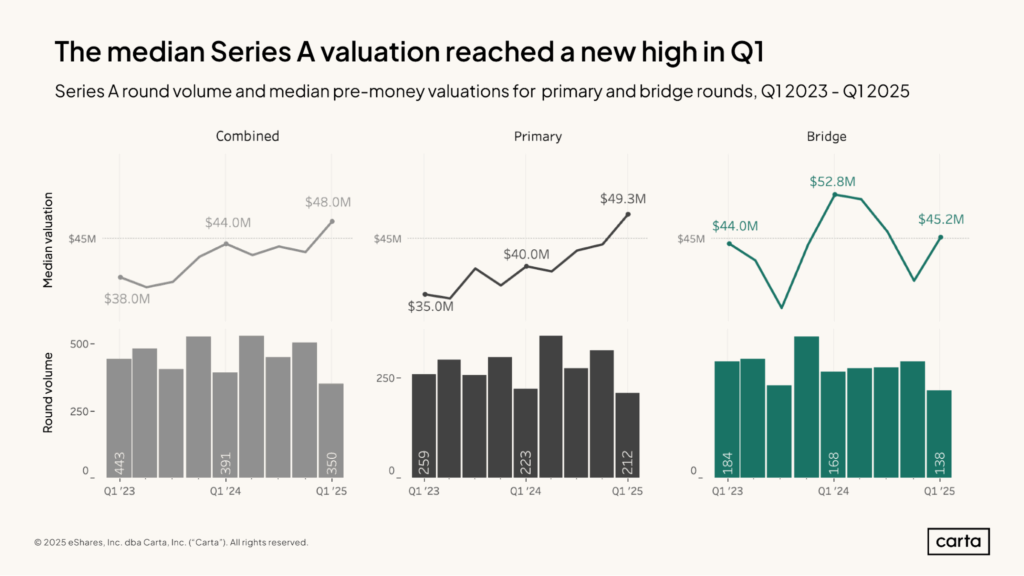
For context, Series A valuations have more than doubled since early 2020 and are now higher than their recent peak. Primaries rose from about $27 million in Q1 2020 to nearly $49.1 million in Q1 2022, and are back to that level three years later.

In plain terms: startups making it to Series A command high prices, showing that Investors are still selective at this stage.
However, the transition from Seed to Series A funding has become notably more challenging in recent years. The "graduation rate," or the percentage of startups that advance from Seed to Series A within two years, has seen significant fluctuations.
During the boom period of 2020, over a third of startups raising seed rounds successfully completed a Series A round. (See table on the left below) This was driven by a favorable funding environment and aggressive investment strategies.

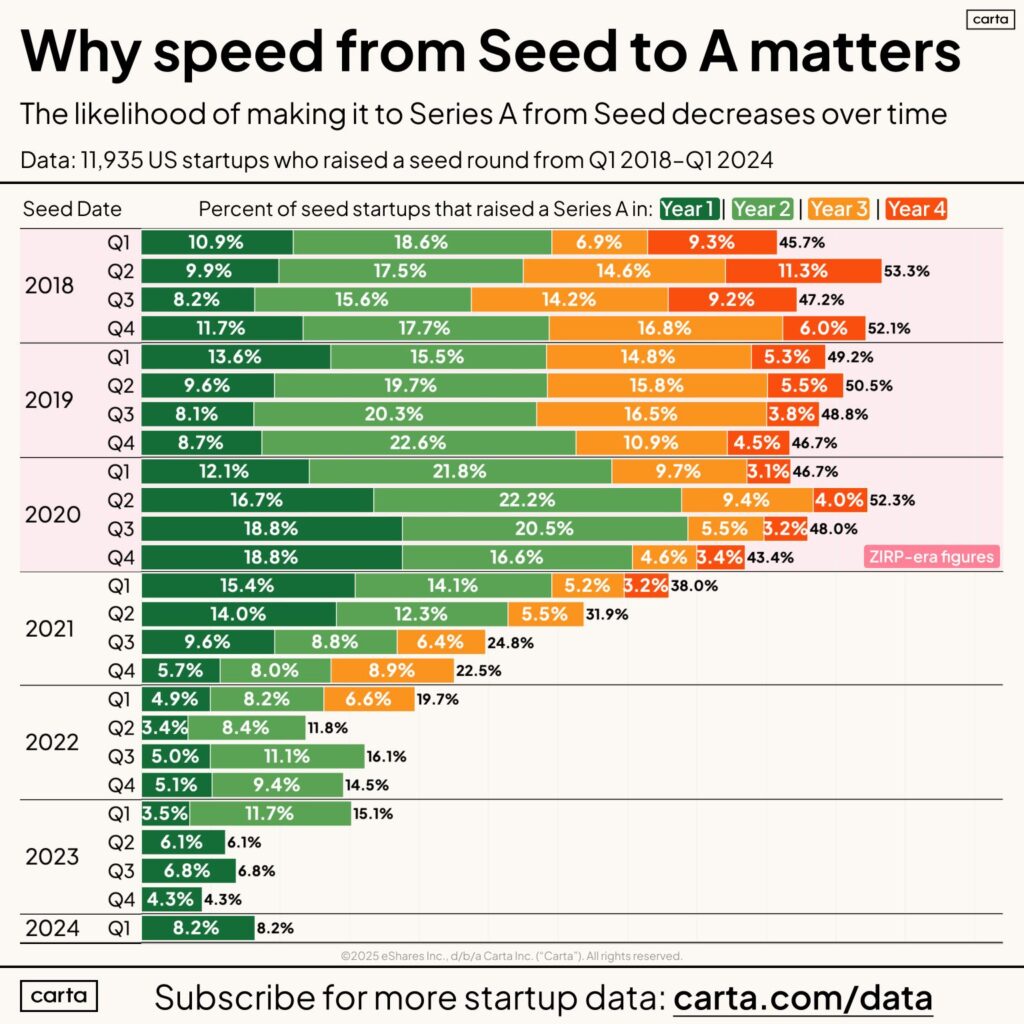
However, with changing economic conditions and rising interest rates, the rate has dramatically declined. For startups that raised seed rounds in Q1 2022, only 12% secured Series A funding within two years, marking a substantial drop below the historical average.
A look at more recent data, reported differently by Carta, shows a slight improvement: 8% of Seed rounds closed in Q1 2024 raised a Series A in four quarters, the first time it has been so high since the height of the 2021 boom (9.6%).
I wrote an extended article on why Series A graduation is so hard, which touches upon Founders' mindset.
Related: Why Series A Graduation Is So Hard: Lessons from Paul Graham
Series B
At Series B, Investors are writing larger checks into a comparable number of deals. Median primary pre-money valuations rose from $100 million in Q1 2024 to $107 million in Q1 2025, while the count of primary B rounds slipped from 117 to 108 (-8%), mostly driven by new bridge investments (-38%, or three-quarters of the total drop in volume).
Bridge extensions fell to 29% of Series B deals in Q1 2025, down from 38% a year earlier, showing that more companies are securing full-priced B financings rather than milking top-ups.
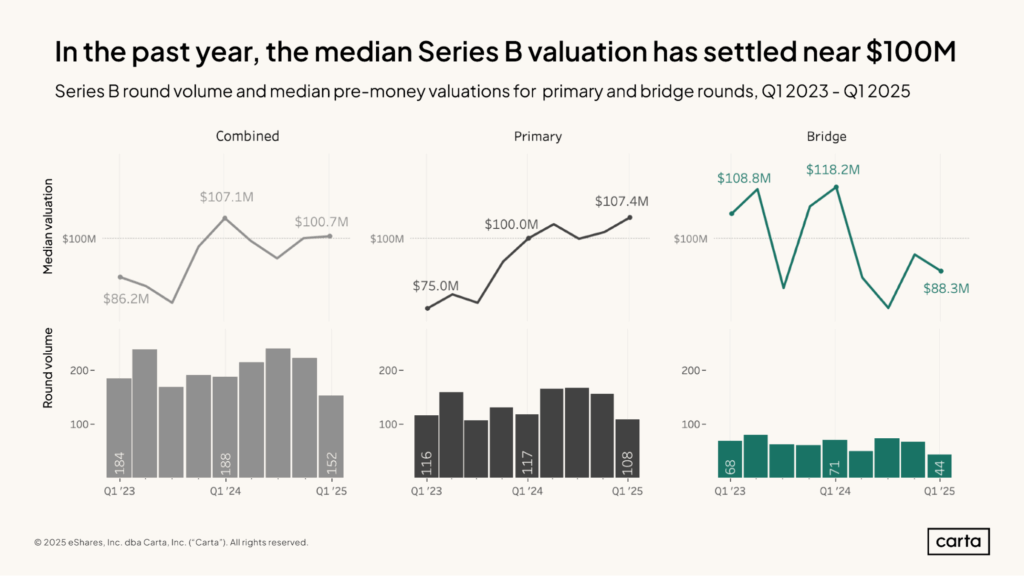
For context, primary B valuations have rebounded since their Q4 2022 - Q3 2023 trough. While they're still below the Q4 2021 peak, the recovery is promising.

Interestingly, the median bridge valuation for Series B rounds is now below the primary valuation ($88 million vs. $107 million), suggesting that companies opting for bridge rounds may be doing so to extend their runway until they can raise a fully priced funding round.
Series C
Investors are writing bigger checks at the C-stage, too. Median primary pre-money valuations rose from $188 M in Q1 2024 to $272 M in Q1 2025, while primary deal count held near 60 rounds.
Bridge extensions accounted for about 29% of all Series C financings in Q1 2025, roughly flat versus a year earlier, showing that most companies now go straight to fresh C rounds.
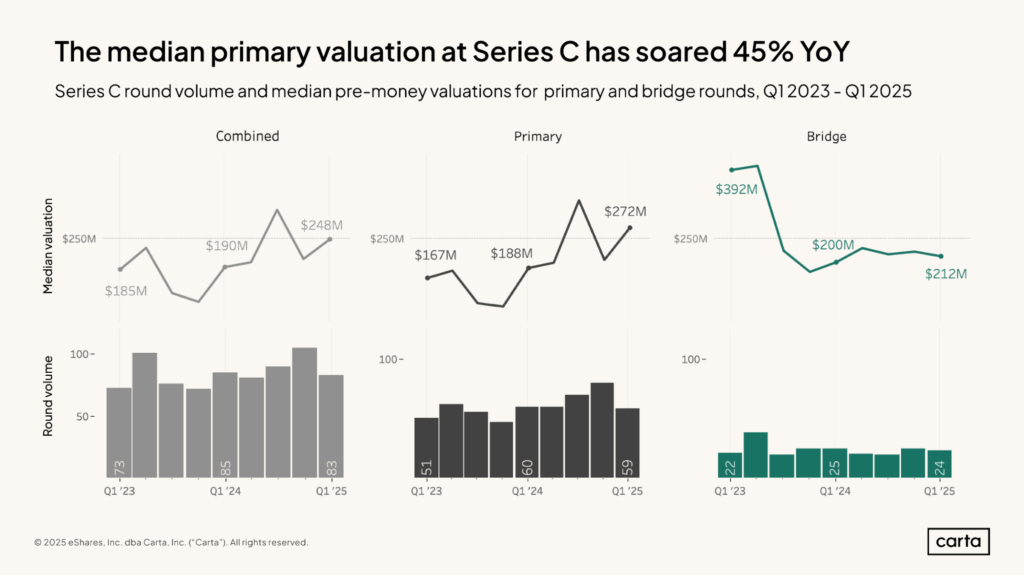
In context, primary Series C are still well below their 2021 peak, but the rebound is confirmed. As for other rounds, we'll need to have updated Carta data with the same format to make meaningful comparisons.

Series D+
Series D and E+ valuations must be taken with a grain of salt, given the small Carta sample.
Investors are back to betting big at the Series D stage. Combined median pre-money valuations rose threefold from $199 million in Q1 2024 to $618 million in Q1 2025, as deal count increased from 27 to 35 (+30%).
Same trend at Series E+, where combined median pre-money valuations jumped 2.4x from $390 million in Q1 2024 to $926 million in Q1 2025, while round volume edged up from 20 to 26 (also +30%).
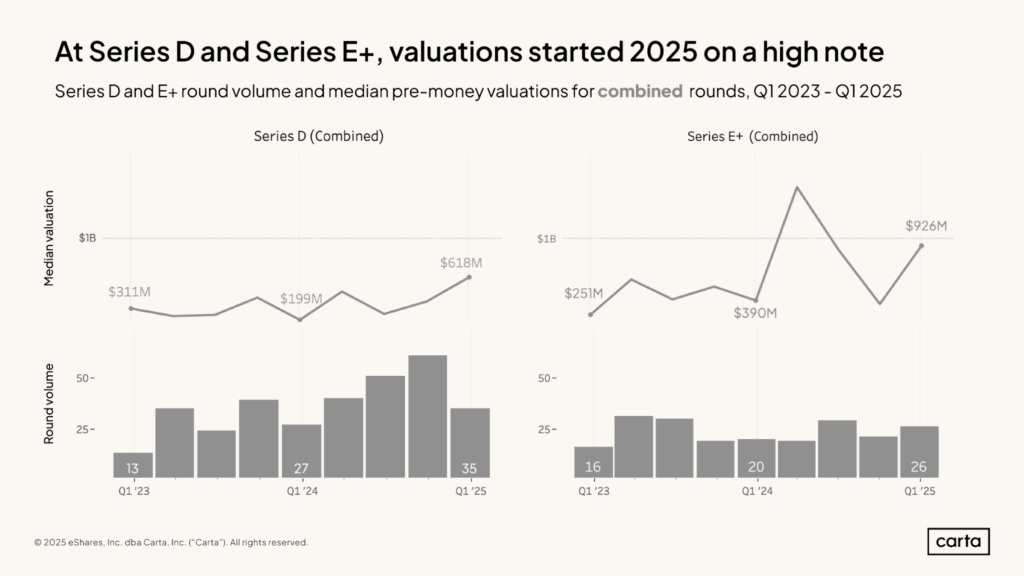
In context, Series D+ has swung from boom to bust and now surged again, signaling renewed confidence in late-stage performers. Mega-round pricing is heating back up even on modest deal flow.


Bridge Rounds Abound
Bridge financings (follow-on equity inside an existing series) keep swelling at the bottom of the stack: 46% of all seed deals in Q1 2025 were bridges, up from 40% a year earlier.
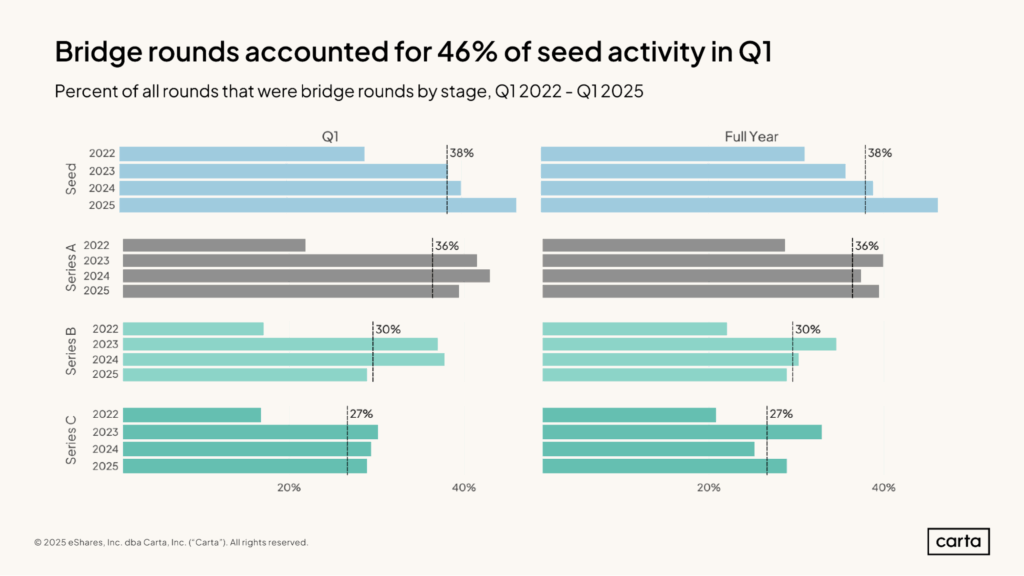
Above that, bridge appetite is fading:
- Series A & B: holding in the low to mid-30 %s, with a slowdown in Q1 2025.
- Series C: plateau near 27 %, both well below Seed levels. Investors are ready to price fresh rounds when conviction is high.
The significant jump at seed level reveals the fundraising bottleneck: earliest-stage startups must rely on existing backers. Bridge rounds have become an early-stage lifeline rather than a market-wide crutch.
Bridge financing is the hardest decision in Venture Capital, especially at Seed stage, when they're still scarce data to make an informed decision.
Related: Bridge Financing: When Venture Capitalists Throw Good Money After Bad
Down Rounds Stabilized
Early-stage Investors on both sides of the Atlantic are still demanding price resets, but the pressure remains heaviest in the US, while Europe saw a tentative easing—at least for now.
The prevalence of down rounds reached a ten-year high in Q1 2024, with a quarter of all funding rounds occurring at flat or reduced valuations compared to the previous round.
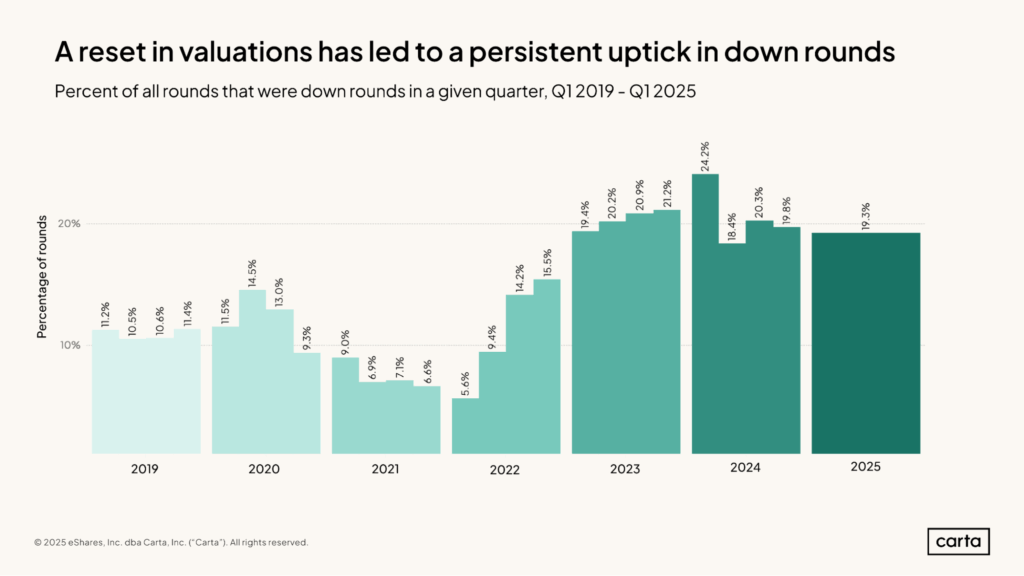
Down-round risk stayed front-of-mind in Q1 2025, but its intensity differed by market.
In the US, the share of financings that priced below the company’s previous round hovered near post-2022 highs: Carta logs just over 19% of all Q1 deals as down rounds, broadly in line with every quarter since early 2023 but far above the single-digit rates common pre-pandemic.
PitchBook’s wider US sample is even starker, with flat or down rounds topping 26% of activity—the highest proportion in more than a decade.
Europe moved the other way: PitchBook counts down rounds at 12.2% of deals, down from 17.1% in 2024, though it warns the bulk of step-downs were still clustered in the UK & Ireland and skewed toward cleantech, AI/ML and healthtech names.
Given a median time between funding rounds of two to three years, many companies seeking new funding in early 2025 last raised capital in 2022, a time when valuations were still high but lower than the bullish 2020-2021 VC environment.
Down rounds are particularly challenging as they often involve highly dilutive terms, impacting both common stockholders (primarily Founders) and early-stage Investors. Pitchbook also reported more pay-to-play rounds in 2024, where existing Investors face significant dilution if they do not participate with additional capital.
Founders also find these stringent terms difficult, leading to a reduced alignment of incentives between top management and Investors—all the more so since ratchets are often attached to down rounds.
Read the article below about ratchets for detailed explanations and calculations.
Related: Anti-Dilution Ratchets in VC Term Sheets: Should Venture Capitalists Enforce Them?
More Downside Protection
Carta tracks three classic “belt-and-braces” terms that pad Investors’ returns if a company stumbles: Participating preferred shares (Investors first recoup their preference and then still share pro-rata in the remaining upside), liquidation preferences above 1× (Investors receive more than their original capital before common stock sees a cent), and cumulative dividends (unpaid dividends accrue over time, boosting the eventual payout if the company is sold or liquidated).
Across its entire Q1 2025 deal set these provisions were still the exception, not the rule—but the mix is shifting.
Participating preferred spiked in Q1 2025. Participation featured in 7.7% of primary rounds and 8.8% of bridge rounds, up from 6% and 4.9% the prior quarter. However, the two-year trend is down. Back in Q1 2023, more than 10% of new primary rounds issued participating preferred.
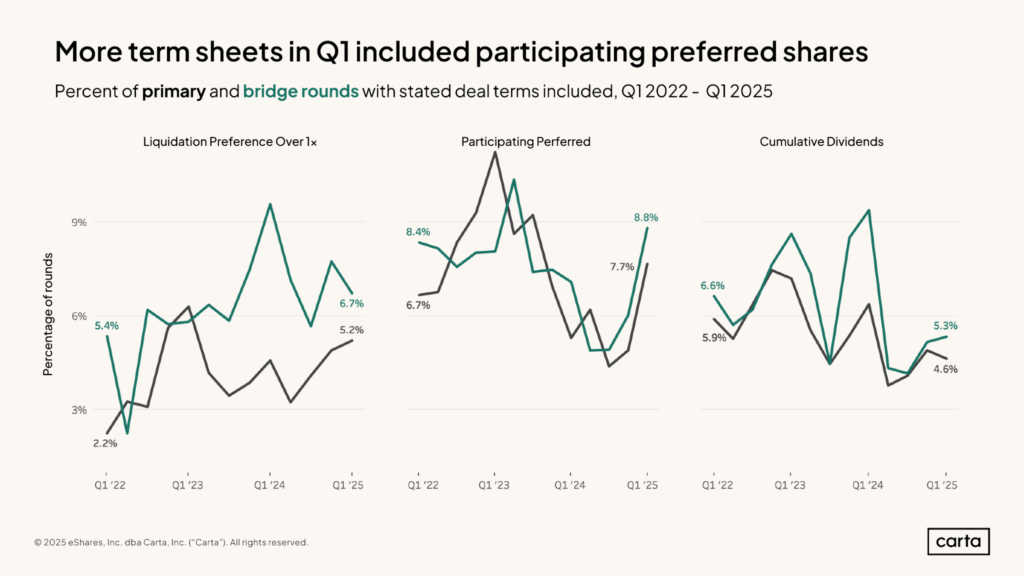
Liquidation prefs > 1× and cumulative dividends remain rarer still. Bridge rounds are marginally more likely than primaries to include them, but the gap is “slight.” The vast majority of rounds in Q4 2024 carried neither clause.
Investors are still relying mainly on headline price adjustments (down rounds, flat rounds) to manage risk. Structured downside protection is creeping back in—particularly the right to “double-dip” via participating preferred—but it shows up in fewer than one in ten term-sheets, far from the stress-era levels seen in 2020–22.
I wrote an extensive essay about the perils of liquidation preference, see the link below.
Related: How Liquidation Preference Fuels Conflicts in Venture Capital
A Tale of Two Cities: AI vs. The Rest (2024)
Another confounding factor may skew the data presented here: the impact of Artificial Intelligence (AI).
AI startups have clearly distinguished themselves from other sectors in terms of valuations in the last few quarters. As VC Hall of Famer Bill Gurley noted on the BG2 Pod, the AI hype cycle has permitted a soft landing in the Venture Capital market.
There was a mini correction in VC in 2022-2023. Then the AI wave came, and that segment is almost behaving like it was prior to the mini correction.
Bill gurley - Benchmark (Source: B2G Pod)
His co-podcaster Brad Gernster shared a graph highlighting a dramatic surge in AI investment in 2023, with $28 billion funneled into over 700 deals in 2023, representing a nearly fourfold increase year-over-year. This spike is primarily driven by heightened interest in companies developing models. Data from Sapphire Ventures showed that the top 5 deals in 2023 represented almost two-thirds of invested capital in AI.

AI has also distinguished itself in terms of valuation.
According to Pitchbook, early-stage AI companies have seen median valuations skyrocket to above $70 million by Q1 2024, while other sectors have generally struggled to maintain previous valuation levels. For instance, fintech, which once led in early-stage valuations, now trails behind AI, with the median fintech valuation falling below $50 million. This stark contrast highlights a significant shift in Investor priorities and capital allocation.

We’re in that land grab moment. You have a lot of investors that maybe aren’t thinking in a fundamentally sound matter, willing to pay whatever price it takes to get in.
Giuseppe Stuto - 186 Ventures (Source: Pitchbook)
The late-stage valuation landscape also shows a pronounced disparity between AI and other sectors. Late-stage AI startups continue to command premium valuations, significantly higher than their counterparts in eCommerce, Fintech, and SaaS.
Despite this, some investors urge caution. Tim Guleri of Sierra Ventures advises a diversified approach, arguing that the current high valuations liken the investment frenzy to "high-stakes poker," which may not yield sustainable venture returns. The competitive pressure in AI has led some Investors to explore other verticals, finding more reasonable valuations and less crowded markets.

Now, let's delve into the methods VCs use for startup valuation.
Two Methods VCs Use for Startup Valuation
While startup valuation remains part art and part science, two primary methods help guide Venture Capitalists in their valuation process: the Venture Capital Method and the Equity Ownership Approach.