Peter Walker (Carta) on Investing in Emerging Managers
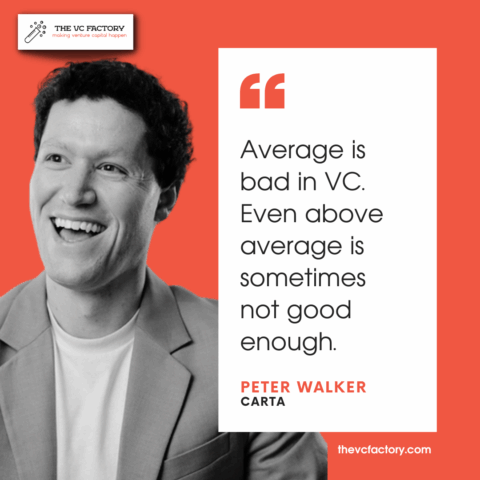
I sat down with Peter Walker, Head of Insights at Carta, one of the most attentive observers of Venture Capital trends today. Peter and Carta have published helpful data on Emerging Managers. Over the past few months, I’ve spoken with more than 80 Emerging Managers myself, but Peter’s vantage point is different: he observes the entire market from above, watching who gets allocations, who doesn’t, and why.
I wanted to understand how someone who lives so close to the numbers thinks about key questions, such as: should LPs invest in Emerging Managers — especially first-time and second-time ones — how Emerging Managers should approach raising in the current market, and what separates the few who break out from the many who don’t.
Our conversation kept circling back to the same uncomfortable reality: the Emerging Manager segment is both the most promising and the most unforgiving corner of Venture Capital. LPs want the upside but fear the long tail; GPs want to break out but struggle to prove why they deserve a seat at the table.
What follows is a distilled version of our conversation: a practical guide for LPs who want to underwrite Emerging Managers, and for GPs who wish to survive the current cycle.
In This Article
Should LPs Invest in Emerging Managers?
I opened our conversation by asking Peter whether a newcomer to the venture asset class, an LP with no prior VC exposure, should even consider investing in Emerging Managers.
As I highlighted in my report on Emerging Managers, data shows that Emerging GPs (especially first- and second-time VC fund managers) are both the highest-performing and the most volatile segment of the VC asset class.
The Emerging VC Conundrum is: how do you get exposure to this high-performing segment but avoid being stuck in the long tail of poorly performing Emerging Managers?
However, sources comparing the performance of emerging vs. established funds are scarce, so I was eager to hear Peter’s view.
Size Matters in VC Returns
Peter noted that, while there are overlaps, the small funds vs. large funds comparison mattered more than the established vs. emerging one.
Most emerging funds are small, so this is a valid proxy to think about the issue at hand.
In Peter’s view, the numbers have always pointed in the same direction. “The best of the smaller funds will outperform on a multiples basis versus the best of the larger funds,” he told me.
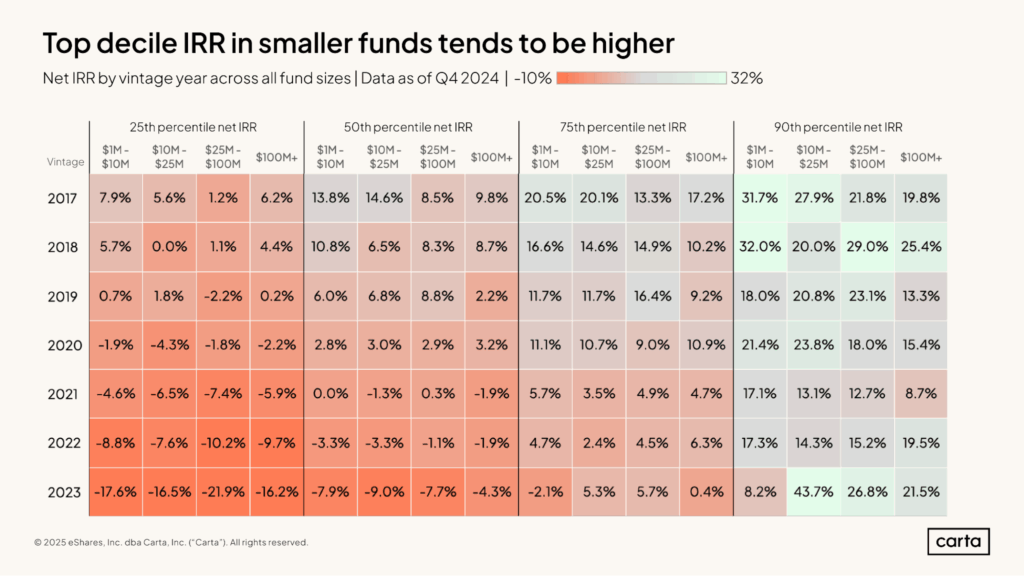
In the 2017 vintage, the 90th-percentile IRR for $1–10 million funds is around 32%, compared with roughly 20% for funds larger than $100 million.
Source: 2024 VC Fund Report
However, he immediately added that while the top decile of small funds can outperform billion-dollar platforms, the dispersion in performance is wider, and the likelihood of zeros is higher.
This combination — higher upside at the top, ‘meh’ outcomes in the middle, and a long, painful tail — is precisely why LP selection matters so much in the Emerging Manager segment.
Median is bad in VC. Average is bad. Even above average is sometimes not good enough.
Peter Walker – Carta
Peter’s conclusion aligns with what I laid out in my Emerging VC report: the Emerging Manager opportunity is real, but only if LPs develop a framework to identify the future outliers.
With mediocre or above-average managers, small or large, the math doesn’t work.
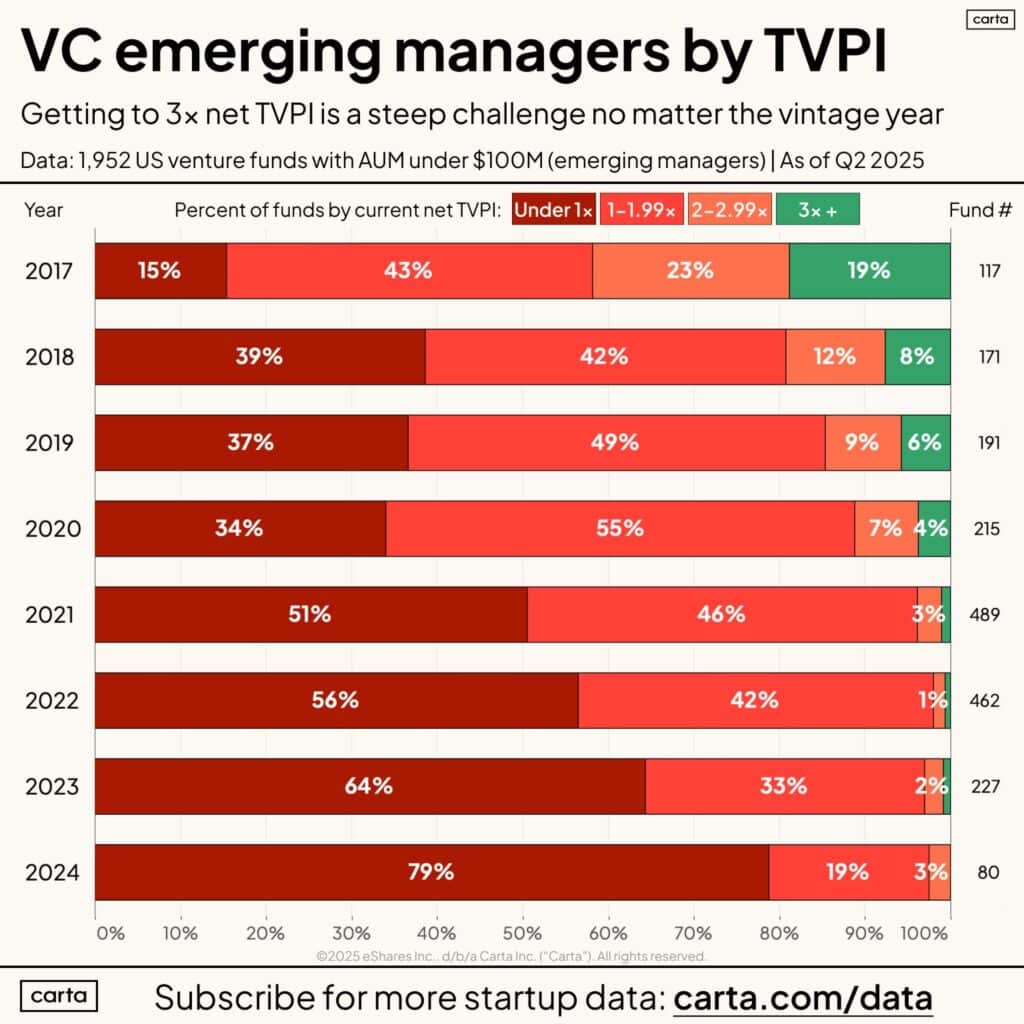
Carta data on c. 2,000 US funds below $100 million show that more than 1/3 of Emerging Managers lose money, and 3/4 don’t justify the risk of investing in an unproven manager.
Even 2017, a strong vintage due to an exceptional exit window in 2021, has only 19% of funds above 3x.
Note: Data will evolve as TVPI translates into DPI
Peter then added more granularity to the challenges faced by new entrants investing in VC funds.
Newcomers’ Challenges: Selection, Size, Consistency, and Patience
Peter boiled the problem for new LPs down to four linked constraints: who you can back, how much you can sensibly deploy, how consistently you stay in the market, and whether you give yourself enough time to build real pattern recognition.
The first challenge is selection. Established brands such as Sequoia, Benchmark, and a16z rarely accept newcomers, making first- to fourth-time fund managers the default.
However, a new LP without any VC investing track record lacks the network and reach to access the best Emerging Managers.
If you’re an LP who’s never invested into venture before, how likely is it that the managers you can reach are in the top tier? Very unlikely.
Peter Walker – Carta
The second constraint is how much capital the LP needs to put to work. “If you’ve got around $100 million, sure, you should devote some of it to Emerging Managers,” Peter told me. Check sizes and fund sizes line up: you can back a handful of small funds and still build a sensible portfolio.
For a billion-dollar program, the math breaks. There aren’t enough high-quality Emerging Managers, or enough capacity in their funds, to absorb that amount. “You can’t put a billion dollars into Emerging Managers with any sort of regularity,” he said.
Peter’s recommendation was incremental exposure. Start small, build experience, and give yourself enough cycles to understand what “great” looks like.
Consistency also matters. For him, the biggest misconception new LPs have is thinking they can test the asset class by writing one or two checks and then evaluating whether venture “worked.”
Peter was very clear: this is not an asset class you dip into. For a family office or first-time LP, adding a single first-time fund to a portfolio is statistically meaningless.
Venture investing, especially in the Emerging Manager segment, needs time and diversification. “You can’t just check a couple of funds and see what the returns were,” he told me. If you decide to step into this part of the ecosystem, you need to do it over multiple funds and over an extended period of time.
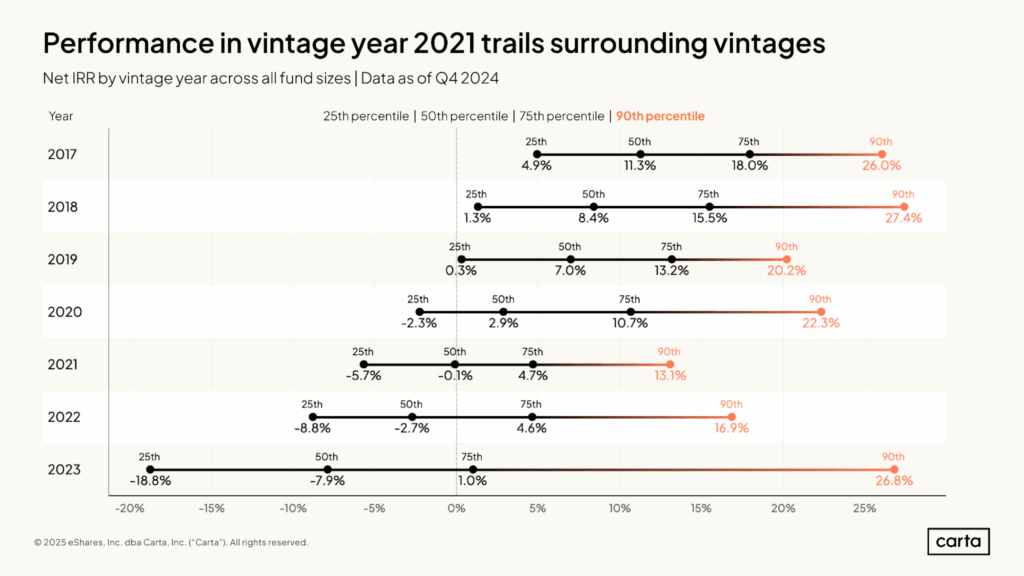
LPs who stopped investing after the 2022 market reset are likely to miss higher performance for 2023+ vintages.
Source: 2024 VC Fund Report
As I wrote in my detailed analysis of VC returns, even a powerhouse LP such as CalPERS learned this lesson the hard way. The institution reported a few years ago that its compounded VC returns over 2000-2020 were astonishingly meager at 0.49%! CalPERS had missed some of the most outstanding vintages in the last two decades by stopping investing after the GFC.
Finally, Peter added that new LPs should not invest in the first Emerging Manager they meet. As he put it, “You first need to build a sense of what ‘great’ actually looks like.” Without that comparative base, LPs risk building conviction too early.
This one hit home. I spoke with about 80 Emerging Managers over the last few months, had follow-up calls with 20 of them, and ultimately decided to invest in just one after months of regular updates and even joining his investment committee to gain more confidence in his decision-making process.
Peter’s advice for LPs investing in VC for the first time:
- Selection risk: New LPs have no network or track record in the ecosystem, so their access is weak.
- Diversification: One commitment won’t tell you anything; you need enough shots over enough years.
- Invest time to meet as many Emerging Managers as you can and build pattern recognition capability.
Criteria LPs Should Use To Evaluate Emerging Managers
Next, we moved to the criteria that LPs should use to evaluate VC funds in general, with a focus on Emerging Managers. Carta is the go-to solution for GPs onboarding LPs, so Peter has a rare vantage point as an independent third party sitting between LPs and GPs.
Fund Size Discipline as a Signal
The first criterion Peter mentioned is how a GP handles fund size across vintages. He pointed out a trend he sees taking hold: keeping funds roughly identical in size from one vintage to the next, with only modest adjustments for market conditions.
Peter gave the example of VC fund managers who raise a $50 million fund, then a $55 million one, then perhaps a $65 million one. Those small, incremental increases make sense: valuations shift, interest rates move, and teams grow modestly.
The real test is when GPs resist the temptation to jump from $50 million to $100 million, and then to $250 million. “If I’m an LP,” Peter said, “size discipline is a wonderful signal.” For him, a GP who keeps their fund size relatively constant is telling LPs two things.
If you’re the best Seed investor, why would you be the best Series A investor?
Peter Walker – Carta
First, they understand where their edge actually lies. For example, a GP investing in the earliest stages has tight-knit Founder relationships and offers hands-on support.
But investing downstream requires different skill sets, different rhythms, different relationships. Managers who stay close to their zone of excellence and keep their funds sized accordingly send a strong signal to LPs.
Second, maintaining fund size discipline demonstrates that the incentive structure hasn’t drifted. The hidden reason behind sudden fund-size expansion, Peter noted, is often management fees, not strategy.
Some firms, he acknowledged, argue for a larger fund so they can take more ownership in the same kinds of companies they backed in earlier funds. Peter pushed back: “If you go from a $50 million Fund I to a $500 million Fund IV, you’re not investing in the same kind of companies anymore.”
The “Benchmark Model”
To illustrate what size discipline looks like in practice, it’s hard to find a clearer example than Benchmark. The firm’s first three funds show a typical pattern, doubling in size from $85 million to $175 million.
(Worth noting, the velocity of capital deployment is unusual by today’s standards: the first three funds were raised in just a couple of years.)
After an unusual billion-dollar Fund IV raised at the height of the dot-com cycle, the firm reset its strategy and went back to something much closer to its debut funds.
Fund V came in at $400 million, Fund VI at $500 million, and from Fund VII onwards, Benchmark has kept its flagship vehicle at around $425 million, effectively standardizing a sub-$500 million, early-stage fund size for more than a decade.
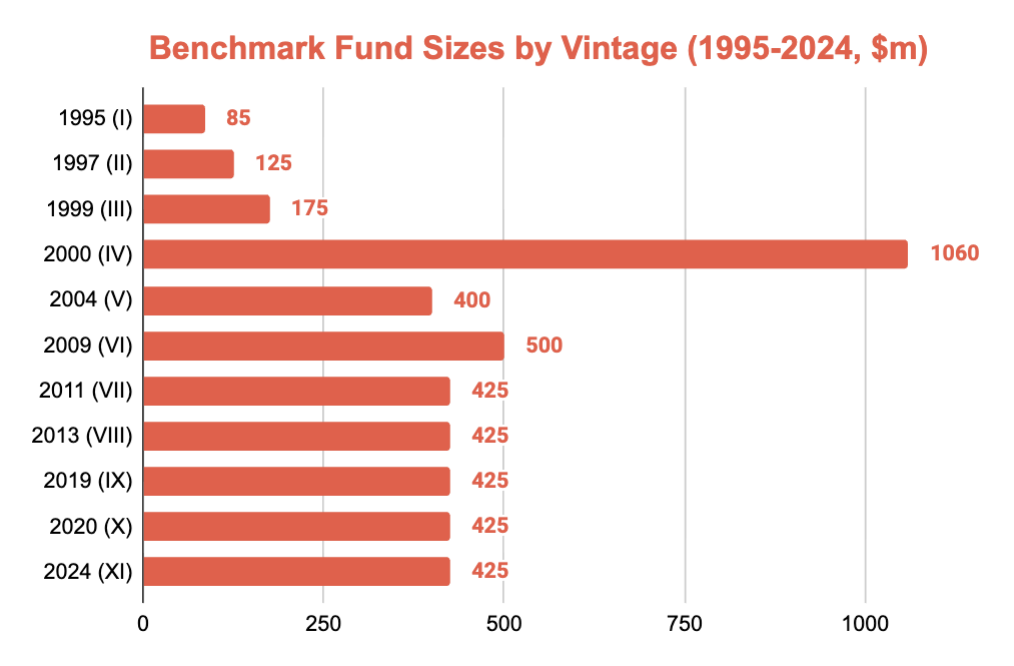
What happened with Fund IV?
Benchmark’s first fund was only $85 million, but it went on to return roughly $7.8 billion (92x), primarily powered by a $6.7 million investment in eBay in 1997 that was worth around $4–5 billion by 1999, a few months after eBay’s IPO.
Fueled by this extraordinary success during the dot-com bubble, Benchmark raised Fund IV shortly after Fund III, but six times as large at $1.1 billion. The firm had more than enough proof points to justify a much larger pool of capital.
Yet public pension data suggest a very different outcome for the bubble-era Fund IV: one disclosed LP reports a multiple of roughly 1.4x on its Benchmark Capital Partners IV commitment — a far cry from the 20x to 90x realized on the early funds. (Fund II, at $125 million, is reported to have returned on the order of $2.5 billion).
We see ourselves as craftspeople and artisans. We try to do one thing and do it well, and that means staying small and focused.
Matt Cohler – Benchmark (Source: Techcrunch)
Whatever the exact internal post-mortem, the pattern in the numbers is clear. After experimenting with scale in Fund IV, Benchmark pulled its flagship back down and then held it at a consistent, relatively modest size while continuing to focus on very early-stage, high-conviction bets.
The partners understood that this style of investing requires a specific size and structure: a fund small enough to stay close to Founders, and a partnership tight enough for every investment to matter. Increasing the fund size would have changed that.
This is what Peter Walker has in mind when he talks about size discipline. Benchmark shows what it looks like when a GP aligns fund size with its edge, and then resists the pressure to let success inflate the vehicle.
For LPs, fund discipline is a powerful signal: a manager who knows exactly where they win and is willing to leave money on the table to keep playing that game well.
First-Call Relationships with Founders
Another criterion LPs should use to select Emerging Managers is the quality of their relationship with Founders.
In Peter’s view, the daily reality of that relationship looks very different from what you typically see at a brand-name mega-fund.
Early-stage Emerging GPs are, as he put it, “in the trenches.” They’re the ones Founders call for advice or intros, not the person who shows up once a quarter for Board meetings. “They are the first port of call when it comes to something that’s happening in the company that’s on fire,” he told me.
Peter contrasted this with the big-fund model. “Does Andreessen have the biggest Rolodex in venture, and can they get you a meeting with anyone? Yes, I’m sure they do,” he said. “That’s different than putting my actual personal capital on the line in terms of relationship building and networking.” For him, those two types of value-add are not interchangeable.
One of the best things we can hear from a founder is that while the fund manager was a smaller investor, they are one of the first people the founder calls for advice.
Michael Kim – Cendana Capital
Peter advises LPs to direct their reference checks to understand whether this GP is the first person Founders call when something breaks.
Michael Kim, who runs Cendana Capital, one of the highest-performing VC funds-of-funds, uses the same test. In my report on Emerging GP selection, my research team and I combed through hundreds of sources to analyze how three LPs (Sapphire Partners’ Beezer Clarkson, Allocate’s Samir Kaji, and Michael Kim) did it.
We came up with six criteria, and laid out detailed examples and case studies for each. Read the report for more details.
Strength of the Brand & Access
Peter made a second point about access.
In his view, Emerging Managers who consistently show up for Founders earn something that no Rolodex or platform team can manufacture: access to the next group of Founders.
“You have to maintain some sort of quality brand in order to get access to the next group of founders,” he told me. “They’re all talking amongst each other.” This is where Emerging Managers can stand out.
So much of VC is just optics and access.
Peter Walker – Carta
Founders remember who helped them. They talk about which GPs answered the first call at midnight, who made introductions that mattered, and who stayed present when things were difficult. A GP’s reputation within Founders’ networks often determines whether they get invited to the next breakout round.
I mentioned this to Peter with a recent example of my own. I backed a first-time GP who initially secured a $500k allocation in a $5 million round. When the round later expanded to $20 million, his allocation became too small and should have been crushed. It wasn’t. He kept it because the Founders wanted him in the round. They valued his advice, their past relationship, and what he had already done for them.
LPs evaluating Emerging Managers should drill into sourcing quality, and in particular, how much deal flow comes from Founders who invite them back when something big is starting, or who make quality introductions to other Founders.
That form of access compounds.
Peter Walker’s Advice to Emerging Managers
Peter also had unfiltered, practical advice for GPs themselves, especially those raising a first or second fund in today’s environment. His perspective is grounded in what he sees every day from Carta’s vantage point: which managers get allocations, especially when capital is scarce and competition from established firms is intense.
Prove to LPs That You Are Strategically Different
Peter started by reminding Emerging Managers that if they’re raising Fund I or Fund II, they can’t expect anyone to back them on track record alone.
“Track record will be discussed,” he told me, “but it’s not the factor that points to whether or not you’re going to be a winner, simply because the data is not old enough.”
The uncomfortable truth is that most early funds look similar on paper. What LPs are really trying to understand is whether you are strategically different. That’s why every element of differentiation matters.
As an Emerging Manager, you are selling a product that is very commoditized.
Peter Walker – Carta
For Peter, Emerging Managers can show their differentiation in three core areas.
Founder access. You need to demonstrate why you will be in the room when it counts. It’s a clear story about who calls you, why they trust you, and how you’ve earned that trust so far. See the section on first port of call above.
Portfolio construction. Peter was struck by how little time many first- and second-time managers spend on this. LPs want you to walk them through your diversification, ownership, reserve ratios, recycling strategy, and how you expect your return profile to emerge from those assumptions. “You want to convey your thoughtfulness through your model,” he said. If you can’t explain the logic of your own portfolio, it’s hard for anyone else to believe in it.
Specialist thesis and “right to win.” In a market where capital swings between generalists and specialists, a focused fund has to clear two distinct hurdles. First, you must prove that your area is worth specialising in at all: is there enough TAM, enough exits, and is this a widening opportunity set rather than a shrinking niche? Second, you must show why you are “the most special within that specialty.” As Peter put it, too many managers assume that saying “we’re a biotech fund” or “we’re a climate fund” is enough. It isn’t. You have to justify both the category and your specific edge inside it.
Pre-Consensus Early Is Better Than Non-Consensus
Peter’s second piece of advice to Emerging Managers echoed the debate a16z’s Martin Casado sparked some time ago with his comment on non-consensus investing.
Peter espoused the idea that great early-stage investing is not about being contrarian for the sake of it. In his view, the real advantage is being pre-consensus, the ability to act before consensus forms.
“The goal is not to be in the wilderness for 15 years. The goal is to be in the wilderness for the next two and a half to three years, and then have everyone recognize that you were in first,” he said.
The point of venture isn’t to be non-consensus forever, but to be pre-consensus.
Peter Walker (Carta)
Peter stressed that Emerging Managers are well-positioned to capture pre-consensus bets thanks to tighter decision cycles driven by personal conviction (especially among solo GPs) and proximity to early Founders. The top Emerging GPs can often see an opportunity and move on it long before it shows up on a big fund’s radar.
However, Peter was careful not to oversell it: he doesn’t think Emerging Managers are inherently more contrarian. “I could make the case either way,” he said. Instead, Emerging Managers should leverage “their unique edge to get in early with the Founders that will matter most.”
For some GPs, that edge comes from networks built at places like Apple or Google, and the deep ties they maintain with people who spin out of those ecosystems. For others, it comes from being a recognized expert in a specific domain — deep tech, fintech, or climate — where Founders already see them as a natural first call.
Start Building LP Relationships Early
Peter’s final piece of advice to Emerging Managers was simple but often overlooked: start building LP relationships long before you need them.
Most LP meetings won’t turn into commitments, especially at Fund I or Fund II — but that doesn’t make meeting them useless. “You’re going to have a lot of meetings that result in no dollars,” he told me, “but I don’t believe those are wasted.”
Experienced GPs know that these early conversations are part of a much longer arc. LPs watch as GPs evolve, their strategy takes shape, and how early Founders speak about them. “You’re always in their zone,” he said, meaning that once an LP knows who you are, they track you for years, not months.
Conclusion
Peter Walker sits in a rare spot in the ecosystem. He sees which Emerging Managers are backed by data and which ones never take off. What I took from this conversation is that the Emerging Manager segment is an opportunity worth investing in, but requires time and patience.
On the LP side, the math is unforgiving: median is bad, dispersion is brutal, and you only get returns if you can consistently find the small funds that focus on their edge and are able to spot the best Founders early.
On the GP side, the product is commoditized capital; what stands out is strategy, discipline, and how you show up for Founders and LPs over time.
Peter’s vantage point also reinforces the core idea behind my work on Mindset-Based Investing: in an asset class where median outcomes are poor and the right tail sits in small, focused funds, LPs cannot rely on early numbers or pedigree alone.
They need to understand how Emerging Managers think under uncertainty, their comfort with losses, their willingness to swing when conviction is high — in short, whether they are genuinely trying to win. These traits are ultimately what turn data and access into repeatable outlier returns.