5 Questions LPs Should Ask Before Investing In A VC Fund
I recently spoke with a group of family offices and endowments about the questions LPs should ask before investing in a Venture Capital fund. Some participants had invested in VC…
I recently spoke with a group of family offices and endowments about the questions LPs should ask before investing in a Venture Capital fund. Some participants had invested in VC…
Mindset-Based Investing is a framework designed to improve decision-making under extreme uncertainty, with the goal of generating outlier Venture Capital performance.
In contrast with typical allocation processes, where decisions are based on pedigree, networks, and track record, Mindset-Based Investing examines the decision maker: what motivates them, how they form conviction, and how they see the world.
Mindset-Based Investing can be applied by an LP evaluating a GP or a GP evaluating a Founder. The framework is based on a decade-long research effort analyzing how elite Venture Capitalists, called “Power-Law Masters,” make investment decisions.
I committed to a VC fund without opening the data room the GP sent me. It sounds careless, but after you read this essay, you may change your mind about VC fund due diligence, and adopt a complementary set of tools.
LPs evaluating Venture Capital funds typically rely on track record, using past performance as an indicator of future returns – a principle called persistence. Yet, evidence of persistence in VC fund returns remains inconclusive. Past performance may say less about the next fund’s potential than most LPs assume.
So the question is: how should LPs evaluate VC funds before they commit?
In a recent chat with Martin Tobias, a veteran entrepreneur and Angel Investor now raising his Fund II, I laid out how my framework, Mindset-Based Investing, can help LPs select VC funds with limited recourse to track record data.
Caveat: I wouldn’t have done it if it wasn’t my own money. Professional LPs’ fiduciary duties compel them to carefully analyze all the data.
I hope you enjoy our talk. I added links to research backing this approach in the summary below, including my report: Emerging VCs: Selection Through Mindset.
SpaceX, the rocket company founded by Elon Musk in 2002, went public on June 12, 2026. The SpaceX IPO is the largest in history, generating $75 billion in cash and valuing the company at $2.1 trillion.
The IPO created life-changing wealth for thousands of current and former employees, including factory workers, a group often excluded from meaningful startup equity. It also made Musk the world’s first trillionaire.
Much has already been written about the SpaceX IPO. I chose instead to collect first-person stories that surfaced on social media in the weeks around it. Together, they show how a company that attracted skepticism turned improbable ambitions into reality.
They also offer a unique window into how Elon thinks and works. Whatever your opinion of his politics and antics is, Elon is undeniably one of, if not the most successful entrepreneur of our era. The stories shared from people who worked at SpaceX suggest that much of his success begins with his mindset: how he sees the world and acts on it.
However, SpaceX’s trajectory to its public offering is not a Cinderella story. Current and former employees tell a tale of hardship, ruthlessness, and damage to both mental and physical health. It seems that outlier outcomes are seldom exempt from “pain and suffering,” as Nvidia’s Jensen Huang notably claimed.
In this article, I draw on stories from those who worked with Musk to illustrate his mindset and how he built a company that most closely resembles him: mission-driven, based on first-principles thinking, resilient, and unrelenting.
When I first visited Silicon Valley, a decade and a half ago, a prominent VC on Sand Hill Road explained to me why this 40-mile stretch had become so successful: the unprecedented concentration of research, entrepreneurial talent, capital, and potential acquirers.
It made sense: Stanford and Berkeley produced talent who founded startups funded by Venture Capitalists and later acquired by big technology companies. The same pattern repeated itself in every generation.
Much has changed since then. Other hubs in the U.S. and abroad have been successful, and Silicon Valley seemed, for a moment, to have lost some of its edge. But the AI boom has pulled the Bay Area back to the center of global tech.
So the question remains: where does Silicon Valley’s enduring success really come from?
While digging into Northern California’s history on a recent visit to San Francisco, it became clear that the usual explanation started too late. The decisive success factor behind Silicon Valley’s success is the gold rush mindset.
First called “gold fever” in the context of California’s Gold Rush between 1849 and 1853, the gold rush mindset has become an expression commonly used to describe the state that arises when a scarce, poorly understood opportunity appears to offer life-changing upside to those who arrive early.
While it has its limitations and perils, the gold rush mindset is a helpful framework for Venture Capitalists to evaluate outlier-caliber Founders.
Like their forebears, tech entrepreneurs in Silicon Valley are modern-day prospectors with defining character traits such as restlessness, commitment, overconfidence, resilience, and sometimes ruthlessness. Few of them find gold, but all of them try.
I believe these traits are essential for entrepreneurial success. In this essay, I analyze each of them and provide capital allocators with the tools to recognize them in the Founders they evaluate.
In 2011, Peter Thiel gave Venture Capital one of its most memorable complaints: “We wanted flying cars, instead we got 140 characters.”
Thiel was attacking an industry that had drifted away from its daring company-building roots. Instead, Investors had become good at pattern matching: recognizing companies that looked like previous winners, joining fashionable rounds, and asking who else was investing. As the asset class grew, most VCs became money managers.
In short, they focused on capital instead of venture.
I believe that we’re now closer to funding “flying cars” again, a metaphor for bold innovations carried by mission-driven Founders backed by visionary VCs.
Since the 2022 reset, Venture Capital has split into two distinct segments. On one side, large platforms compete for big LP commitments and concentrate capital in the most obvious winners. On the other, smaller firms (including Emerging Managers) fight to prove they can identify the next outlier before the rest of the market agrees.
But size is not the real distinction. Some large firms still make bold, early, non-consensus bets, while some small funds merely copy fashionable themes with less capital. The deeper divide is in the mindset. It separates promotion-focused Investors, who focus on what can go right, from prevention-focused Investors, who strive to avoid being wrong.
That distinction matters most for allocators in VC funds (Limited Partners or LPs).
LPs aiming for superior returns should back VC managers investing in flying cars. Risk and illiquidity are so high in VC that only top-quartile, and even top-decile performance makes financial sense.
However, there’s a catch. Instead of requiring VC managers to shorten the liquidity horizon, LPs should recognize that it takes time to build category-defining companies. They must mirror the mindset of GPs with sufficient risk appetite and patience to make bold bets — or stay out of the asset class altogether.
In this article, I show how the current environment favors promotion-focused Investors, those who are mentally equipped to make conviction-oriented, pre-consensus investment decisions, and how LPs can discern them from the pack.
It’s time to start building those flying cars.
Martin Tobias is one of the most focused pre-seed Investors out there. He has backed six unicorns while running a tight solo-GP machine that saw ~4,500 decks last year and wrote 11 checks. Before starting Incisive Ventures, he built three VC-backed companies, raised $500 million, and took two of them public. Martin is also an LP in 18 VC funds and an Angel in 250 startups.
Despite the solid track record and the accolades, Martin is what we call, in the trade, an Emerging Manager. After a $10 million fund I he launched in 2021, he’s now raising a $25 million fund II. If you’re not familiar with how Limited Partners (people or institutions who invest in VC funds) make allocation decisions, you’d think this is a no-brainer: an experienced entrepreneur with a solid track record as an Investor, it doesn’t get better than that.
You’d be wrong. Although Martin’s already well on his way to reaching his fund target, this is one of the shittiest markets for VC fundraising in a long time, and many talented Emerging GPs struggle to raise capital. So, I’m writing this post to explain to my fellow LPs why I decided to invest in Incisive Ventures II and to illustrate how Mindset-Based Investing can help identify industry outliers. Fundraising GPs will gain insight into the LP allocation process, and Founders will understand more clearly how a VC selects investments.
TL;DR: Don’t rely on track record alone; focus on the GP’s mindset. In particular, analyze how they make investment decisions. It gives you a window into their personality, a crucial aspect of VC performance. I’ve written a series of reports on why and how to do it, quoted in context below.
Venture Capital is one of the few professions where a gut feeling can be worth billions, but where the same intuition can veto the very outliers that define exceptional careers. …
I sat down with Jason Kirby, a four-time exited entrepreneur who hosts the excellent $100M Exits podcast. Jason is a thoughtful interviewer and, as a former entrepreneur who now helps…
Michael Ströck has built and exited startups, co-founded multiple VC firms, and now runs Allocator One (“A1”), one of the few global platforms dedicated to backing first- and second-time GPs.…
I sat down with Peter Walker, Head of Insights at Carta, one of the most attentive observers of Venture Capital trends today. Peter and Carta have published helpful data on…
Investors in Venture Capital funds are presented with a dilemma: top-decile performers capture most of the asset class’s alpha, yet it’s quasi-impossible to get access to established funds with stellar…
Softbank’s Masayoshi Son has been credited with the largest win (Alibaba) and loss (WeWork) in Venture Capital’s history. As he’s commonly referred to, “Masa” is reported to be a very…
One of the hardest parts of Venture Capital is navigating bad news. Over the years, I’ve seen some Founders handle those moments with clarity and composure. I’ve seen others spiral…
Entrepreneurs’ mental health issues, like Aliens, are the unwelcome passengers of what was supposed to be a pleasant voyage. Navigating the entrepreneurial landscape can be an exhilarating journey ripe with…
Why do so many Founders make the same mistakes, costing Investors substantial capital? My previous explanations—overconfidence and fear of failure—capture part of the problem. There’s a third factor that VCs…
One of the most consistent personality traits I’ve observed in entrepreneurs over the years is a tendency to live in denial. They don’t seem to perceive the inherent risks of…
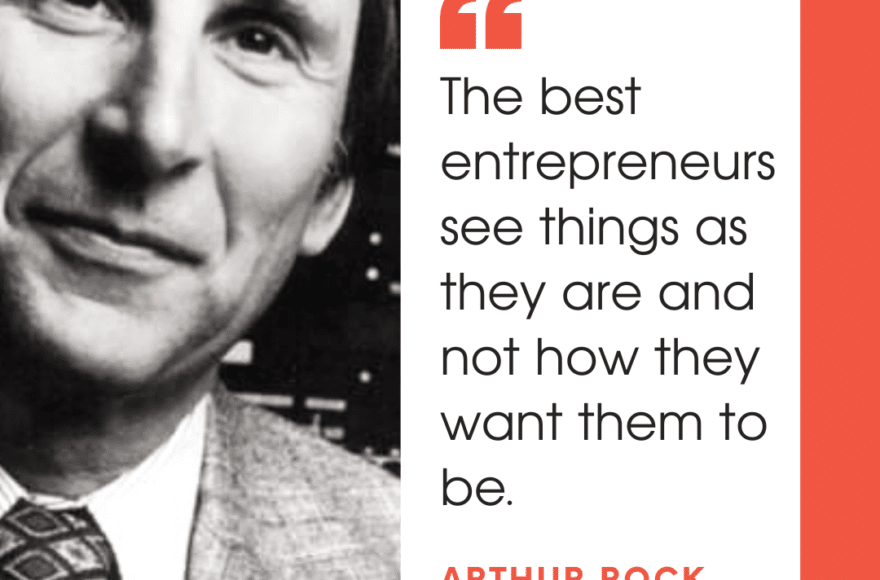
Arthur Rock’s name is tied to early Silicon Valley, that’s why he thrones among our collection of VC quotes. A decade before Don Valentine founded Sequoia Capital and Eugene Kleiner…
I recently attended meetings where experienced VCs and Founders claimed that money is the primary driver of successful entrepreneurs. This idea stood out because it conflicted with much of what…
I recently attended a talk by MIT professor David Rand, a leading researcher on misinformation and the psychology of belief. Rand’s findings challenged my assumptions about confirmation bias—a concept I’ve…
Operating with diligence is often a decisive factor in startups’ successes. In some industries, the first to market wins. In others, it’s the company that innovates most consistently or serves…
Deciding to reinvest in a company amid uncertainties is one of the most challenging choices Venture Capitalists face. One question always arises whether they are considering extending bridge financing to…
Despite bumps on the road, Venture Capital has become an attractive asset class for Investors and operators, promising cherry-on-top returns and access to what will happen next. More VC funds…
Entrepreneurial success often depends on having the right combination of personality and abilities. Among these, grit—the combination of persistence and passion toward long-term goals—has been hailed as a must-have trait,…
Venture Capitalists are vocal about what they look for in startups they invest in: stellar team, large market, scalability, exit routes, etc. What about the evaluation criteria they don’t discuss…
Early-stage Investors seem to rely on little else than their gut to make multi-million dollar bets on fledgling startups—and their Founders. How do the best VCs mix their intuition and…
Venture Capitalists always stress that their most important investment criterion is the quality of the startup’s Founding team. What are the characteristics and personality traits Investors are looking for? More…
Venture Capitalists receive hundreds of investment opportunities annually, making performing quick and effective exploratory due diligence crucial. They need to identify promising startups while swiftly avoiding potential pitfalls. However, data…
Once seen as mavericks making crazy bets shoulder-to-shoulder with the entrepreneurs they backed, Venture Capitalists are increasingly railed for focusing more on the “Capital” part of the job (managing money)…
In the annals of Silicon Valley’s storied history of booms and busts, the tale of Juicero stands out not merely as a business case gone awry but as a psychological…
Prosecutors working in the case against Sam Bankman-Fried (SBF), the embattled crypto magnate accused of siphoning billions of dollars from users of his crypto exchange FTX, are intent on demonstrating…
Venture Capitalists come across thousands of business ideas every year. But how do they make their investment decisions? Do cognitive biases influence them, or is there something more systematic present?…
Kevin O’Leary, best recognized for his role as an Investor on the hugely successful TV show “Shark Tank,” has earned his moniker ‘Mr. Wonderful’ for his candid and often brash…
Venture Capital due diligence is a critical process that ensures informed decision-making. By conducting thorough due diligence—involving market validation, financial and legal audits, and customer and reference checks—VCs can considerably…
Venture Capital diversity has become a hot topic in recent years, as the industry faces growing scrutiny over the lack of representation among Investors and VC-backed entrepreneurs. Despite numerous efforts…
When it is all over, and the whole truth is known, Theranos will undoubtedly join the great frauds of business history, competing with the likes of Enron and Worldcom. More…