The Ultimate Guide to VC Portfolio Construction (with Fund Model)

Over the last few months, I’ve spoken with more than 100 Emerging GPs. A pattern keeps showing up. They have a clear thesis, strong sourcing instincts, and real ambition. But then I ask about VC portfolio construction, and the same weak point appears again and again: their fund model doesn’t make sense. The story sounds right, but the numbers don’t add up.
This matters because most serious LPs treat portfolio construction as a screening filter. They may like the narrative, the market, and the differentiation. They still won’t commit if the fund math feels loose. If a GP cannot explain what ownership is needed, how reserves will be deployed, and why the target returns are achievable, the diligence process becomes uncomfortable fast.
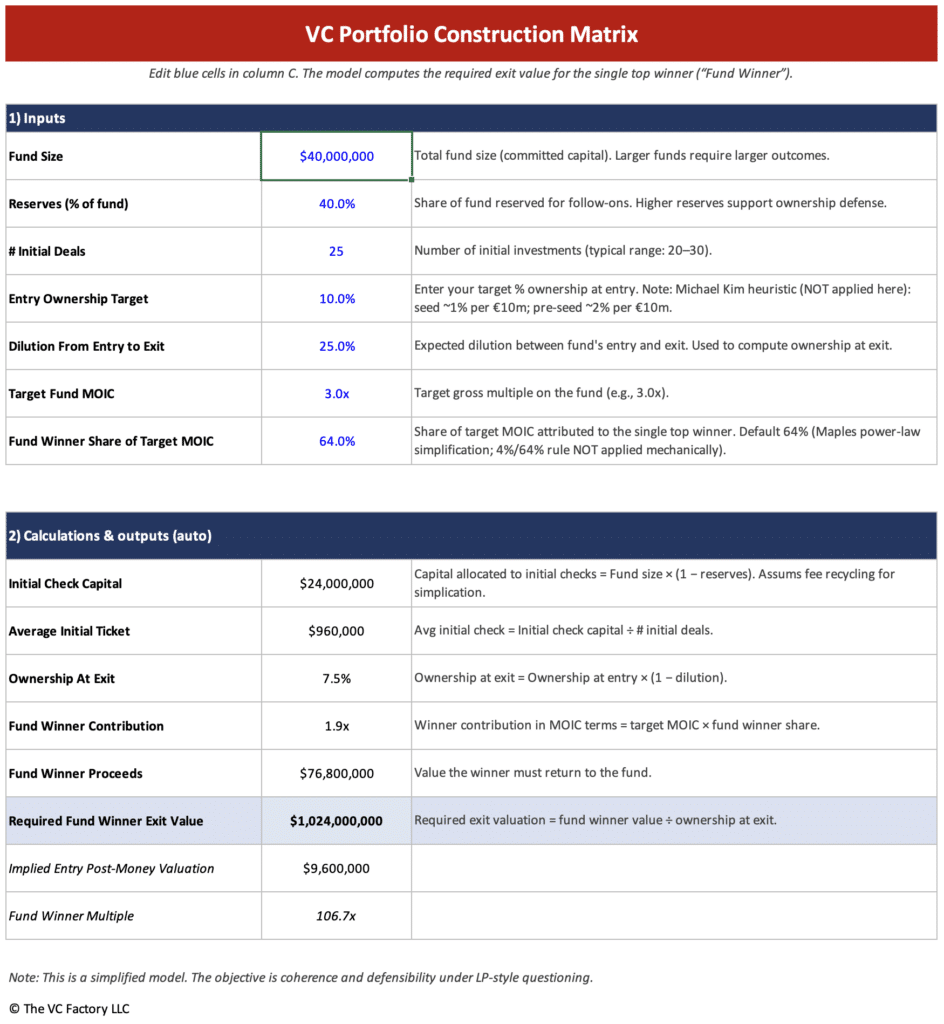
That’s why I built the VC Portfolio Construction Matrix. It is a simple tool designed to force coherence. You enter a limited set of assumptions, then the VC Portfolio Construction Matrix computes one number that anchors the entire conversation: the exit value your single biggest winner must reach for the fund to work.
Everything else in this guide exists to help you choose those inputs and to make your venture capital portfolio construction defensible under LP scrutiny. The Matrix helps answer one urgent LP question: “Given the assumptions behind your portfolio construction, what exit price must your single biggest winner reach for the fund to work?”
You’ll be asked to enter your email, and you will join 12,000 VCs & Founders who read our super cool weekly newsletter. Nothing else, and you can unsubscribe at any time (but if you need this model, I bet you won’t).
In This Guide
Why VC Portfolio Construction Matters
Venture capital portfolio construction is the translation of a GP’s investment thesis into numbers: how much to invest, in how many companies, at what ownership levels, and with what reserve strategy.
LPs pay close attention because it tells them whether the fund is eligible for their own investment strategy. But it also signals whether the GP is thoughtful and market-ready. Most Emerging GPs model portfolios cannot succeed because they skip a reality check against external data and rely on unrealistic assumptions.
A credible model shows both diversification, enough companies to give the power law a chance, and conviction, enough ownership and follow-on capacity for the outliers to matter at the fund level.
As an emerging manager, your reputation won’t be made during fundraising, it’s made with investments, and you want to start doing that as soon as you can.
Beezer Clarkson – Sapphire Partners
LPs are not looking for perfect predictions. They want evidence of discipline: the GP has done the math on how many fund-returning outcomes are required, how ownership will be maintained, and what assumptions underpin follow-ons. Experienced LPs such as Beezer Clarkson understand that you win the battle on the field; portfolio construction shows them whether you have a promising plan.
When a GP cannot explain how the projected portfolio yields a 3x outcome, the thesis starts to sound like storytelling. VC portfolio construction is a credibility test, which is why I built the VC Portfolio Construction Matrix to surface a fund’s requirements to win.
If you want to dive deeper into LP criteria for Emerging GPs, read my report: “Emerging VCs: Selection Through Mindset.” My research team and I reviewed hundreds of sources to identify the key criteria LPs look for before investing in untested VC fund managers.
With that, I start with the first step in the VC Portfolio Construction Matrix: fund size.
1. Fund size
Fund size is the VC Portfolio Construction Matrix’s first input because it sets the absolute hurdle for all subsequent inputs.
A $10m fund targeting 3.0x must return $30m of gross value back to LPs, but the same GPs targeting a $50m fund must now return $150m. When I point this out to fundraising GPs, and we’re past the “duh” factor, they launch into long-winded explanations such as “I can’t be raising money all the time,” “We need a large fund to pay ourselves off the management fees,” or “It won’t look serious to LPs if we raise a small fund.” These are almost always a red flag for me, and for many other LPs I talk to.
That’s where the VC Portfolio Construction Matrix comes in. It doesn’t argue whether ambition is “good” or “bad.” It just forces you to see what it implies mechanically. If you can’t convince LPs using exit data tied to your investment strategy (geography, vertical, stage), you must reduce your fund size.
Fund size is your strategy.
Mike Maples Jr. – Floodgate
A useful mental model is: fund size is strategy, a principle popularized by Floodgate’s Mike Maples Jr., one of the most successful early-stage VCs of the last two decades.
In a recent 20VC interview, Maples explains his rationale. Fund size sets the minimum bar you must clear in outcomes, and it shapes what kind of rounds you can credibly participate in, what ownership you can realistically hold, and how concentrated your VC portfolio construction needs to become to work.
“It’s kind of like you’re a pole vaulter. It’s the height of the bar that you set, that you promised to jump over. If you don’t jump over that bar, you have a bad fund.” I love this analogy. If the bar is higher than what your market, stage, and ownership can support, execution won’t save you.
That’s why fund size sits at the top of the VC Portfolio Construction Matrix.
I like to treat it as a variable. Run the Matrix with three fund sizes you think you could credibly raise. If the required winner exit goes from “hard but plausible” to “statistical miracle” as the fund size increases, the Matrix is doing its job. You’re better off lowering the vault bar.
2. Reserves %
Next, input the reserves ratio as a percentage of the fund size.
Reserves are the portion of the fund you keep aside for follow-on investments in existing portfolio companies. They help you defend your ownership position, but are sometimes used as “survival capital” to bridge the startup’s cash needs until it reaches the next funding round.
There is no “right” number for your reserve ratio. It depends on your fund size: a small fund will struggle to keep meaningful reserves and reach the target initial ownership level.
Beyond that, the appropriate reserve level depends on your investment strategy, in particular:
- Your vertical(s): the more capital-intensive the sectors you invest in, the higher the reserves you need to maintain ownership. Hardware, biotech, robotics, nuclear, and deep tech require more capital to get to an exit than software-based solutions
- Your stage: investing early means there will be more rounds, on average, before reaching an exit. Although some AI-based startups trump this adage and go from seed to exit thanks to spectacular growth, they are still rare
- Your approach: in my article on how to craft a compelling investment thesis, I described the “optimize for traction vs. dilution” paradigm.
One last piece of advice comes from Cendana Capital’s Michael Kim, one of the most successful LPs in VC.
He urges GPs to stop thinking of deploying reserves as a rule (“I always do pro rata”) and start thinking of them as an option (“I can defend the top positions when they deserve it”).
If you have good reserves, you don’t want to do pro rata in every follow-on round.
Michael Kim – Cendana Capital
Michael Kim makes a point that many Emerging Managers miss when they build their VC portfolio construction: reserve allocation requires exercising judgment. If most of your companies raise a Series A, you should not take your pro rata programmatically.
In some cases, a small token check can be useful for signaling. It allows the Founder to credibly state that existing Investors continue to support the company. In other cases, the right move is the opposite: super pro rata, leaning in hard because you believe the company is on a path to outlier success.
3. # Initial Deals
The number of initial deals you want to make over the fund’s investment period looks like a diversification choice, but it’s also an operating choice.
Most emerging funds land around 20–30 initial deals because it balances two realities. Venture outcomes are power-law distributed, so you need enough shots. I’ve met Emerging GPs who target 15 companies and others who aim at 150 portfolio lines. In a few cases, I was convinced by the rationale. If you’re going to extremes, be ready to defend your position and demonstrate how the VC math works for you.
At the same time, a GP has limited bandwidth to support companies effectively, and this becomes a hidden constraint on performance. Every additional company becomes a stream of decisions: hiring, intros, bridge requests, governance, follow-on signaling, and the emotional labor of staying close when things get messy.
When your phone’s blowing up all the time — and if you’re on 22 boards it’s blowing up all the time — you’re not as awake to the possibility of what Pinterest could be when you get pitched by Pinterest.
Mike Maples Jr. – Floodgate
The anecdote shared by Maples Jr. is a warning for Emerging GPs building their VC portfolio construction. It is tempting to treat deal count as a pure statistical lever: more shots means more chances, but also less focus on each company.
Deal count also shapes ownership over time. A portfolio with 25 names can still concentrate reserves into the top few without breaking concentration limits or operational capacity. A portfolio with 60 names usually can’t.
The VC Portfolio Construction Matrix allows you to lay out the few metrics that matter, benchmark them against market data relevant for your investment strategy, and convince LPs that your ideal portfolio makes sense.
4. Entry Ownership Target
Entry ownership is one of the most sensitive inputs in the VC Portfolio Construction Matrix. It’s also, in my experience, the one fund managers get wrong most spectacularly. They pick a number that is too optimistic and fail to back in with up-to-date market data.
The clean way to set an ownership target is to start from market pricing. Pick the stage you invest at, look up typical valuations for that stage, and translate your typical lead check into implied ownership. If that number is below your target, the market is telling you that you must revise your target downward – which will also impact your fund size.
I know what you’re thinking.
It’s a version of “My unfair sourcing advantage translates into lower valuations.” You may be right, but unless you have a solid, proven track record (which most Emerging GPs don’t have), LPs won’t believe you. Only data will convince them. As you talk to Founders and issue term sheets, you can revise this assumption. But until then, you have limited options.
Fortunately, there’s more publicly available valuation data across sectors and geographies. For example, Carta’s Peter Walker regularly shares expected dilution by round.
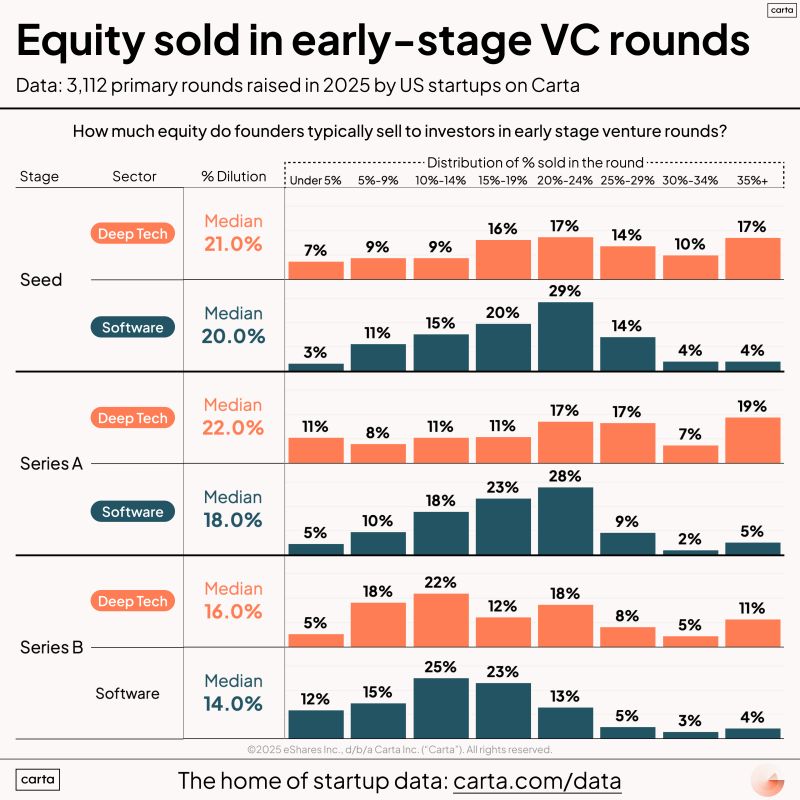
This graph shows what % of startups in the sample sell what proportion of their equity in each round.
For example, in 2025, 10% of deep tech startups sold between 30-34% of their equity at Seed.
Source: Carta
If data is hard to find, Michael Kim’s heuristic on fund size vs. ownership % is a useful starting point.
Cendana reviewed its dataset and identified a rough pattern.
At seed, the initial ownership target lands around 10% of the fund size. In practical terms, that means 1% ownership for every $10m of fund size. If you run an $80m seed fund, the heuristic suggests you should target at least 8% initial ownership in your core deals.
For pre-seed, his benchmark is higher: about 20% of fund size, or roughly 2% ownership for every $10m. A $50m pre-seed fund should target around 10% initial ownership.
Kim is clear that this is not a law. It becomes harder to scale linearly as funds increase. A $200m seed fund rarely secures a 20% initial ownership stake without creating adverse selection. At that point, the strategy often shifts through reserves, selective follow-ons, or moving slightly later, which changes both ownership and return dynamics.
Also, the ownership-to-fund-size heuristic does not work well for micro-funds (a $5m pre-seed fund will not win with 1% initial ownership). It’s also heavily geared toward Silicon Valley valuations.
The rule of thumb is useful as a sanity check because it highlights when a model assumes an unusually high level of ownership relative to the capital deployed. It should not replace real valuation data from your stage, geography, and sector.
Watch this excellent interview for more details on Cendana’s approach to VC portfolio construction.
5. Dilution From Entry To Exit
We are now reaching the final layer of assumptions. The objective remains unchanged: to answer the core question: “Given your portfolio construction assumptions, what exit valuation must your single biggest winner achieve for the fund to reach its return target?“
At this stage, we know how much capital goes in: the Initial Check Capital, computed automatically by the VC Portfolio Construction Matrix (detailed below). The remaining variable is how much comes out, which depends on your ownership at exit.
Dilution from entry to exit depends on your investment strategy (all things being equal, as economists like to say):
- Your investment stage: the earlier you take a stake, the more diluted your position
- Your sector’s capital intensity: the more money is raised before the startup can get to exit, the more diluted your position
- The vertical’s “hotness”: dilution is a function of money raised and valuation. Frothy markets with high valuations limit dilution
- Other factors such as geography, option pools, etc.
The most impactful elements on your position’s dilution from entry to exit are, by far, how many reserves you hold and how you allocate them (see the discussion on token pro rata vs super pro rata above).
A useful way to think about dilution is to separate “passive dilution” from “defended dilution.” Passive dilution is what happens if you never follow on. Defended dilution is what happens when you selectively spend reserves to maintain ownership in the few companies that earn it.
Your fund-level dilution assumption should live somewhere between those two, because you cannot defend everything and you cannot predict winners with certainty.
One of the most common mistakes I see new “emerging VC managers” make is that they don’t sufficiently reserve for follow-on investments.
FreD Wilson – Union Square Ventures
Many first-time fund managers struggle to set aside sufficient capital to maintain their ownership.
Let’s take a simple numerical example.
How Many Reserves Do You Need To Maintain Ownership?
Our main assumptions are:
- You’re deploying a $40 million fund and operating with 50% reserves
- The fund’s average ticket is $800,000 for a 10% ownership at pre-seed ($8 million post-money valuation)
- The fund exits after three rounds (at Series B)
- Each round has a 2x mark-up, i.e., the post-money valuation of the current round is twice the post-money valuation of the last one
Question: How much in reserves do you need to keep your pro-rata ownership?
First, you must consider that:
- Round size (new money raised) = % sold × post-money valuation (I use the Carta data above for the median software category)
- Your pro-rata check = your ownership × round size (here, the objective is to maintain 10% ownership)
The table below shows the calculation.
| Round | Post-money valuation | % sold to new investors | New money raised | Your pro-rata check (to stay at 10%) |
|---|---|---|---|---|
| Seed | $16m | 20% | $3.2m | $0.32m |
| Series A | $32m | 20% | $6.4m | $0.64m |
| Series B | $64m | 15% | $9.6m | $0.96m |
Total follow-on capital needed: $0.32m + $0.64m + $0.96m = $1.92m
Total invested (incl. pre-seed round): $0.80m + $1.92m = $2.72m (c. 7% of the fund)
To maintain ownership, the fund must have reserved 2.4x its initial check capital. Few funds, and even fewer emerging funds, have a 2-to-1 to 3-to-1 follow-on-to-first-money ratio (theoretically, a 2.4-to-1 ratio across an entire fund would mean a 71% reserves ratio; but in practice, only a small portion of a portfolio gets to an exit. For instance, Series A graduation is hard).
At the other extreme, if you don’t follow pro rata, your stake would dilute to:
10% × 0.8 × 0.8 × 0.85 = 5.44% at exit (46% dilution from entry to exit). This aligns with the rule of thumb that the average dilution to exit for early-stage VC firms is about 40%-50%.
However, since you never know ex ante which companies will become fund winners, you cannot expect to systematically take your pro-rata share in every portfolio company that raises subsequent rounds.
Reserves are deployed selectively and imperfectly, based on incomplete information and evolving conviction. As a result, even with meaningful reserves, you should still assume some dilution from entry to exit at the fund level rather than modeling full pro-rata defense across the board.
6. Target Fund MOIC
Target Multiple Over Invested Capital (MOIC) defines the return objective you aim to deliver and, by extension, the risk you are asking LPs to take. This number is stage-dependent. LPs do not underwrite pre-seed funds the same way they underwrite Series A funds.
A target that is too low makes the strategy unattractive. A target that is too high can force the VC portfolio construction into unrealistic exit requirements.
As with other assumptions used in the VC Portfolio Construction Matrix, you must anchor your target in market data. LPs have both public and private data from their portfolios, so you’re at a disadvantage. You must reduce information asymmetry as much as possible.
What MOIC should you target, then?
Median is bad in VC. Average is bad. Even above average is sometimes not good enough.
Peter Walker – Carta (read more here)
In Venture Capital, 3x gross has become a shorthand for top-tier fund performance. Yet the uncomfortable truth for Emerging GPs is that few actually reach that threshold.
A serious target has two requirements. It must be ambitious enough to justify the risk LPs take on an unproven manager. It must also be consistent with the market you are underwriting: your stage, geography, exit environment, and ownership you can realistically hold.
You can dive into the data in this article on Venture Capital returns to refine your target.
The VC Portfolio Construction Matrix helps you test your return assumptions. Pick a target MOIC, then let the model compute the required winner outcome and pressure-test it against reality.
If the implied fund winner exit looks like an edge case in your market, your target MOIC is not wrong, but it is unsupported. At that point, you either adjust the target, or you redesign the rest of the VC portfolio construction until the numbers and the story finally match.
At this stage in the VC Portfolio Construction Matrix, all the structural inputs have been defined, and the middle-layer assumptions have been automatically calculated:
Initial Check Capital. It’s derived from fund size and reserves ratio. For simplicity, I assume that management fees were recycled. I have another model accounting for this assumption more precisely, but I want to test it further first
Average Initial Ticket. The VC Portfolio Construction Matrix assumes that you invest the same amount in all your portfolio companies. The reality may be different, but again, I simplify here to present the overall logic of my approach
Ownership at exit. Applies the overall dilution to the entry ownership. Simple enough.
We now get to the heart of the matter: the exit value required for the highest-performing startup in the portfolio, the fund winner. The underlying principle is that the power law is a feature, not a bug, of Venture Capital. If you’re unconvinced, review the six comprehensive datasets I present in my article on the VC power law.
The power law is real.
Mike Maples Jr. – Floodgate
The Matrix now needs one last input: what percentage of your Target Fund MOIC will the fund winner generate?
I use Mike Maples Jr.’s guidance, shared in a recent 20VC interview (see the video below).
Maples is making a very specific, quantitative argument about why one deal must dominate a venture fund’s performance, and why fund size mechanically determines the outcomes you must pursue.
His starting point is the power law, of which the Pareto distribution is a specific mathematical form. Maples says that it is a continuous curve. If 20% of inputs generate 80% of outputs, then the top 20% of the top 20%, or 4% of your portfolio, generate 64% of its total returns (because 0.8 × 0.8 = 0.64).
Translated into fund terms: in a reasonably sized VC portfolio (say ~25 companies, so 4% = 1 company), the single best investment is expected to generate ~64% of total fund returns.
That has a brutal implication. If you target a 5× fund, that one company alone must return about 3.2× the entire fund to LPs (64% of 5×). The rest of the portfolio makes up the difference, given that loss ratios in Venture Capital are 50%.
This is the core of Maples’s argument that fund size is strategy.
Fund size sets the absolute dollar hurdle that your fund winner must clear. A larger fund raises the bar mechanically: it forces you to believe that at least one company in your portfolio can plausibly exit at a scale large enough — given your expected ownership at exit — to carry most of the fund.
If the fund size is too high relative to the companies you invest in, the stages you enter, or the ownership you can realistically hold, then the fund is structurally misaligned. You may execute well and still fail to achieve your target MOIC.
In the Matrix, compute how much the winner must contribute to the fund. The default is 64%, but you may use a different assumption if you can justify it.
The VC Portfolio Construction Matrix then computes the output you need to translate from fund-level ambition to company-level requirement. It takes the target you’re selling to LPs and turns it into one concrete constraint for VC portfolio construction: what your single best company must achieve.
Fund Winner Contribution (MOIC). This line converts your target fund MOIC into the share carried by the fund winner. In the example shown, a 3.0x target and a 64% winner share imply the fund winner must contribute about 1.9x of the entire fund.
Fund Winner Proceeds. This line converts the multiple into a dollar amount by applying it to the fund size. With a $40m fund, a 1.9x winner contribution means the fund winner must return roughly $76.8m back to the fund (before carry).
Required Fund Winner Exit Value. The VC Portfolio Construction Matrix takes the $76.8m requirement and asks: given your expected ownership at exit, what exit valuation is needed to generate that cash return? With 7.5% ownership at exit, the required exit value lands around $1.0bn.
We now have the answer we were looking for. Given all the key assumptions behind your portfolio construction, you need at least one billion-dollar exit (called, in the jargon, a “minotaur”) to have a chance of making the target MOIC promised to LPs.
The last step is to compare the likelihood of this happening to the market you’re targeting. If you can find no or very few minotaurs within the scope of your investment strategy, you won’t be able to convince LPs to invest in your fund.
In short: If your strategy cannot credibly produce such a deal, the problem is construction, not selection.
Conclusion: tl;dr
The VC Portfolio Construction Matrix is the one-page input/output of the key assumptions behind VC portfolio construction (fund size, reserves, number of deals, ownership, dilution, target MOIC, and fund winner contribution share).
Its purpose is to translate those high-level choices into one concrete requirement: What exit value must the single top winner (“fund winner”) reach for the fund to hit its return target?
Based on all the assumptions detailed above, the Matrix computes the exit value required by your fund winner to make your fund model work. Real data on your stage, geography, sector, etc., must justify that number.
For example, if you need a $1 billion exit for the fund winner to reach your target return, but there have been only three such exits in your geography x stage x sector in the last 10 years, you must be prepared to explain why you feel so confident.
When the required winner exit looks unrealistic, the answer is to redesign your assumptions, starting with the fund size and market focus, until the construction becomes coherent and credible.