Emerging VCs: Selection Through Mindset (Report)

Investors in Venture Capital funds are presented with a dilemma: top-decile performers capture most of the asset class’s alpha, yet it’s quasi-impossible to get access to established funds with stellar track records. Many turn to “younger” firms, called Emerging VCs, with various fates. The “super power law” is even more entrenched in this category, where very few players generate outlier returns—even outperforming established funds. The critical skill LPs in Emerging VCs must master is selecting the future top dogs successfully.
I propose that traditional selection methods should be supplemented with Mindset-Based Investing principles, built on rigorous research in Venture Capital and psychology. We, as LPs in Emerging VC funds, need a practical approach to identify rare future outperformers when traditional metrics arrive too late.
TVF Insights is my new series of evidence-based reports for Venture Capital. Each report follows a clear standard, synthesizing credible data, LP/GP interviews, and case studies into practical tools. The aim is simple: give LPs sharper selection lenses and help GPs make their edge legible.
We start our series with this first report on Emerging VCs, which was presented to a select group of LPs & GPs in Austin, TX on October 17th, 2025.

Click below to access the report.
This report is in regularly updated with new content (interviews with top LPs, GPs, and ecosystem leaders).
Note: Email verification required. Please do not use from an incognito window.

Thank you to our sponsor!
This report is sponsored by Juniper Square, the fund operations partner to 2,000+ private markets GPs worldwide. Juniper Square’s unified platform connects software, data, and fund administration services to help firms scale faster, streamline operations, and enhance the investor experience. Learn more
Get your message to our leading community of Venture Capitalists & Founders worldwide. As a partner, you also support our groundbreaking research in Mindset-Based Investing. To view our exciting sponsorship opportunities, click here
Who Are Emerging Venture Capitalists?
Traditionally, “Emerging VC” designates a Venture Capitalist deploying their first, second, third, or fourth Venture Capital fund.
It may come as a surprise to outsiders that someone who has been a General Partner (GP) for over a decade is still considered emerging. The cause lies in the lengthy cycle time required to determine how a VC fund performs.
Early-stage VC funds that invest in pre-seed to Series A funding rounds take close to a decade to liquidate all their positions. DPI takes years to materialize, especially in the best-performing funds.
The saying in Venture Capital is that when you commit to one fund from a new manager, you must be ready to invest in two. By the time Limited Partners (LPs) must decide to invest in Fund II, few “markups”—a lift-up in valuation due to a subsequent funding round—and fewer exits have occurred to indicate Fund I’s performance.
Most LPs are not ready to take the leap of faith.
The Emerging VC Conundrum
Life is hard for Emerging VCs.
Most institutional LPs do not make commitments before Fund IV due to the lack of investment track record. The situation is akin to that of untested startup Founders raising their pre-seed or seed rounds: Emerging VCs meet dozens, sometimes hundreds of potential financiers to close their fund. It takes years. Most give up.
Yet, the best first- and second-time Venture Capital funds have historically outperformed established VC managers. They are often “hungrier” and exploit a market opportunity with a unique investment thesis.
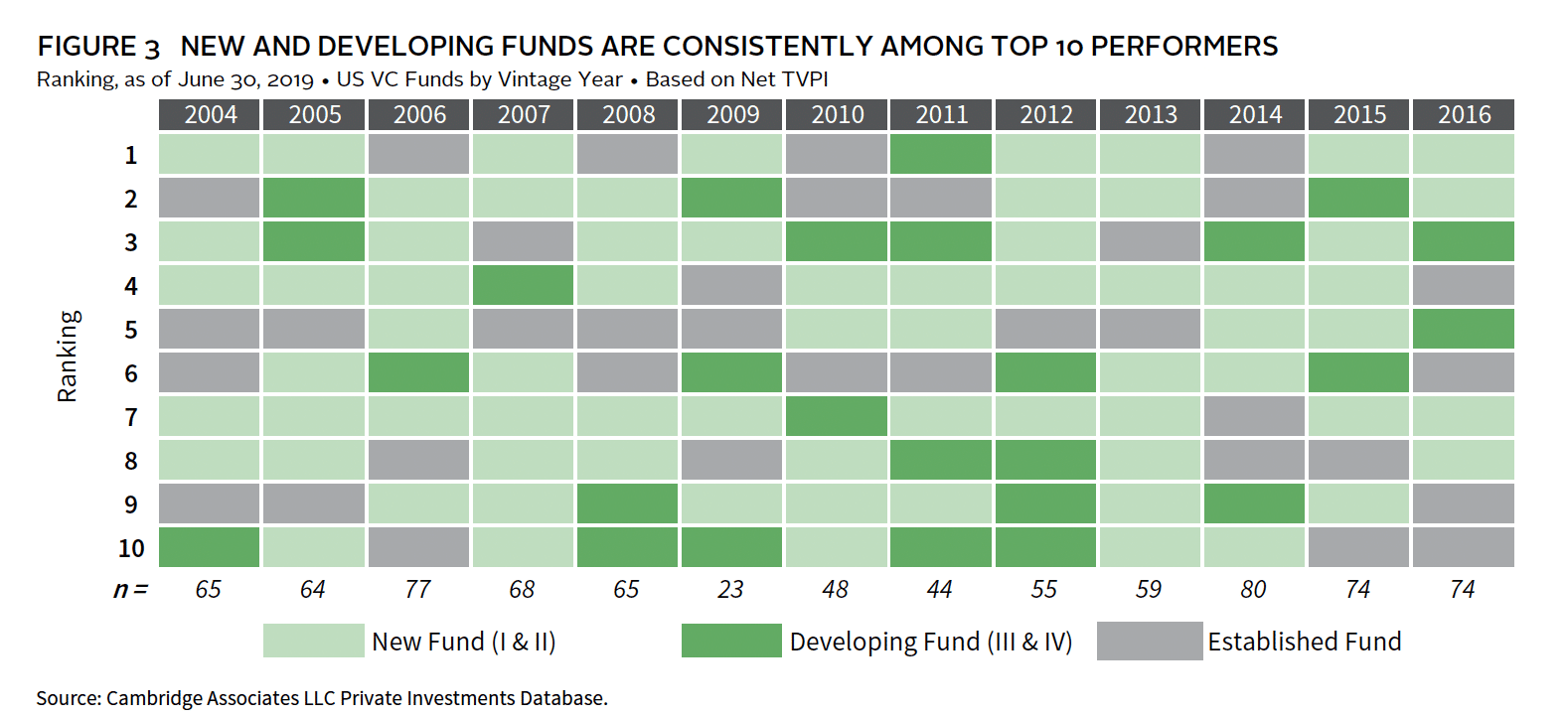
This analysis by Cambridge Associates, reputed to have one of the most reliable datasets on Venture, looks at the top 10 VC funds by vintage over 2004-2016. The data is telling: on average, over half of the top 10 performers are new funds (Fund I’s & II’s); three-quarters are emerging funds.
Investing in Emerging VCs is therefore paramount to capture alpha in the asset class.
However, there is a catch: returns are highly volatile. While the top Emerging VCs generate outlier outcomes, most funds in the category produce meh returns.
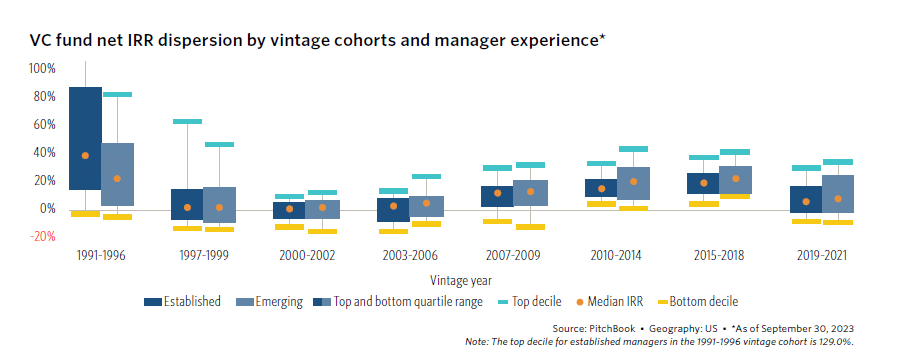
Let’s focus on the difference between the blue line and the orange dot, which illustrates the variance in IRR performance between the top 10% and the median funds. If we take a similar period to the previous table (2003-2014 vintage cohorts), it becomes clear that only the top-decile performers offer a suitable risk/return profile to LPs.
Making less than 20% net IRR on a recent fund seems low given the onboarded risk.
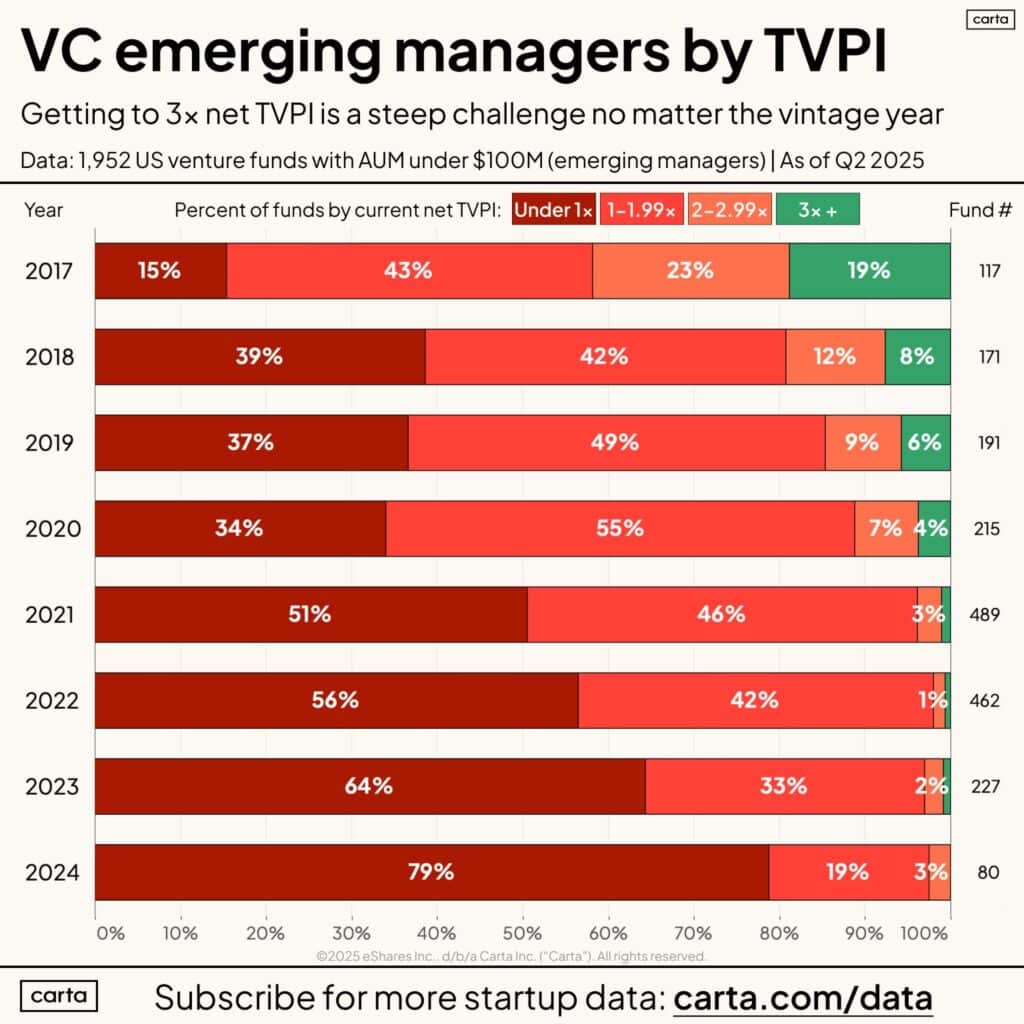
Carta showed that few Emerging funds make it to the 3x threshold traditionally considered in VC as top-tier fund performance. I urge exercising caution, as:
- These are TVPIs, which can be grossly inflated, especially by recent fund managers who must show traction
- I showed in another post that the 2017 vintage benefitted from the extraordinary 2020-2021 exit window
- Recent funds are still in the J-curve
However, the data directionally confirms the point on dispersion.
Even more than for established managers, the key to success in investing in Emerging VCs is selection. Being able to determine the rare future category winners is where money is made.
It is the Emerging VC Conundrum: LPs may generate outstanding potential returns by investing in first-time and second-time funds, but these funds come with significantly higher volatility and uncertainty – making the selection process both crucial and challenging.
LPs must therefore identify rare future outperformers without relying on traditional metrics, as these managers often lack a proven track record or immediate measurable results.
A New Approach To Selecting Emerging VCs
I propose a new approach called Mindset-Based Investing: Evaluating how VC-compatible a manager’s mindset is before deciding to invest in their funds.
Traditional selection criteria, such as track record and pedigree, frequently fail LPs – particularly with Emerging managers who lack measurable histories. To be clear, I do not dispute that technical criteria (unique investment thesis, unfair sourcing advantage, and thought-out portfolio construction) matter. However, they are not enough.
My research suggests that repeated outlier venture outcomes depend primarily on a VC manager’s mindset. Winning characteristics include comfort with uncertainty, limited loss aversion, the ability to think contrarian and swing big.
In short, they “play to win, not to not lose,” the title of a fascinating article co-authored by E. Tory Higgins, a renowned psychologist at Columbia. I believe that Higgins’s Regulatory Focus Theory, first proposed in 1997, is a powerful lens to understand outlier performance in entrepreneurship and Venture Capital.
Over the years, I have built a large corpus of empirical evidence based on testimonials and interviews with elite Venture Capitalists, including Arthur Rock, Peter Thiel, Brad Feld, Fred Wilson, Doug Leone, Bill Gurley, John Doerr, Masayoshi Son, Mike Moritz, and Vinod Khosla, among others.
“I don’t mind a 90% probability of failure if there’s a 10% chance of changing the world.” – Vinod Khosla
Source: Bloomberg Wealth
This quote perfectly encapsulates what Higgins calls a “promotion focus” (playing to win).
I have applied this theory, linked to my research on the most prevalent cognitive biases in Venture Capital, to train dozens of VCs and hundreds of Aspiring VCs worldwide. It has helped them make better investment decisions in startups.
I am now expanding it to the “level above,” helping LPs make informed decisions when evaluating Emerging GPs.
Why Now?
Downcycles are the best time to underwrite Fund I–II — if you can tell who survives.
Investment in Emerging GPs has plummeted since the 2022 market reset, making this one of the most demanding environments in decades for raising a first or second VC fund.
A general “flight to quality” favouring established brand names has severely restricted capital flows into Emerging funds.
Recent data show a sharp decline in both the number of closings and total capital committed to first- and second-time funds, accompanied by a concentration of LP commitments in large, brand-name VCs.
In 2018-2020, fundraising for new funds was so much easier. People were “risk on,”, and now they’re “risk off.”
Beezer Clarkson – Sapphire Partners (source:
Beezer Clarkson, a leading LP in Emerging VCs at Sapphire Partners, recently discussed this trend, mentioning the rise of spinouts—Emerging GPs with prior experience at a VC firm.
In a risk-off market, LPs favor spinouts because they signal real training on established platforms (cap tables, term sheets, reserves discipline) and come with warm LP relationships, lowering diligence risk and fundraising friction.
LPs don’t want managers “learning on their dime,” so standing-start GPs hit a brick wall—many try, few close. The result is a lot of fundraising activity, but closures are concentrating on experienced spinouts, while unknowns stall.
My recent experience confirms her assessment: since mid-2023, most LPs I have spoken with have declared that they are no longer looking at Emerging managers. Those who do favor spinouts for Tier 1 firms, as I recently reported.
Yet, the experienced LPs who still commit to Emerging VCs do so precisely because downcycles filter out weaker GPs and surface resilient, resourceful ones.
Indeed, despite current market pessimism, opportunities remain attractive. Veteran LPs know that downturns create fertile ground for exceptional opportunities. Just as Darwinian selection favours the most adaptable and robust organisms, tough cycles reveal the managers who can survive and thrive.
It is time to focus on the “venture” side of Venture Capital, not (preserving) capital. Crises are a turning point, an opportunity to try new approaches.
What This Report on Emerging VCs Is About
We aim to show how current LP evaluation methods can significantly benefit from incorporating a structured analysis of the mindset dimension.
Most reports about Emerging VCs focus on raw statistics or industry-standard best practices. These resources are undoubtedly valuable, but they fall short of capturing the nuanced human factors that truly differentiate exceptional VC fund managers from the pack.
This report takes a different approach.
We synthesize data from multiple authoritative sources to quantify the performance variance and pinpoint the genuine upside of Emerging VCs. But numbers alone don’t tell the full story, especially in an industry shaped so profoundly by individual judgment and conviction.
We’ve combined rigorous data analysis with qualitative insights from candid, in-depth interviews with elite LPs who regularly invest in first- and second-time fund managers. These interviews offer a rare peek behind the curtain, revealing how experienced LPs assess the critical yet intangible aspects of a fund manager’s mindset and strategy.
Additionally, you’ll find perspectives from Emerging GPs, those who have recently navigated, or are currently navigating, the challenge of raising their first institutional funds. These firsthand accounts, presented as focused case studies, explore how successful new fund managers apply their unique mental frameworks to seize market opportunities and manage risk.
By juxtaposing quantitative evidence with qualitative insights, this report builds a distinct and practical framework for what I call Mindset-Based Investing. The approach acknowledges that exceptional outcomes in Venture Capital emerge not just from analyzing market dynamics or portfolio construction mechanics—though those elements are crucial—but from a GP’s fundamental approach to risk, opportunity spotting, and most of all how they deal with common cognitive biases in decision-making under uncertainty.
This report provides both LPs and emerging GPs a fresh lens to identify and foster future outperformers, going beyond traditional methods and placing mindset at the heart of the selection and development process.
Fill out this form to know how you can gain visibility from the report and contribute to this endeavor.