Emotional Intelligence Is A Board Meeting Skill. Here’s How To Use It

One of the hardest parts of Venture Capital is navigating bad news. Over the years, I’ve seen some Founders handle those moments with clarity and composure. I’ve seen others spiral and lose legitimacy, even their job. The same applies to Venture Capitalists: some become allies in the face of bad news, while others let their anxiety take over and turn into foes. The Board meeting becomes a battlefield. That’s where psychology can offer help. In particular, a framework rarely applied in Venture Capital, based on emotional intelligence.
Most people know the phrase. Fewer understand what it means. Almost no one connects it to Board dynamics. But it turns out the Four-Branch Model of Emotional Intelligence (EI)—developed by Peter Salovey and John Mayer in the 1990s—can help Founders and VCs show up more effectively in high-stakes discussions. It’s also one of the hidden traits LPs should watch for in top-performing VC managers.
In this article, I apply the intelligence framework to Board dynamics and show how it can revolutionize Founder-VC relationships to foster efficient decision-making. This perspective is part of a broader approach I’ve come to call mindset-based investing: the idea that success in Venture Capital—at any level: Founder, GP, LP—lies not in the technical stuff but inside our minds.
In This Article
Emotional Intelligence: A Mental Model for High-Stakes Decision-Making
Peter Salovey and John Mayer, now leading researchers in psychology, introduced the concept of Emotional Intelligence (EI) in 1990. Their endeavor was part of a centuries-old quest to define intelligence, following illustrious figures like Descartes and Thorndike.
At the time, it was a fringe idea. Most people still thought emotions got in the way of thinking. Salovey and Mayer believed they were part of it.
Emotional intelligence, they argued, is about recognizing emotions in ourselves and others, making sense of them, and using that insight to guide decisions.
Mayer and Salovey later formalized the concept into a four-part model now widely used in psychology research, called the Four-Branch Model of EI. The model has evolved over time, but this version still holds. Here are the four branches:
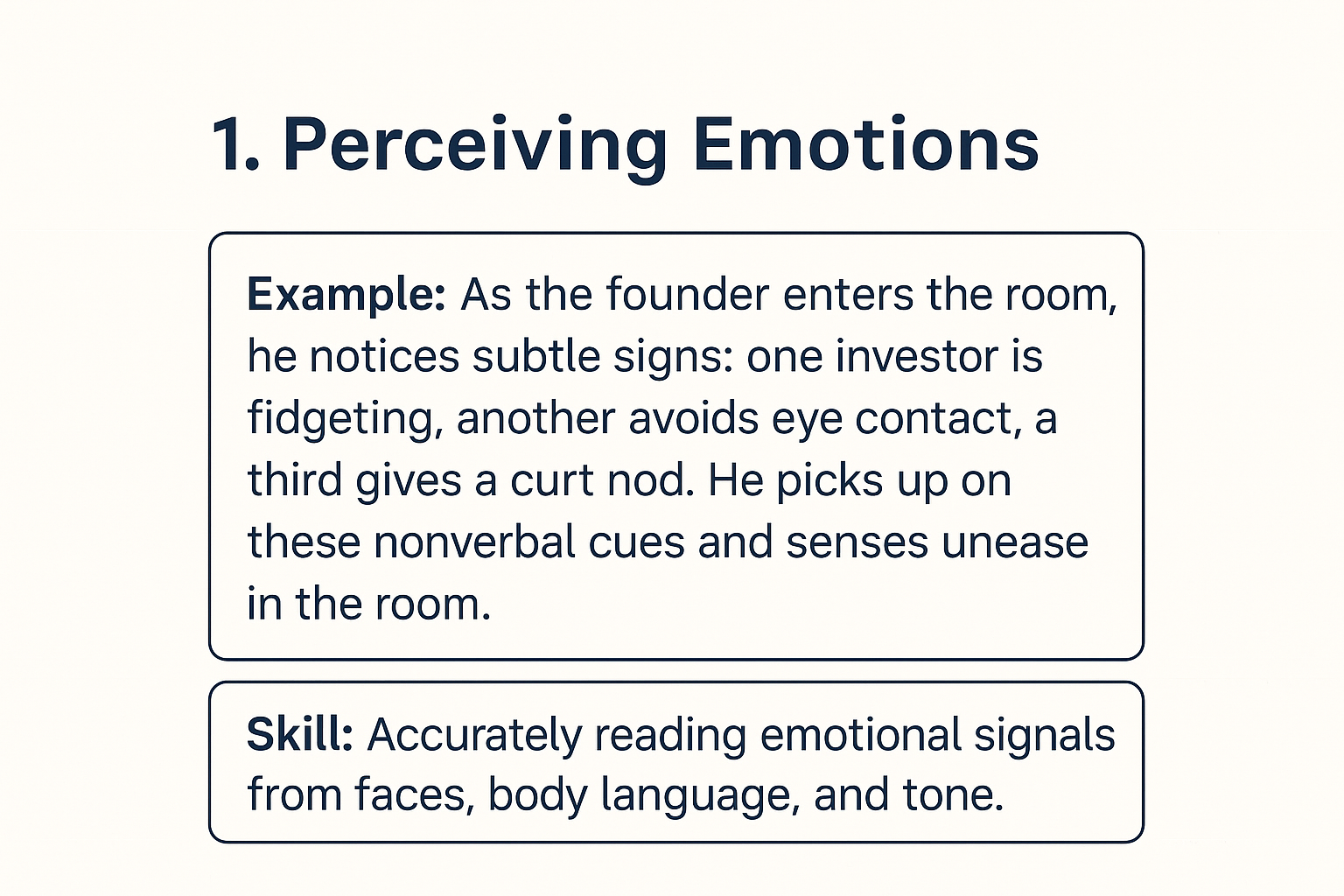
Perceiving emotions means being able to read what someone else is feeling, even when they’re not saying it. Think of noticing a friend fidgeting during dinner, avoiding eye contact, or suddenly going quiet. Nothing’s been said, but the signal is clear: something’s wrong.
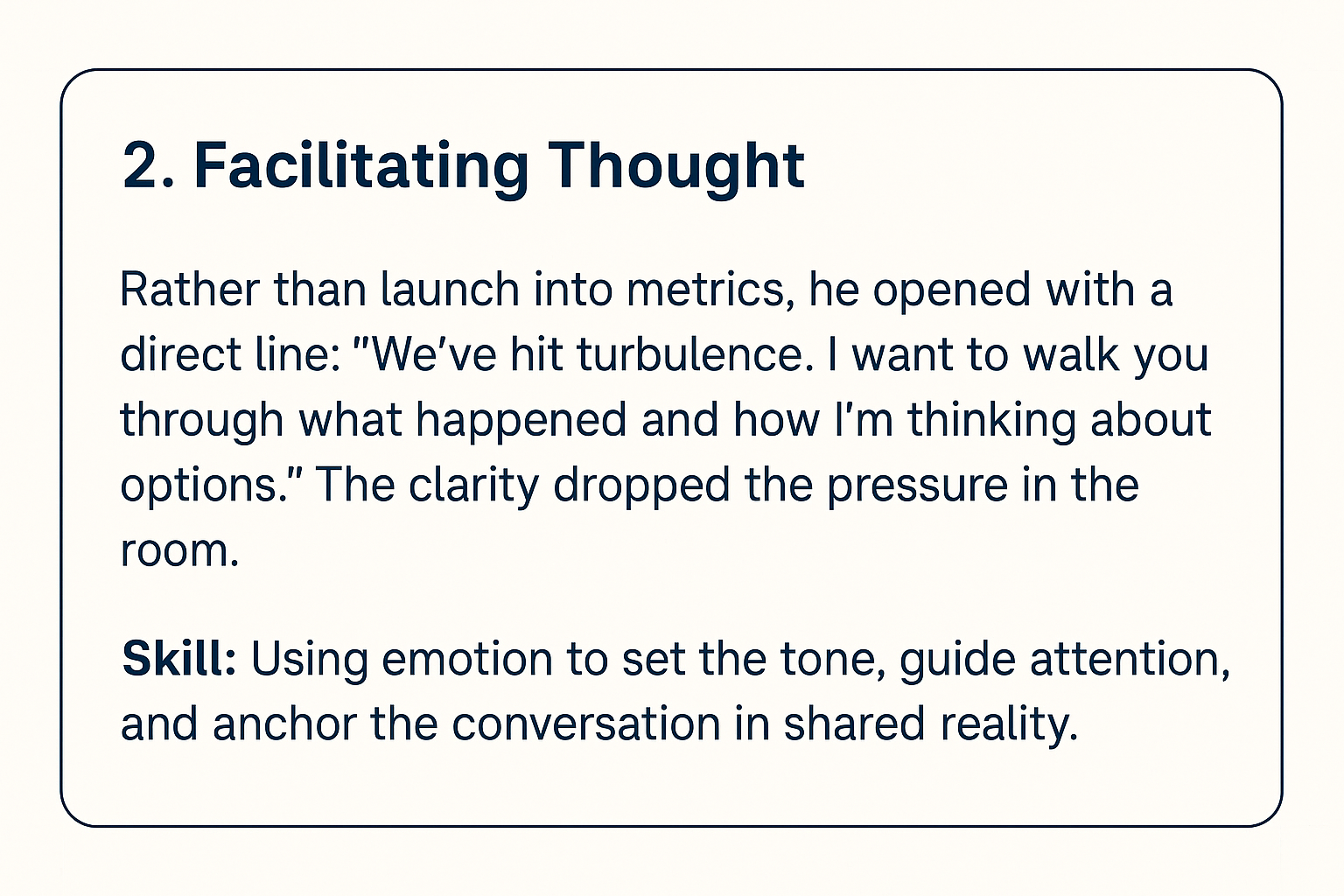
Facilitating thought using emotions is about letting those signals shape how you prioritize or communicate. If you sense someone’s anxious, maybe you slow down, ask different questions, or shift the tone of the conversation. It requires being attuned enough to steer the conversation forward.
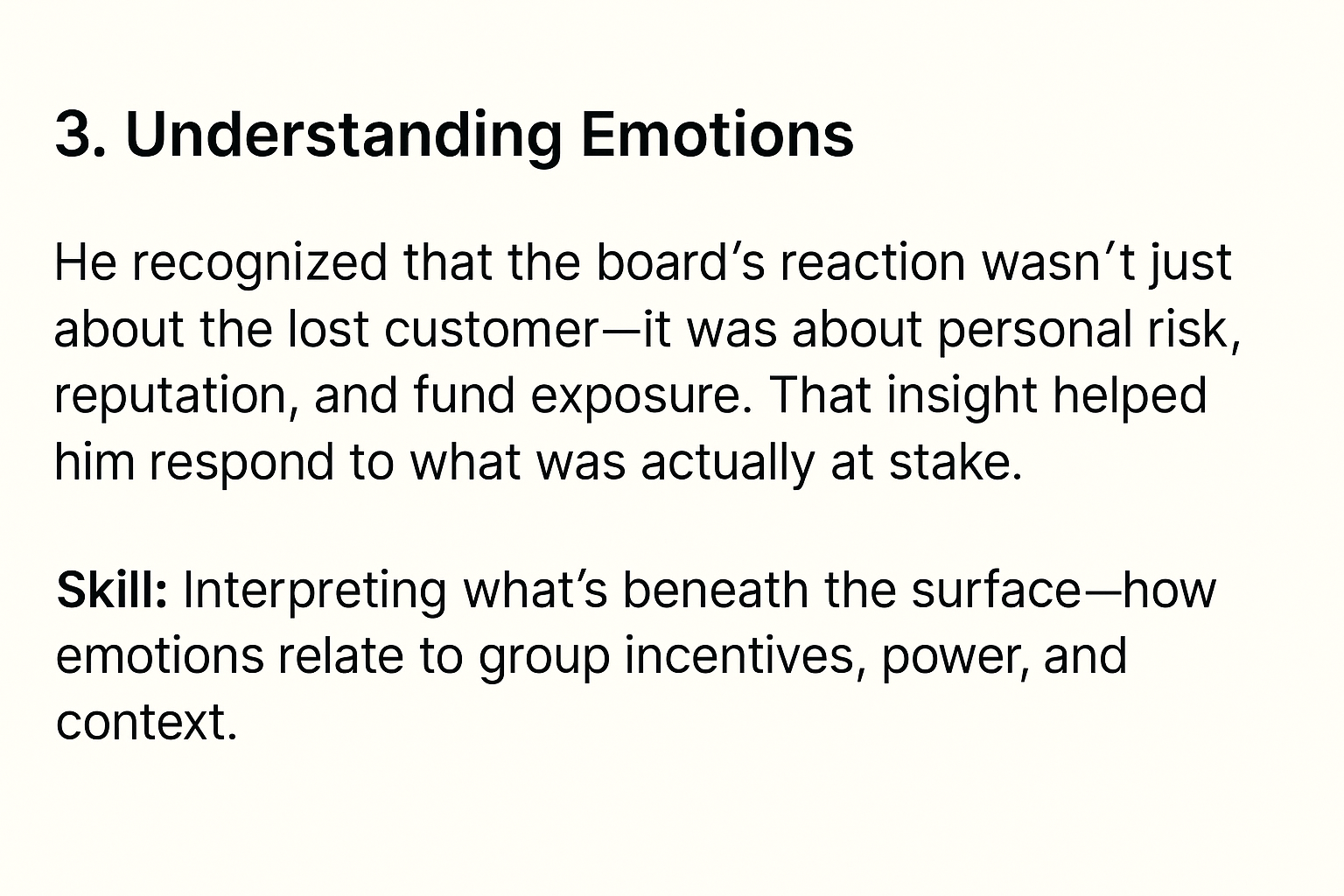
Understanding emotions is the ability to recognize where a feeling is coming from, and how it might change. A partner isn’t annoyed because of what you just said, they’re often carrying stress from earlier. You can trace the emotion back to its source, and anticipate how it might play out.
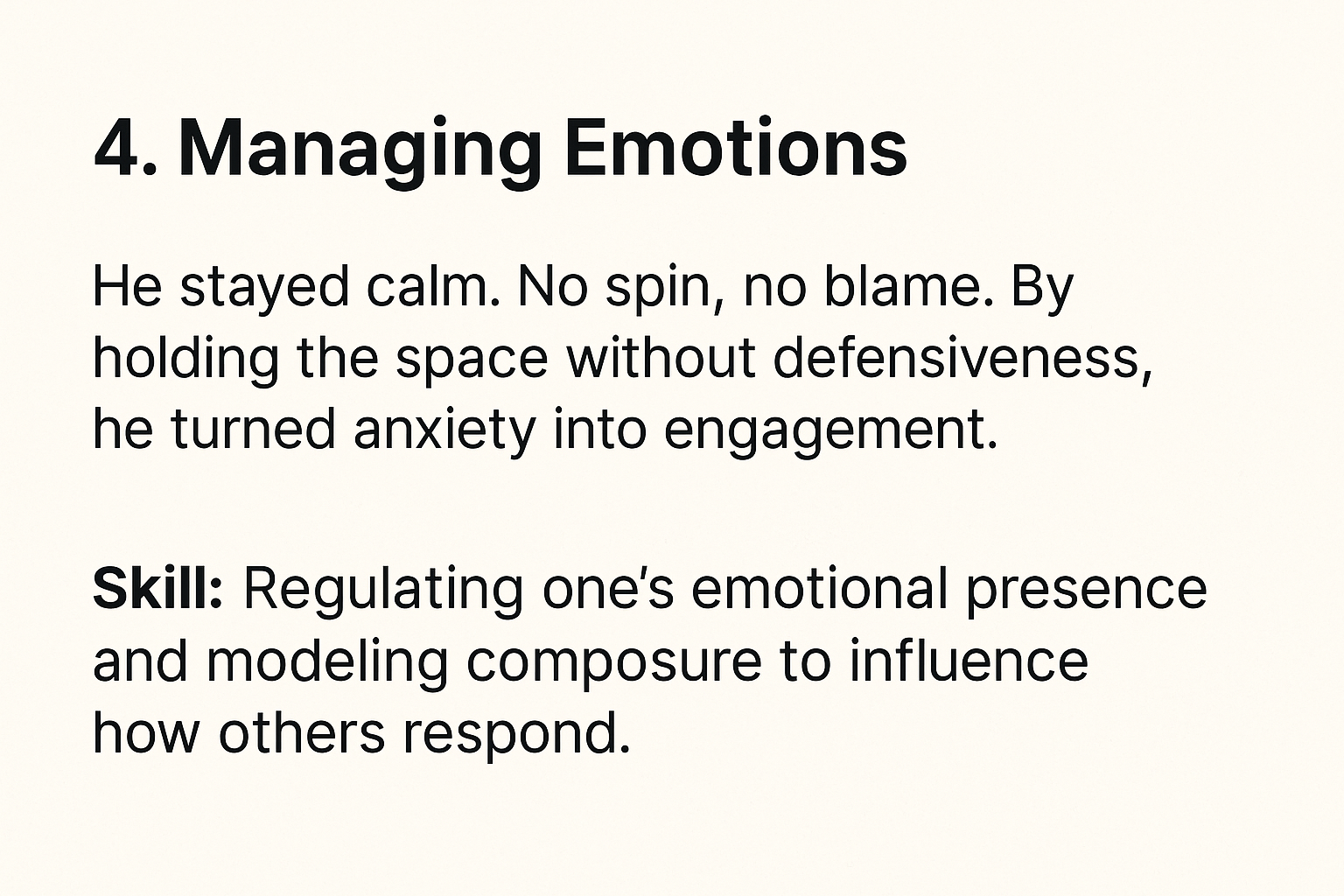
Managing emotions is what most people associate with emotional intelligence, but it only works if the other parts are in place. It’s the ability to stay grounded when you’re angry, to reassure someone without dismissing their fear, to defuse tension instead of escalating it. Like staying calm when your kid throws a tantrum in a crowded supermarket. (It’s hard.)
Contrary to what many believe, emotional intelligence is not about being nice. The objective is to remain effective in moments when stakes are high and logic alone won’t get you through. EI heavily relies on being in tune with one’s and others’ emotions, also called empathy.
Empathy, the ability to comprehend another’s feelings and to re-experience them oneself, may be a central characteristic of emotionally intelligent behavior.
Peter salovey & John mayer (source: Imagination, Cognition and Personality, 1990)
In the next section, I walk through two situations I went through as a Board member and use this model to retrospectively show how things unfold when emotions are left unspoken and what it looks like when they’re not.
A Founder’s Guide to Emotional Intelligence: Two Case Studies
I’ve been in more Board meetings than I can count, but a few stay with me—especially the ones where something is breaking and nobody’s sure what to do. (Note: I’ve regrouped different real-life situations into two case studies below for narrative simplicity.)
In one case, the company’s fundraising had stalled. The Founder was a smart guy, deeply committed, but out of his depth. A few months earlier he’d been talking Series A, and now he was facing a cash crunch and wasn’t even sure how to bring it to the Board. When he finally did, the meeting spiraled. Tension rose, people got frustrated, the tone got sharp. He couldn’t answer basic questions or propose a course of action. The more he flailed, the more directors pulled away. He was fired within weeks, and the company was sold in a fire sale that made no one happy.
What made the difference between these two cases wasn’t IQ, credentials, or charisma. It was how they handled the room. One fought the emotions in the air, while the other worked with them.
In another case, the startup’s largest customer had just signaled they wouldn’t be renewing their contract. The impact on revenue and cash was huge, and the team was already feeling the pressure. The Founder walked into the Board meeting knowing it would be a hard conversation. But he didn’t dodge it. He opened the meeting with a simple line: “We’ve hit turbulence. I want to walk you through what happened and how I’m thinking about options.”
The Founder didn’t posture, over-explain, or place blame on others. He named the issue directly, acknowledged how it might look, and gave us enough context to understand the situation before we jumped in. You could feel the temperature in the room drop. Tension didn’t disappear, but it settled into something usable. Board directors stopped performing and started listening.
The Founder understood that the reactions in the room weren’t just about the customer, but about the VCs’ perception of risk, exposure, and their personal reputation within their firm. He managed the moment without defensiveness, which bought him legitimacy.
We kept backing him, and the company survived. As I explained in my article on bridge financing, a large part of the decision to stretch funding is psychological.
Here’s the same dynamic broken down along the four branches of the Emotional Intelligence model described above.
Board Directors Should Use Emotional Intelligence, Too
The EI model doesn’t apply only to Founders. Most VCs would benefit from employing it to foster smoother relationships with their portfolio companies. Let’s use real-life case studies to illustrate. I could have drawn examples from my own experience, but I’ve used a better data set for years to train VCs.
In 2019, Ryan Caldbeck—then CEO of CircleUp—shared a now widely circulated tweet thread recounting some of the most difficult Board experiences he’d had as a Founder. The thread stood out for its honesty. He told ten stories about how VCs showed up in moments of tension, and how much their posture impacted him as the Founder. For anyone who’s sat on both sides of the table, the stories are painfully familiar.
Case Study #1: The Cold Shoulder
“I’m not your friend, Ryan.”
That’s what a Board member told Caldbeck during a vulnerable moment. He was struggling, and instead of empathy, he got distance. No context, no follow-up—just a line that shut the door. Caldbeck said it came across as cold and needlessly cruel. He never spoke to that person 1-on-1 again. The Board member lost all influence from that point forward.

What went wrong: The comment may have been intended to set boundaries, but it overlooked the emotional weight of the moment. Instead of anchoring the conversation, it fractured the relationship.
With emotional intelligence: A more self-aware Board member might have said, “This is tough—I hear that. Let’s work through the business side first, and we’ll figure out what support you need from us.” That’s not becoming someone’s friend, but managing the moment with clarity and care. Acknowledging emotion doesn’t derail the meeting or make the Investor the Founder’s friend.
Analyzing the response through the Four-Branch Model of EI:
- Perceiving emotions: The Board director recognizes that the Founder is under stress and vulnerable, even if it’s not spelled out.
- Facilitating Thought: The VC uses that emotional signal to open the conversation not with coldness, but with acknowledgment.
- Understanding Emotions: They recognize that dismissing the Founder could backfire, as the emotional moment is closely tied to trust and legitimacy.
- Managing Emotions: They stay composed and constructive, redirecting the conversation without shutting the Founder down. Clarity without cruelty.
Case Study #2: The Broken Record
“You guys have never worked with a good consumer company.”
The Board member was wrong. However, the repetition (he said it five times in ten minutes), the tone, and the public nature of the comment hit hard. Caldbeck said he could barely breathe. He paused the meeting—something he’d never done before. Later, he said it felt deeply personal, and the Board member was removed.
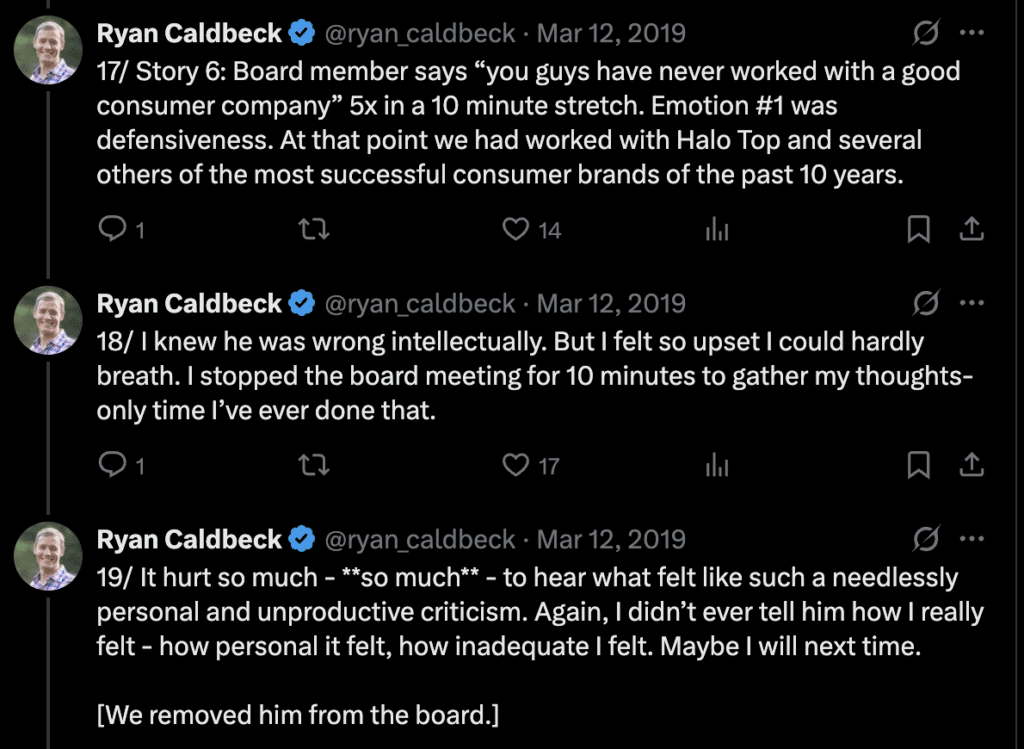
What went wrong: The VC may have been trying to push for higher standards, but he weaponized feedback. He missed the emotional tone.
With emotional intelligence: A better approach could have started with: “I want to push us on what great looks like in consumer. Can we reflect on where we’ve succeeded, and where we might have blind spots?” Same challenge, but now within a collaborative framework. Additionally, it would have provided Ryan Caldbeck with an opportunity to explain how the company performed in that regard.
Analyzing the response through the Four-Branch Model of EI:
- Perceiving Emotions: The VC would first need to recognize that the Founder is already under pressure and that repeating a critical statement publicly is likely to escalate the tension. Instead of pushing harder, they read the room and hold back.
- Facilitating Thought: The Board director uses that emotional awareness to reframe their critique in a way that promotes dialogue. The revised statement turns emotional tension into a tool: “Let’s reflect,” instead of “You failed.” That shifts the mood from defensive to collaborative.
- Understanding Emotions: They recognize that a Founder in that moment may interpret repetitive, pointed comments as personal attacks, rather than strategic feedback. By understanding that dynamic, they can adjust tone and delivery.
- Managing Emotions: The VC regulates their own impulse to press the point, and instead introduces the same challenge in a way that opens space for productive discussion.
Using emotional intelligence, the Board member would have kept his role in a highly successful company.
Case Study #3: The Derail
The Board member offers UI/UX feedback without any expertise on the matter, probably projecting their own tastes. It’s a common mistake VCs make, known as projection bias, which I detailed in this article about the infamous Juicero fiasco.
When the director gave detailed, unsolicited feedback during a Board meeting, Caldbeck appreciated the intent, but the effect was a distraction. The meeting went off track, the agenda was lost, and the comment about user needs wasn’t grounded in reality.
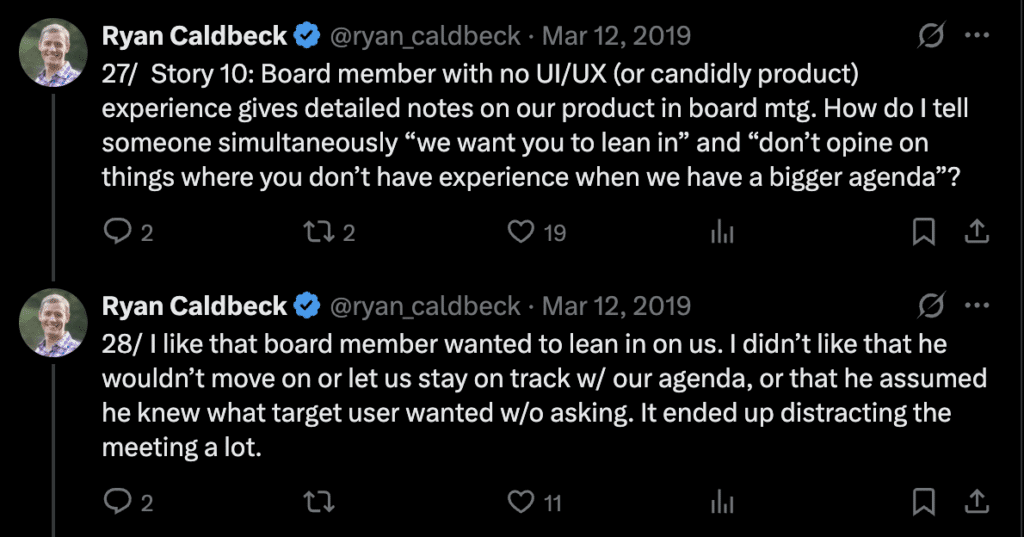
What went wrong: The Board member mistook enthusiasm for insight. He didn’t pick up on the team’s frustration, ignored the meeting’s structure, and assumed authority without understanding the context.
With emotional intelligence: A more attuned board member might have said, “I’m not a product expert, but I’m curious how you’re interpreting recent user feedback. Anything there we should be worried about?” The energy is the same, but the signal is collaborative rather than prescriptive.
Analyzing the response through the Four-Branch Model of EI:
- Perceiving Emotions: The VC would notice subtle cues like the team’s discomfort, the Founder’s attempt to steer the agenda, and the energy drop in the room.
- Facilitating Thought: Instead of bulldozing, they’d use that tension to reframe, asking questions instead of asserting opinions.
- Understanding Emotions: The Board member would recognize that overstepping can feel disrespectful, especially when it contradicts expertise they don’t possess.
- Managing Emotions: They’d hold back, stay constructive, and keep the meeting on track instead of making comments ungrounded in data.
Not every Board member needs to be a product guru (I’m certainly not one!) But there’s a way to get to the bottom of product-driven issues without falsely posing as an expert.
Conclusion: tl;dr
None of the Founders and VCs in these stories failed because they lacked intelligence, experience, or intent. They failed because they misread the moment, and lost their footing in the conversation that mattered most. It’s not a personality flaw but a mindset gap.
Emotional intelligence isn’t a bonus trait. This core skill helps navigate high-stakes decisions, especially in a room where power, fear, and money are all in play. Whether you’re a Founder, a GP, or an LP, how you manage tension in a room says more than any metric.
That’s the heart of mindset-based investing: understanding that while technical skill matters, emotional and situational awareness often determine success in uncertain and pressured environments.