SpaceX IPO: What Insider Stories Reveal About Elon Musk

SpaceX, the rocket company founded by Elon Musk in 2002, went public on June 12, 2026. The SpaceX IPO is the largest in history, generating $75 billion in cash and valuing the company at $2.1 trillion.
The IPO created life-changing wealth for thousands of current and former employees, including factory workers, a group often excluded from meaningful startup equity. It also made Musk the world’s first trillionaire.
Much has already been written about the SpaceX IPO. I chose instead to collect first-person stories that surfaced on social media in the weeks around it. Together, they show how a company that attracted skepticism turned improbable ambitions into reality.
They also offer a unique window into how Elon thinks and works. Whatever your opinion of his politics and antics is, Elon is undeniably one of, if not the most successful entrepreneur of our era. The stories shared from people who worked at SpaceX suggest that much of his success begins with his mindset: how he sees the world and acts on it.
However, SpaceX’s trajectory to its public offering is not a Cinderella story. Current and former employees tell a tale of hardship, ruthlessness, and damage to both mental and physical health. It seems that outlier outcomes are seldom exempt from “pain and suffering,” as Nvidia’s Jensen Huang notably claimed.
In this article, I draw on stories from those who worked with Musk to illustrate his mindset and how he built a company that most closely resembles him: mission-driven, based on first-principles thinking, resilient, and unrelenting.
Mission-Driven
The first thing the SpaceX IPO stories reveal is that the company’s mission, “Make life multiplanetary,” is core to its operations.
The mission makes work that would otherwise seem unreasonable feel necessary. It gives meaning to the long hours, the impossible deadlines, the public failures, the pressure from Elon, and the constant sense that the company might still be one launch away from disaster.
Without a mission people genuinely believe in, that level of sacrifice is hard to sustain. Current employees echo this sentiment. One wrote that “being part of something important, something big” justified long work hours and reduced family time.
It is impossible to put into words the work ethic and mission orientation of the team at SpaceX.
Shaun Maguire – Sequoia Capital (source: X.com)
Shaun Maguire, who led Sequoia’s 2019 investment in SpaceX, wrote that even on IPO day, employees were launching a rocket, holding engineering stand-ups, and welding new superstructures.
[Fun story: Sequoia had the chance to invest in SpaceX in 2011, but the lead partner at the time “got laughed out of the partner meeting.” A reminder that even the best at venture investing are not immune to errors of omission. Don’t be sad for them, though, as Sequoia’s stake after the SpaceX IPO was valued at $20 billion, with billions of dollars of carry coming the partners’ way when they liquidate the position.]
In the wake of the SpaceX IPO, many commentators cited the money Elon made as the main motivator. Yet, research shows that entrepreneurs are primarily driven by meaning.
For Elon, making life multiplanetary seems to be more than a slogan. It appears tied to how he thinks about mortality.
I saw him on stage a few years ago. The interviewer asked why he kept working across so many companies when he was already so rich. Elon replied that he started thinking about death when he was a teenager, and that he couldn’t accept that humanity could disappear one day. He framed his work as an attempt to improve humanity’s odds of survival.
The answer felt genuine. Elon has since publicly discussed his existential crisis.
Built on First Principles
The second thing the SpaceX IPO stories reveal is that Elon doesn’t engage with status quo thinking.
Most people in an industry start with the current way of doing things. They engage in incremental innovation: making things a little cheaper, a little faster, a little better. Elon seems to start with the physics, the cost structure, and the bottleneck. Then he works backward.
One of the smartest VCs I know, Sputnik ATX’s Oksana Malysheva, explained to me why physicists such as Elon Musk tend to think this way. A physicist herself, she pointed out that people trained in physics learn to reduce a complex problem to its underlying variables, separate real constraints from inherited assumptions, and ask which parts of the system can be changed.
First-principles thinking allowed Elon to uncover two crucial insights for SpaceX:
First, making life multiplanetary was a transportation problem, not a settlement one. Before thinking seriously about living on Mars, SpaceX had to make it dramatically cheaper to move people and cargo to the red planet. In Elon’s mind, the first job was not to design a Martian city, but to build the transport system that could make such a city possible.
Second, traditional rockets discard their most expensive hardware after each launch. The booster, engines, and major structures are used once, then lost. SpaceX’s central insight was simple: if rockets are going to become a real transport system, they have to become reusable.
The same pattern shows up in the insider stories shared on social media. SpaceX is not a traditional space company.
Catching the Super Heavy booster with the launch tower is a good example. A more conventional company would have tried to make landing legs lighter and stronger. Elon asked why the booster needed to carry them at all if the tower could catch it.
Elon wanted to catch the booster with the launch tower, like chopsticks. I thought, ‘This is a very different kind of leader.’
Scott Morton – Revel, ex SpaceX (Source: The information)
Like many extremely successful entrepreneurs, Elon often questions the status quo and pushes his teams to find novel solutions to an old problem most people have forgotten about.
Resilient
New launch vehicles have always been risky. Unlike for crewed spaceflight, where every failure leads to a tragic outcome, uncrewed launcher failures are expected. Ariane 5 famously failed on its maiden flight. Even Ariane 1’s first successful launch came only after aborted attempts.
Falcon 1 carried an additional risk: SpaceX itself was fragile. It was not a state-backed aerospace program with decades of institutional runway. Although the DoD and DARPA were early customers, Elon funded much of the Falcon 1 program with proceeds from the sale of PayPal to eBay (some of which also went to Tesla).
Elon had committed $100 million to the first three Falcon 1 launches, hoping to make a successful one that would earn him more contracts. He was expecting some degree of failure.
Some people out here think that everything should work the first time, which is not realistic. Even if the launch is not completely successful, we will be able to gather a lot of good data.
Elon Musk (Source: Space.Com)
But things didn’t go as planned. After three Falcon 1 failures, SpaceX was close to running out of cash. Elon didn’t have enough money for a fourth launch. Tesla was also fighting for survival.
Even the most committed entrepreneurs would have abandoned. Not Elon. And it wasn’t the first time he pushed through in the face of adversity.
SpaceX almost didn’t exist. The original Mars project depended on buying two Russian rockets, enough for one failure before a successful launch. When the Russians tripled their price, his early partner in the venture, Adeo Ressi, organized an “intervention” to stop Elon from starting SpaceX.
Instead, Elon decided to commit to the project, even if it meant SpaceX would build its own rockets.
This is resilience in its purest form. As I explained in this article, resilience is the most important character trait for entrepreneurs because it enables them to handle failure, learn, and pivot.
Elon and SpaceX’s resilience would be tested more than once.
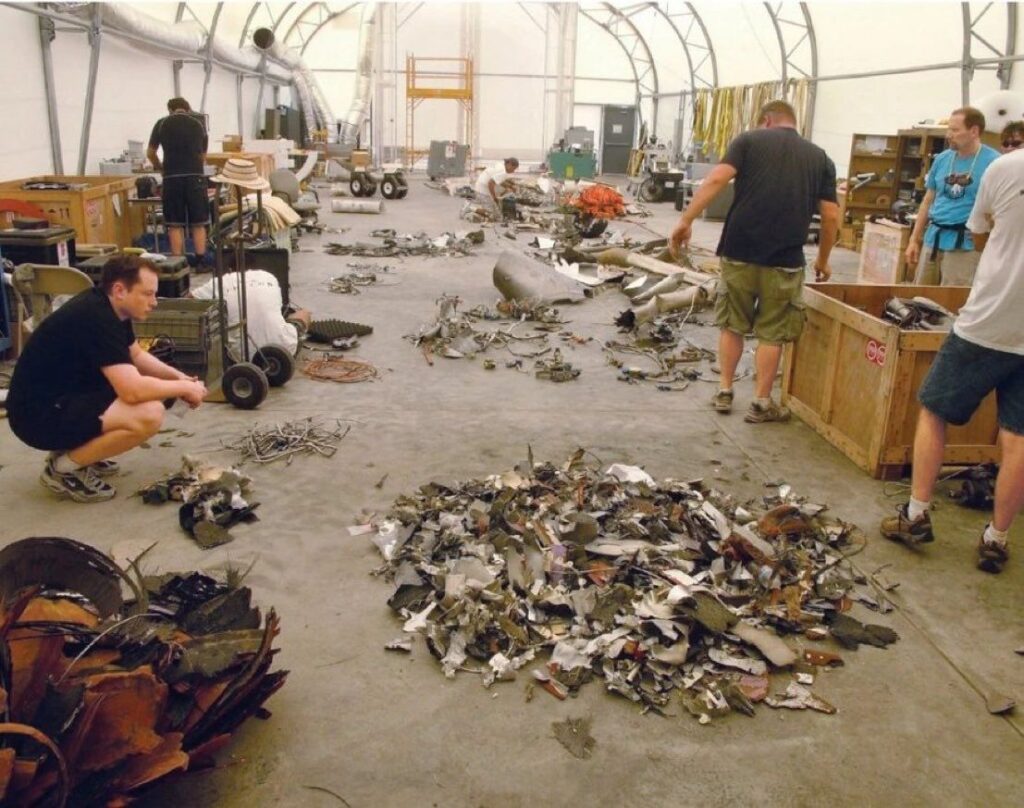
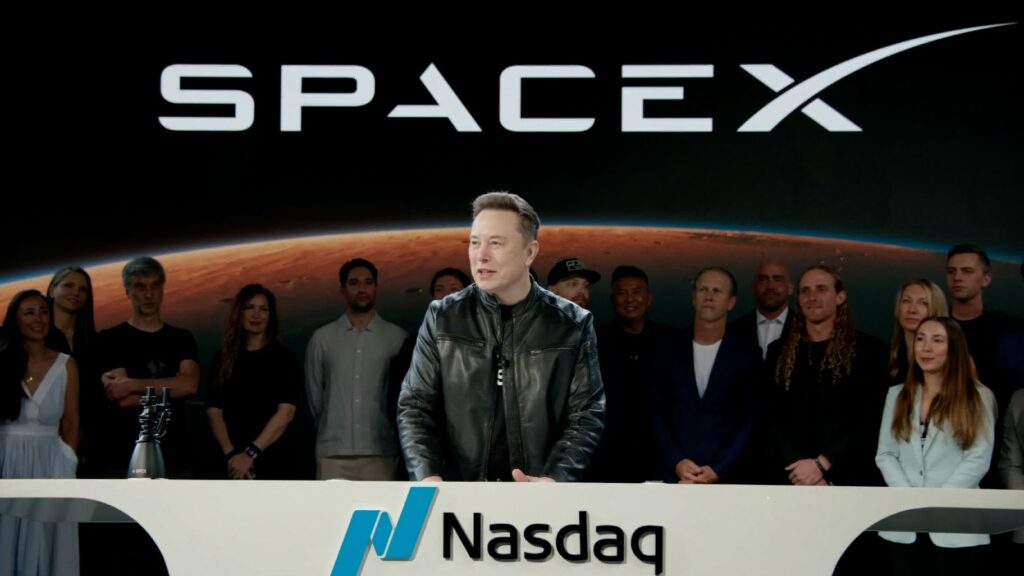
This photo from the early Falcon 1 wreckage shows Elon in a hangar, surrounded by broken rocket parts. It’s the opposite of the IPO image: no opening bell, $75 billion raise, or world’s first trillionaire.
Just debris, doubt, exhaustion, and the question every Founder eventually faces in some form: is this still worth doing?
Faced with bankruptcy after the third Falcon 1 failure, Elon, as always, found a way. He tapped the “PayPal Mafia,” a group of individuals who had all become rich at PayPal and went on to build even more successful companies. The “Don” himself, Peter Thiel, decided to invest $20 million in SpaceX in 2008 via Founders Fund.
It was a good decision. Founders Fund’s stake in the company following the SpaceX IPO is estimated at $60 billion. Although the firm kept investing in SpaceX in later years, that bet is set to equal Masayoshi Son’s $20 million in Alibaba as the most lucrative investment in Venture Capital history.
Brian Singerman, a regular Forbes Midas List VC who was starting at Founders Fund at the time, recently said, “If SpaceX didn’t work, Founders Fund wouldn’t exist.”
Elon’s resilience, which has poured over to SpaceX, seems steeped in a deep promotion focus: the ability to see what can go right, to shun loss aversion, and optimize for gain.
During his SpaceX IPO speech, Elon said he gave SpaceX less than a 10% chance of succeeding.
Most people would hear that and walk away.
Elon thinks differently: even if the odds were terrible, the cost of not trying was worse.
Unrelenting
The fourth thing the SpaceX IPO stories reveal is how unrelenting Elon and his company are. It seems that nothing can stop SpaceX on its mission to make life multiplanetary.
Unrelenting individuals operate at the crossroads between grit and compulsion. In entrepreneurship, the refusal to abandon a long-term goal even when reality pushes back is a plus. However, the cost is often the inability to ease the pressure, even when people reach their limits.
The result is extraordinary output. On IPO day, Starlink’s Joel Cherkis noted that SpaceX completed its 360th launch and deployed more than 7,000 satellites since he joined less than two and a half years ago. Launches had become so frequent that they often no longer made the news.
But output is only one side of the story. The input is intense human effort, sometimes on the brink of collapse.
Ory Israel wrote that he left SpaceX with “a blown-out spine, two toddlers, and a suspicion that ultra-high performance leads to burnout.” He later clarified that disconnection had affected him more than hard work itself.
People can sustain an unusual level of effort when they feel connected to the mission, the team, and the outcome. When that connection disappears, the same workload becomes much harder to bear. Psychologists call it cynicism or disengagement, one of the three dimensions of burnout.
Culture was brutal, many days felt like walking on egg shells that you will get fired, others like eating glass. Kindness wasn’t the focal point – it was execution, rigor and outcomes.
Nick Reva – Former head of security engineering at SpaceX
Pressure at SpaceX is constant, overperform or out. Nick Reva described near burnout, high cortisol, weight gain, 12-hour days, and late nights after he became a father, shortening his time away for fear of not having a job when he got back.
The sacrifice also extended beyond employees. One IPO-day post summarized it well: “It took an army to do this and many years of blood, sweat, tears and sacrifice, including that of supporting family members.” The families absorbed the missed dinners, the weekends at work, the exhaustion, and the uncertainty.
Elon’s unrelenting nature is clearly one of his greatest strengths. It compresses timelines, raises expectations, and produces extraordinary achievements. But it comes at a cost for those who work for him.
Conclusion: Great Minds Need Talent
The insider accounts published around the SpaceX IPO give us a glimpse into Elon’s mind: authentically mission-driven, a first-principles thinker, extremely resilient, and unrelenting in pace that sometimes breaks people.
More than any company in Elon’s portfolio, SpaceX’s culture seems to espouse these traits.
But none of the extraordinary success that SpaceX represents would be possible without talent. Gwynne Shotwell is the clearest example.
Elon would set a goal that sounded impossible. For two decades, Shotwell would execute. She would recruit the team, win customers, manage factories, negotiate with NASA, keep projects moving, and make sure the company survived long enough to deliver.
When Elon says something, you have to pause and not immediately blurt out, “Well, that’s impossible,” or, “There’s no way we’re going to do that.” You zip it, and you think about it, and you find ways to get that done.
Gwynne Shotwell – SpaceX (Source: TED2018)
Here’s to all the people who’ll make this dream of making life multiplanetary possible.