How Experienced Venture Capitalists Analyze Startup Financials

Creating startup financials is, despite claims to the contrary, an essential part of the fundraising process. Solid financial projections based on verifiable data serve both entrepreneurs and Venture Capitalists analyzing the startup’s viability. Experienced VCs know that startups don’t make their plan; they use the forecast as a basis for a larger conversation on the startup’s business model and growth plan, as well as the Founders’ vision. In this article and its companion webinar, I explain why it makes sense to build startup financials and how VCs analyze them to run sensitivity scenarios. I also included a short but sweet “Finance 101” section on startup financials.
In This Article
- Why Venture Capitalists Require Startup Financials
- Startup Financials: What You Need To Know
- The Optimal Startup Financials Package For VC Investors
- Additional Data: Visualizing Cash Needs
- How VCs Use Startup Financials To Run Sensitivity Analyses
- Conclusion: td;lr
for detailed explanations, sources, and quotes.
Why Venture Capitalists Require Startup Financials
I recently found myself embroiled in the eternal “Should startups prepare financial projections?” debate. Before detailing how experienced VCs use startup financials, I want to share a quick personal story highlighting why financial projections are necessary. Then, I’ll offer Founders a look into the VC’s mind when they refuse to provide forecasts.
Many VCs Lost Money Due to Poor or No Financial Projections–Here’s My Story
Early in my Private Equity career, my first assignment was to audit the financial projections of a startup my firm had just invested in. The Great Financial Crisis had just hit, and the original financial projections needed adjusting to the new economic environment—much like in 2022-2023.
When I reviewed the original Excel model, I realized it was too high-level and only covered the first 24 months, assuming the business would reach profitability by then. With a background in modeling M&A and LBO deals, I set out to redo the model entirely with my intern.
It took us weeks, as the business was super complicated. At the end of our work, we realized that not only would the company run out of cash within two months—something the Founders were unaware of—but we would also need to double our original investment to keep it afloat until it became profitable. It was a stark entry into startup financials for me. (And, as a side note, a warning against the cognitive biases of bridge financing).
Numbers that are not even remotely sain show Founders don’t know how business works. That’s scary as an investor.
Jason Lemkin – SaaSTr (source: This Week in Startups)
I’m not alone in facing such challenges, although most Investors don’t open up about them. Jason Lemkin, the Founder of SaaStr and a seasoned Investor, is an exception.
In one of his conferences, Lemkin shared that the Founders of his second-worst investment were convinced they had a 100% gross margin, no matter how much he tried to convince them it was impossible, even in a SaaS business.
He ultimately wrote off the investment and vowed never to invest again in Founders who don’t understand how they make money.
Fundraising Founders Refusing to Prepare Financial Projections Send The Wrong Signals
The camp against preparing startup financials argues that it wastes precious Founder time. Startups don’t make their projections anyway. These proponents are primarily first-time Founders who never raised meaningful funds and super early-stage Angels.
Unfortunately, fundraising Founders walking the “Hey, we don’t have financials” line send three signals to Investors.
They don’t know how this works. Whether they agree or not is not the point. Anyone asking for something must abide by the requests of those providing it. They may be right (in this case, they’re not), but they’re on the wrong side of the checkbook.
They don’t have a vision. Experienced VCs first look at the Year 3 or Year 5 revenue number to assess what type of business Founders want to build. They use that number to determine whether the company is VC material and how fast it will become a worthy exit. It’s not the VC’s job to guess how big the startup can get. It’s the Founders’. I understand it’s hard to do, and Founders don’t have a crystal ball, but neither do the VCs, and they need conviction around this point.
Tom Perkins, the legendary VC who co-founded the eponymous Kleiner Perkins, once said, “I don’t know how to write a business plan, but I know how to read them. You start at the back, and if the numbers are big, we look at the front.”
They don’t understand their unit economics. One of the questions VCs try to answer is: “What needs to happen for this business to become profitable?” There are trends around the Growth vs. Profits debate, but profits win right now. Founders who cannot articulate a path to profitability scare Investors, who automatically assume they don’t know how to make money.
Entrepreneurs don’t need a degree in accounting or advanced corporate finance, but they must know the basics of revenue generation and how expenses affect profitability.
Failing to plan is planning to fail.
Benjamin Franklin
Founders don’t have to produce financial projections if they don’t want to. In that case, they should bootstrap their company and profitably use other external financing sources, such as customers’ money. Ironically, they’ll soon have to build financial projections to ensure they’re on the right path. It’s part of business life. I’ve yet to meet a Founder who’s done the exercise *correctly* and failed to see value in it.
Six Reasons VCs Need Startup Financials For
The “model vs. no model” debate in VC will not be resolved soon because both sides are misaligned on critical dimensions:
- Founders see it as a waste of time because they misunderstand what VCs use the model for. They also fail to see what it can bring them
- Experienced VCs know the value of having a thought-out document as the basis for a conversation and making sure Founders get the basics.
I listed below six reasons why VCs require financial projections from fundraising Founders.
#1 – Analyze Unit Economics at Scale
Understanding unit economics helps VCs assess the viability of the startup’s business model and growth plan.
Unit economics involves evaluating the direct revenues and costs associated with a particular business model, expressed on a per-unit basis. For a startup, this means understanding how much profit it will generate from a single unit of product or service once the business scales.
Financial projections provide insights into the startup’s ability to achieve profitability as it grows and increases its customer base. Read my comprehensive article on unit economics to learn more about this crucial aspect of startup evaluation.

Go Further: How Venture Capitalists Evaluate Unit Economics
#2 – Evaluate Break-Even and Cash Burn
VCs need to know when a startup will break even, i.e., when its revenues will cover its expenses (EBITDA break-even) or its cash inflows will cover its cash outflows (cash break-even). The break-even analysis helps determine the point at which the startup will start generating profits (P&L) or positive cash flow (Balance Sheet), which are key indicators of financial viability. See the Startup Financials 101 section below for more details.
Understanding the cash burn rate—the speed at which a startup spends its cash in the bank—is essential for VCs to evaluate how long it can sustain its operations without additional funding. This information helps assess the risk associated with the investment and plan for future funding rounds.
#3 – Validate The Funding Round Amount
Financial projections should clearly outline the amount of capital needed to achieve specific milestones. They inform on how much the company raised so far and how much more is required to reach the next stage of development.
VCs use this information to determine whether the startup has realistic funding needs and if it aligns with their investment capacity. It also helps them understand the impact of dilution on existing shareholders and the new valuation.
As I explain in the article below and its companion webinar, Founders tend to ask for too much money too soon. VCs’ milestone approach challenges Founders’ assumptions and ensures funds raised will be spent appropriately to achieve growth.

#4 – Value The Startup
Financial projections provide a basis for valuing the company based on expected revenues, profits, and growth rates. Accurate financial projections allow VCs to perform a valuation analysis and compare the startup’s valuation to industry benchmarks.
Read this article on the Venture Capital Method for more details.
#5 – Provide The Basis For A Conversation
Financial projections are essential for effectively communicating the startup’s vision and potential to VCs. They serve as a roadmap, illustrating how the startup plans to achieve its goals and generate returns.
The reason I like to look at financial models at the early stage is not to scrutinize the numbers but understand the main drivers of the business and to have a conversation with the founders about what they think the next year or two looks like.
Micah Rosenbloom – Founder Collective (Source: Medium)
Clear financial projections also provide a basis for discussions during due diligence, helping VCs understand the startup’s business model, market potential, and financial strategy. They are a helpful pendant for the pitch deck, as the VC can dig into numbers roughly presented in the deck.
#6 – Provide The Budget For The First Six Months
While a startup’s revenues are hard to predict, Founders can more precisely plan the next few months’ expenses. At the early stage, they use funds primarily for new hires (in tech and sales), whose seniority and compensation can be easily determined.
A cash-in/cash-out format can be particularly effective for creating a budget. This format helps clearly outline all expected cash inflows and outflows, providing a straightforward view of the startup’s financial health.
Implementing early discipline in tracking expenses monthly is also crucial. By consistently monitoring actual costs against the budget, startups can quickly identify and aze any variations. This practice helps make necessary adjustments to future projections.
Before we dive into the techniques experienced VCs use to analyze financial projections, I offer a crash course in startup financials.
Startup Financials: What You Need To Know
Notions of financial analysis are helpful even in early-stage investing to support VC due diligence analysis and long-term value creation. Here’s an overview of what VCs look for in key financial documents and how they use this information.
Income Statement or P&L
The income statement, also known as the profit and loss statement (P&L), measures a company’s financial performance over a specific period. It outlines revenues, costs, and expenses, ultimately showing whether the company made a profit or a loss during that period. Key components of the income statement include:
- Revenues: Income from sales or services.
- Costs of Goods Sold (COGS): Direct costs attributable to the production of goods sold.
- Gross Profit: Revenues minus COGS.
- Operating Expenses: Costs not directly tied to production, such as salaries and rent.
- EBITDA: Earnings before Interest, Depreciation, and Amortization, a metric of value generated
- Net Income: The final profit or loss after all expenses are deducted from revenues.
VCs use the income statement to analyze:
- Business Model Profitability: VCs look for evidence that the startup can generate sufficient revenue to cover its costs and eventually turn a profit. This involves analyzing income and expenses trends to understand the business model’s sustainability.
- Valuation: The income statement provides the basis for calculating the startup’s valuation, based on a multiple of EBITDA or sales.
Balance Sheet
The balance sheet provides a snapshot of a company’s financial position at a specific point in time. It lists the company’s assets, liabilities, and equity, clearly showing what it owns and owes.
- Assets: Resources owned by the company (e.g., cash, inventory, property).
- Liabilities: Obligations and debts the company owes (e.g., loans, accounts payable).
- Equity: The residual interest in the assets after deducting liabilities, representing the ownership stake.
While the balance sheet itself might not be the primary focus for early-stage VCs, changes in balance sheet items are still crucial, as they may affect the startup’s cash position.
VCs pay attention to changes in key balance sheet items such as accounts receivable, inventory, and accounts payable. These changes can indicate how well the startup manages its working capital and financial resources. Effective management of these items is critical for maintaining liquidity and operational stability.
Cash Flow Statement
The cash flow statement is significant for VCs as it shows the actual inflows and outflows of cash within the business. This statement helps VCs understand how effectively the startup manages its money, which is vital for its survival and growth.
The cash flow statement breaks down cash flow into operating, investing, and financing activities, providing a comprehensive view of the company’s cash management:
- Operating Activities: Cash generated or used in the company’s core business operations.
- Investing Activities: Cash used for or generated from investments in assets, such as property or equipment (uncommon in digital startups)
- Financing Activities: Cash flows related to borrowing, repaying debt, and equity financing.
VCs use the cash flow statement to analyze:
- Round Size: VCs use the cash flow statement to determine the appropriate size of the funding round. They analyze the startup’s cash needs based on its operating, investing, and financing activities to ensure the company raises enough capital to achieve its milestones without over-dilution.
- Uses of Funds: It’s crucial for VCs to see a detailed breakdown of how the funds will be used. The cash flow statement should clearly outline expenditures on product development, marketing, hiring, and vital areas. This transparency helps VCs assess whether the startup has a strategic plan for deploying the capital efficiently to drive growth.
Watch the webinar for more details on these notions, additional financial notions, and concrete examples.
Venture Capitalists use lingo that professionals new to the job and fundraising Founders must know.
Burn Rate
The burn rate refers to the rate at which a startup spends its cash to cover operating expenses before generating positive cash flow from operations.
It is typically measured every month and can be categorized into gross burn and net burn. Gross burn includes all operating expenses, while net burn subtracts any revenue generated from gross burn.
For example, if a startup spends $100,000 per month on salaries, rent, and other operating expenses, but earns $30,000 in revenue, the gross burn rate is $100,000, and the net burn rate is $70,000 ($100,000 expenses – $30,000 revenue).
VCs closely monitor the burn rate to understand how quickly a startup is depleting its cash reserves. A high burn rate can indicate aggressive growth and investment in the business, but it also means the startup needs to achieve significant milestones quickly to justify further funding.
Runway
Runway is the amount of time a startup can continue to operate before it runs out of cash, assuming the current burn rate remains constant.
It is calculated by dividing the total cash reserves by the monthly net burn rate. Runway indicates the urgency of a startup’s efforts to become cash flow positive or secure additional funding.
For instance, if a startup has $500,000 in cash and a net burn rate of $50,000 per month, its runway is 10 months ($500,000 / $50,000). It means the startup has 10 months to increase its revenue, reduce expenses, or raise more capital before running out of cash.
VCs use the runway metric to assess a startup’s financial stability and the timing of future funding rounds. A longer runway provides more time to achieve key milestones and reduce investment risk, while a shorter runway increases the urgency of funding and operational adjustments.
Most VCs evaluating a new investment opportunity don’t like to work against time. If the runway is too short, they will most likely pass.
Fume Date
The fume date is the projected date when a startup will run out of cash if no additional funding is secured or significant changes are not made to the burn rate. It is the end of the runway. Knowing the fume date helps startups plan their fundraising efforts and operational strategies to avoid financial distress.
VCs consider the fume date to evaluate the urgency of the startup’s financial needs and the potential risks. Startups nearing their fume date may face increased pressure to raise funds quickly, often at less favorable terms, which can impact valuations and ownership dilution.
The Optimal Startup Financials Package For VC Investors
Another challenge VCs often encounter when they request financial projections is that many Founders fail to send the appropriate data in the expected format, necessitating significant rework. To facilitate an efficient evaluation process, startups should focus on delivering a comprehensive financial package.
The Cash Flow Forecast
Providing a complete set of financial statements is challenging for Founders. A full P&L requires accountants to verify revenue recognition rules and allocate costs to calculate margins precisely.
Balance sheets are unnecessary, as the information needed is captured in the cash flow statement (assuming the startup has no debt and minimum capex, which is often the case). Watch the webinar to learn more about these notions.
At a minimum, startups must provide a detailed cash flow “forecast” (a more common term than “statement,” which is not forward-looking).
It should be formatted in a cash-in/cash-out manner. This straightforward format provides VCs with a clear view of the startup’s financial operations, helping them understand cash movements within the business. It’s also more intuitive, as personal and professional bank statements are built that way.
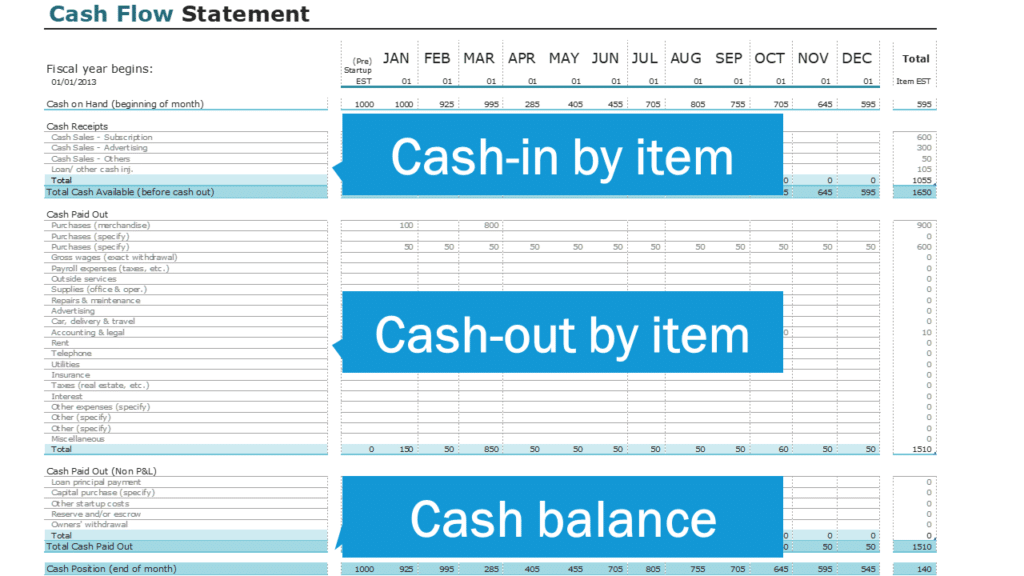
Here’s how Founders should structure their Cash Flow Forecast, and how experienced VCs analyze them:
- Cash Inflows: VCs expect detailed listings of all expected cash receipts, including cash from customers (such as subscription fees) and any other sources of income. I recommend breaking these down by category to give a clear picture of where the money comes from.
- Cash Outflows: The forecast should also detail all cash outflows, such as operational cash expenses like payroll, rent, utilities, and marketing costs. Additionally, it should include non-operational expenditures such as loan repayments and capital purchases (if any). These details help VCs understand the startup’s spending patterns and financial commitments.
- Net Cash Flow: Each month’s net cash flow (cash inflows minus outflows) should be calculated to show whether the business will be cash-positive or -negative. A continuous negative cash flow might signal a need for additional funding, which VCs will scrutinize closely.
- Ending Cash Balance: The forecast should show the ending cash balance for each month.
A detailed and well-structured cash flow forecast demonstrates to VCs that Founders have a solid grasp of their finances, building confidence in their ability to steer the company toward profitability.
Financial Projections: Do’s and Don’ts
I’ve worked in financial management since 2002 and learned a few best practices to avoid mistakes.
#1. Monthly Breakdown
Founders should prepare the forecast on a monthly basis to provide a detailed and granular view of cash flows. It helps identify trends and plan for seasonal variations.
I’ve seen startups prepare CF forecasts on a quarterly basis. It works, but they lose some flexibility.
#2. Start From Actuals
In financial modeling, “Actuals” mean real performance, “Budget” concerns the current year, and “Forecasts” present projections from the following year onward. “Reforecast” indicates that the initial predictions were later revisited with more information.
If we assume that Founders present their CF Forecast in mid-2024, they should present, depending on the startup’s life span:
- 2023A: real numbers for the twelve months of 2023. This ensures they didn’t forget a type of expense. The cash balance at the end of each month should reflect that of their bank statements
- 2024B: budget for the current year
- 2024R: it’s good practice to reforecast the budget around June, as more data is available on the performance of the first two quarters
- 2025F-2028F: these columns present the projections for the next few years
VCs should insist on having detailed cash flow information for the past few months to ensure consistency with forecasts.
#3. Provide Sufficient Details
Founders should break down cash flow items into specific categories. This detail helps VCs understand precisely where the money is coming from and where it is going.
A large “Other / Miscellaneous” line may blur the picture. It should adapt to the size of the yearly cash expenses. For example, if a startup spends $1 million this year, the “Other” line should not exceed $100,000.
#4. Don’t Forget VAT
Ensure that the cash flow forecast accounts for VAT (Value-Added Tax), particularly for businesses operating in regions where VAT is applicable.
It’s a common mistake that understates cash outflows, as Founders tend to report the cash-ins including VAT, but fail to account for the corresponding outflow.
#5. Formatting Matters
Founders should label cash inflows as positives and cash outflows as negatives.
It sounds silly, but I can’t count how many errors stem from not following this very simple formatting principle.
What Time Horizon For Startup Financials?
The appropriate time horizon for financial projections depends on the startup’s stage and the type of Investors considering the opportunity. However, I recommend three years at minimum and five years as an ideal time horizon.
A few factors come into play, some presented by Brad Feld. For early-stage and pre-revenue startups, the focus is on the near-term burn rate and how long the current funding will last. Projections in this phase are usually limited to the next 12 to 18 months.
As the startup progresses and begins to generate revenue, extending projections into the second and third years becomes necessary. These longer-term forecasts allow VCs to assess how the startup plans to scale operations and reach key milestones.
VCs will be interested in how long the current round of financing is going to last, and how much additional money is needed to get cash flow positive.
Brad Feld – Foundry Group (source: Venture Deals)
For more established startups with significant revenue, a projection horizon of 3 to 5 years is appropriate. These detailed, long-term forecasts help VCs evaluate the startup’s strategic planning and long-term vision. They are essential for understanding how the company intends to grow, scale, and achieve profitability. Additionally, these extended projections are crucial for valuation purposes, enabling Investors to estimate the business’s future value and potential returns.
Throughout all stages, VCs remain interested in how long the current financing round will last and how much additional funding will be necessary to reach cash flow positivity. They use these projections to calibrate expectations and comprehend the startup’s financial needs over time.
Additional Data: Visualizing Cash Needs
On top of the cash flow forecast, the startup financials pack should contain two graphs built from the same spreadsheet.
The Cash Flow Curve
The first one, which I call the Cash Flow Curve, is a graph built from the end-of-month cash balance in the CF Forecast.
It depicts the startup’s cash position over time, highlighting periods of cash surplus and deficit. This visualization helps VCs verify how much funding is needed, when it is required, and when the startup is projected to reach cash break-even.
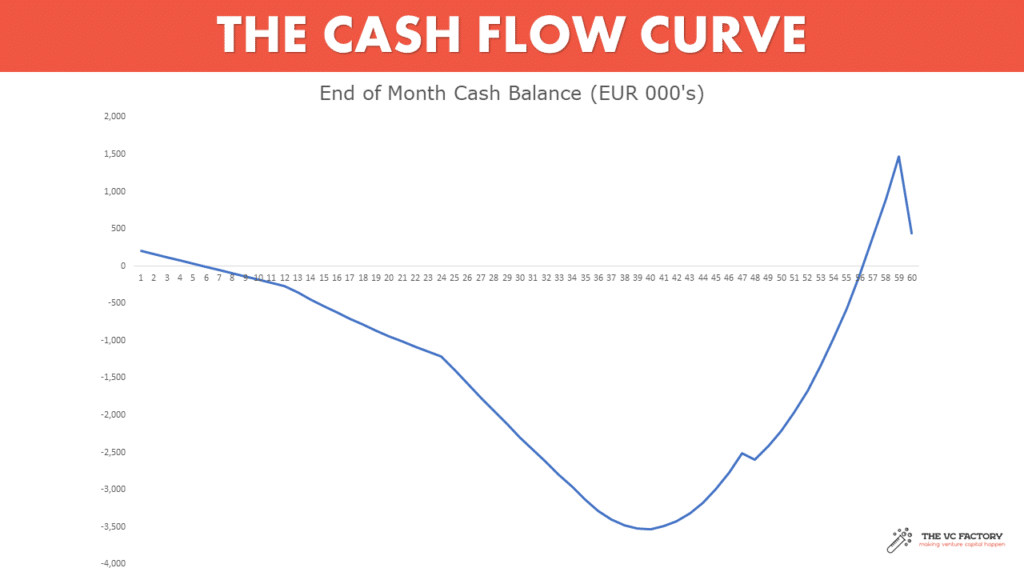
By tracking these cash flows, VCs can more accurately assess the startup’s financial health and plan the timing and amount of investment.
They can also engage in a conversation to inject capital in several tranches as the startup hits pre-agreed milestones.
Watch the webinar for more details.
The Uses Walk
The second graph illustrates the uses of funds from the current position to the break-even point.
It breaks down the startup’s cash inflows and outflows, detailing expenditures on payroll, advertising, purchases, and other costs. This breakdown gives VCs with a transparent view of how the startup plans to utilize the funds raised.
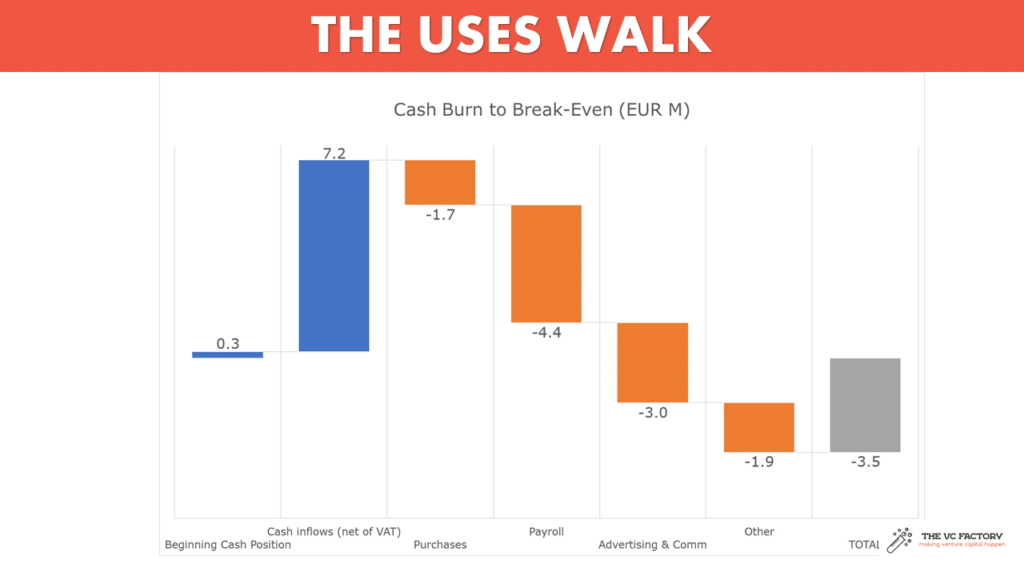
Understanding these allocations allows VCs to evaluate the startup’s efficiency and strategic planning, ensuring the investment will drive growth and achieve financial stability.
I demonstrated in another article how VCs use a milestone-based approach to evaluate startups’ funding needs.
In the last section, I explain how experienced Venture Capitalists build sensitivity scenarios using Founders’ financial projections, including crash cases.
How VCs Use Startup Financials To Run Sensitivity Analyses
Sensitivity analyses allow VCs to assess how changes in key performance variables impact a startup’s performance. It’s a critical skill even early-stage Investors must possess.
Why VCs Run Scenarios on Founders’ Financial Projections
By testing various scenarios, VCs can understand the potential risks and opportunities associated with an investment. This analysis helps identify the key performance drivers and assess the startup’s ability to withstand adverse conditions.
The central question is: “If this critical assumption in financial projections does not materialize, how much more cash do we need to break even?”
Founders are optimists and overconfident by nature. They tend to overestimate the company’s revenue and underestimate its expenses. Scenario analysis helps VCs assess more realistic cash needs with degraded metrics.
A startup is a human institution designed to create a new product or service under conditions of extreme uncertainty.
Eric Ries – Lean Startup
Additionally, startups operate under extreme uncertainty. Founders don’t have answers to most questions leading to company growth. Experienced VCs know this and fund “a series of experiments” designed to test critical points.
How much will it cost to acquire customers? How long will they use the product? Are 5% of my free customers transitioning to a paying plan? 10%? Etc.
Scenario analysis allows experienced VCs to build a set of assumptions that produce a range of outcomes, some acceptable (e.g., a slight variation in transformation rate may postpone the break-even point by three months and cost $500,000 more), and others less so (e.g., a similar variance leading to tripling the initial cash injection).
As the name suggests, the objective is to understand the startup’s sensitivity to changes in key assumptions, driven by its business model, cost structure, and market position.
Identifying & Tweaking Key Business Drivers
One rule I learned in twenty years of analyzing businesses is that their growth plan relies on two or three drivers. For example, a SaaS business depends on CAC, LTV, and churn. An e-commerce startup’s main drivers are the average ticket, gross margin, and repeat sales. For a company running a freemium model, success depends on the conversion rate to a pay plan.
Sensitizing startup financials requires identifying these key drivers and changing their values in the model to build a realistic scenario.
Here lies the value of experience. Junior VCs tweak numbers in their spreadsheet almost randomly without considering a real-life scenario. Going through a few busts teaches valuable lessons.
I still remember how the 2008 GFC shattered my sensitivity scenarios. I built various downside cases for my firm’s LBO deals, with a 15% decline in sales over two years and a quick ramp-up back to baseline. The reality was much harsher: revenue went down 30-40% in one year, and it took many years to go back to baseline in many of these businesses.
The folks at Bessemer create the most exquisite scenarios publicly available. I analyzed several of these tables in this article on Investment Committee Memos.
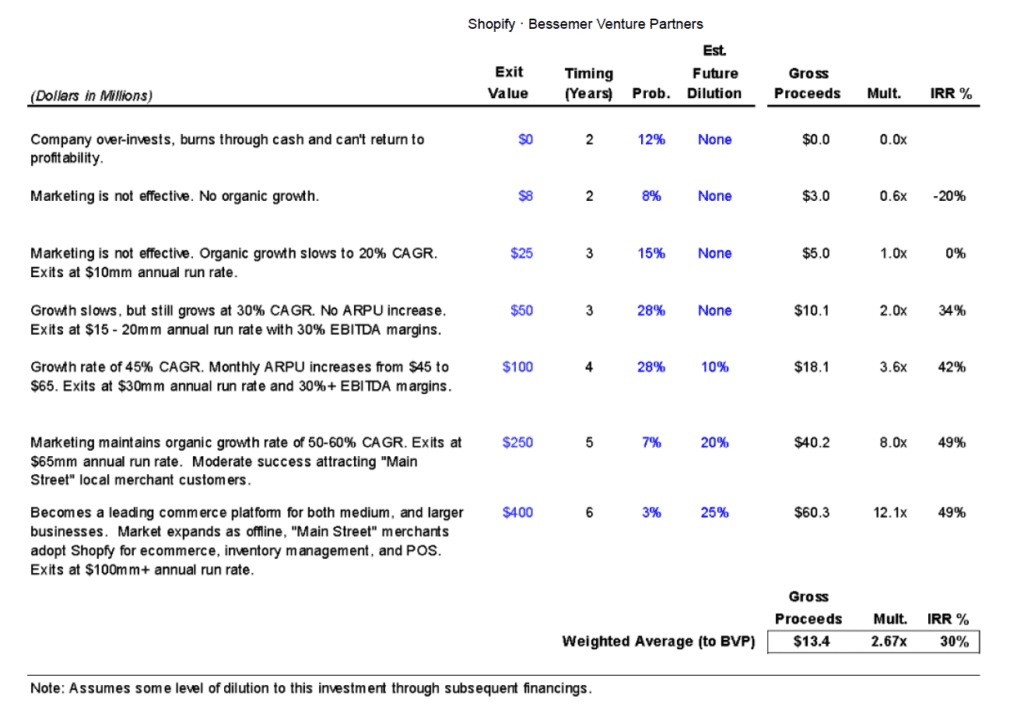
They use a probability rate to estimate the likelihood of each scenario. As I told a former Bessemer associate who explained to me how they built these tables, the key is to have consistent probability rates across the firm.
Watch the webinar for a detailed spreadsheet-based explanation of building scenario analysis.
Conclusion: td;lr
Analyzing startup financials is crucial in Venture Capital, even for early-stage VCs. It allows them to grasp the depth of a Founding team’s vision and business skills, using the spreadsheet as the basis for a conversation.
VCs and Founders must have basic notions of financial statements and understand how to use each to analyze a specific aspect of the startup’s future financial performance. Experienced VCs frequently guide Founders in producing the outputs needed to evaluate the investment opportunity: at a minimum, a cash flow forecast with a cash flow curve and a “uses walk.”
Starting from these outputs and the model, VCs build sensitivity scenarios to simulate the impact of degraded assumptions on the startup’s growth and cash needs.