How The Best LPs Evaluate Emerging VC Fund Managers
Despite bumps on the road, Venture Capital has become an attractive asset class for Investors and operators, promising cherry-on-top returns and access to what will happen next. More VC funds have been raised by so-called “emerging VC fund managers,” General Partners who raise their first, second, or third institutional Venture Capital fund, than ever before in the history of VC. Consequently, more experienced Limited Partners have come to the fore to explain what they are looking for to invest. In this article, I lift the veil on the criteria elite LPs use to select the best emerging VC fund managers. After addressing the state of the VC fundraising market, I’ll address each selection criteria at play and provide advice for emerging VC fund managers to attract LP investments.
In This Article
Emerging VC Fund Managers: The Data
There is no denying VC has become an attractive asset class in the last fifteen years, as the trauma from the DotCom crash faded in distant memory. “Software is eating the world,” and Venture Capitalists provide the cutlery.
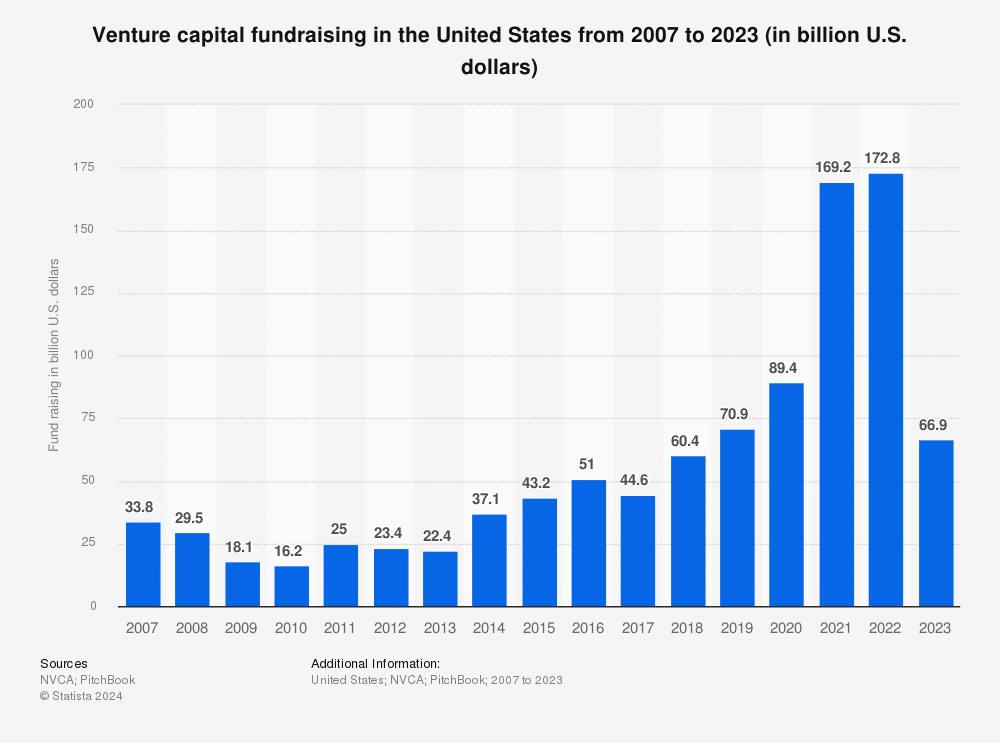
VC Funds Raised (2007-2024)
Marc Andreessen, who coined the phrase, wrote in 2011 that software has become a fundamental driver of innovation, disrupting traditional industries and enabling the creation of high-growth, high-margin businesses. He explained how software’s scalability, coupled with lower startup costs and the global reach of the internet, has fueled a surge in new tech companies–attracting significant VC investments.
As a result, VC fundraising (funds raised by VC firms) grew almost eightfold between 2013 and 2022. Apart from a minor blip in 2017, it grew without interruption over the period, with a sharp increase during the 2021-2022 boom fueled by the Zero Interest Rate Policy (ZIRP) in the U.S.
There is a similar trend in other geographies, albeit an order of magnitude lower. For example, according to Statista, the value of VC funds in Europe rose from €5 million in 2013 to €24.5 million in 2022—just 15% of the total U.S. amount.
Although the “mini correction,” as Benchmark’s Bill Gurley called it, has hampered the mood, mid-term perspectives for VC fundraising remain optimistic. Funds raised by U.S. VC firms in 2023, although substantially down compared to the 2021-2022 peak, were still three times the 2013 levels, on par with 2019. 2024 shows similar trends, with $24 billion raised by the end of April.
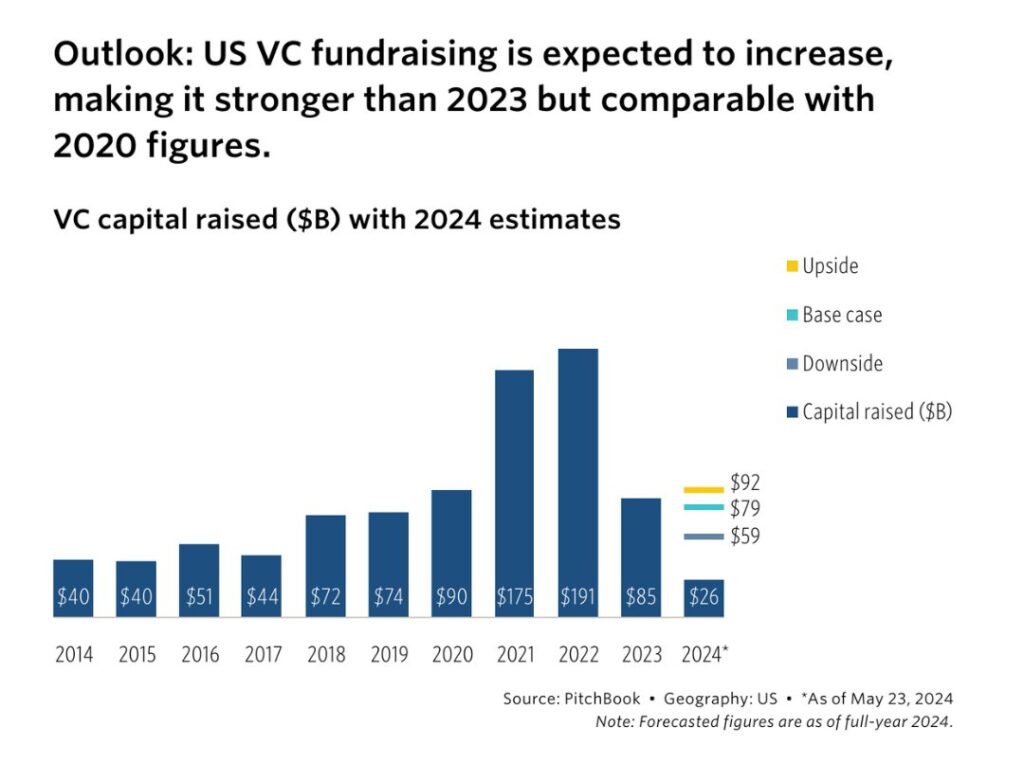
2024 data from Pitchbook with Downside, Base, and Upside cases
(Note: historical data differs from Statista data presented above).
Focus on Emerging VC Funds Managers
The data provided above includes both established VC firms and emerging ones. While no data is available specifically for emerging VC fund managers, Pitchbook recently shared data for emerging managers across several asset classes, including VC.
The graph below indicates a fluctuating but generally growing trend in fundraising activities among emerging managers over the years, with a spike in 2007 (probably driven by emerging PE funds) and a peak in 2021, most probably due to emerging VC funds.
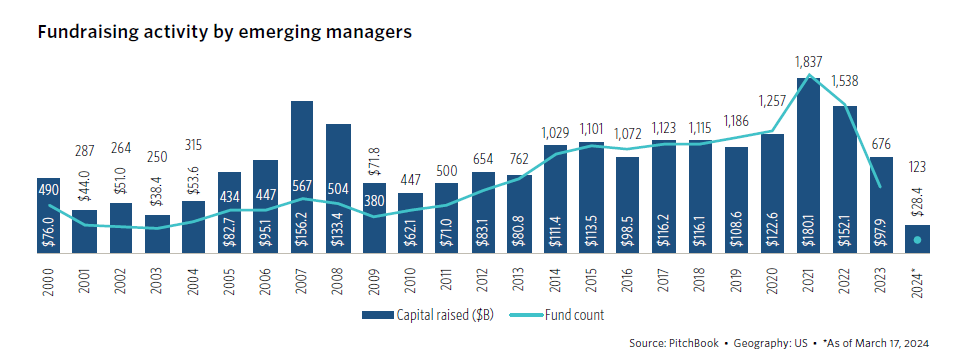
Pitchbook notes that the growth of private markets over the past decades has resulted in a disequilibrium in demand vs. offer. While more than 25,000 GPs have successfully raised at least one private fund since 1990, there are currently over 10,000 open funds seeking LP commitments.
The multitude of choices and smaller private market budgets due to slower distributions have led to reduced new fund commitments. The share of U.S. fund closings by emerging managers has decreased to 44.7% of total fund count and 15.7% of total capital raised, down from 55.0% and 23.4%, respectively, over 2009-2019.
As private markets mature, LPs increasingly favor established managers to build their portfolios—a “flight-to-quality” typical of post-bubble eras: LPs prioritize VC firms with longer track records, proven performance, and established reputations, considered safer bets over emerging or first-time fund managers. (More below).
Do Emerging VC Fund Managers Perform Better Than Established VC Firms?
Despite the risks of backing first-time fund managers, the promise of better returns attracts many LPs to emerging GPs. Does the data back these claims, and how can the overperformance be explained?
Established vs. Emerging VC Fund Managers Rankings
One piece of analysis often used to demonstrate the superior returns delivered by emerging VC fund managers is Cambridge Associates’ 2019 ranking of top 10 performers.
The table below illustrates the performance of US VC funds by vintage year from 2004 to 2016, ranking them based on Net TVPI (Total Value to Paid In). It highlights that new (I&II) and developing (III&IV) funds are consistently among the top 10 performers across these years.
New funds, represented by the dark blue squares, often occupy the top rankings, indicating their strong performance relative to their peers.
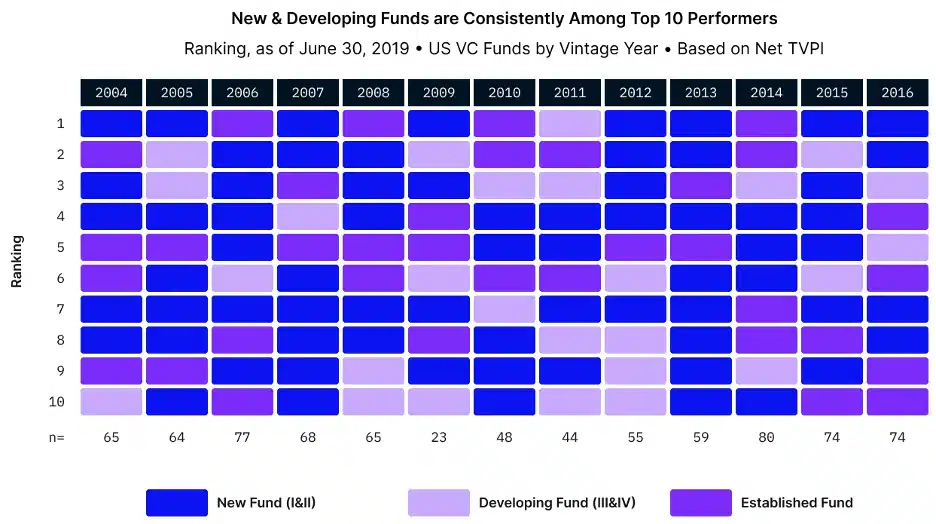
Developing funds, shown in light blue, also frequently appear in the top ranks.
In contrast, established funds, depicted in purple, are less consistently ranked among the top performers. This suggests that newer and developing funds achieve higher returns more regularly than their established counterparts.
A few caveats are necessary. First, the data reflects only the funds that survived and performed well, ignoring those that failed (survivorship bias). Second, it is based on Net TVPI and may change over time, as DPI comes in; paper returns by emerging funds are more volatile since they tend to invest earlier. Read the article below for more explanations on how VCs value their portfolios and why their methodologies are often problematic.

Go Further: Venture Capital Returns: True Lies?
Betters Returns But More Volatility
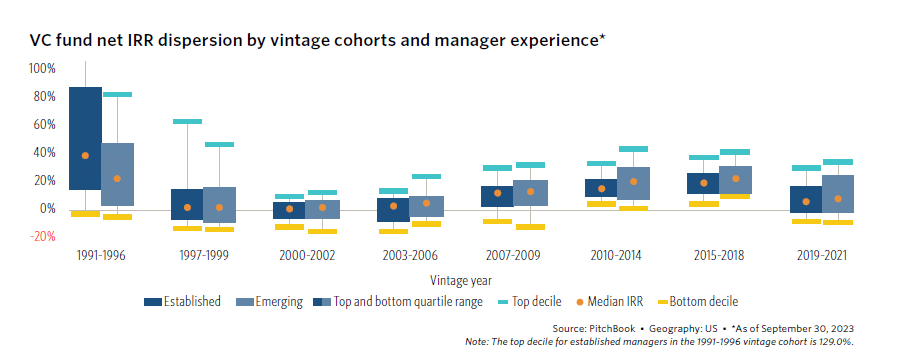
As the graph below shows, emerging VC fund managers have historically outperformed established peers. Their median Internal Rate of Return (IRR) has been higher since the late 1990s, especially during market recovery periods such as the post-global financial crisis (GFC) years.
However, returns from emerging VC fund managers tend to be more volatile. While they offer significant upside potential, the range of outcomes is broader, with a greater likelihood of both top-decile and bottom-decile performance. This volatility underscores the challenge for Limited Partners (LPs) in achieving predictable, needle-moving exposure from these managers.
Let’s take an example. A $30 million emerging seed VC fund returning 5x is exceptional performance, yet it does not significantly impact the returns of an LP with billions of dollars in assets under management (AUM). Besides, building a portfolio of such emerging VC fund managers is challenging due to the low consistency across their performance.
Here’s how to read the graph:
- Top and bottom decile: This is represented by the upper and lower end of the bars, indicating the IRR of the top-performing and bottom-performing 10% of the funds within each category (established and emerging).
- Top-and-Bottom quartile range: The interquartile range (IQR) represents the middle 50% of the data, excluding the lowest 25% (bottom quartile) and the highest 25% (top quartile) of values.
Pitchbook’s graph above shows that both the range and the interquartile range of returns are higher for emerging VC fund managers, indicating volatility across investment firms. There are many emerging managers, but selecting the best ones is more challenging.
Why Do Emerging Managers Outperform Established Ones?
One reason often heard in VC circles is that they are “hungrier,” hustle more, and make more efforts to meet as many Founders as possible and get on the most promising deals. Emerging managers have more at stake personally and professionally, driving them to work harder for success.
Unlike established VC firms, which tend to deploy larger funds, emerging VC fund managers cannot rely on management fees to make a living. They must strive for carried interest, a profit-sharing scheme rewarding high performance.
Another (anecdotal) explanation is that they more readily invest in non-obvious ideas and Founders. Being able to be “contrarian but right” is a critical trait in high-performing VCs, as I detailed in the article below.

Another cause is that emerging VC fund managers often specialize in niche sectors or geographies, which can provide unique alpha opportunities not easily replicated by larger, more diversified funds. This specialization allows them to leverage on-the-ground expertise and exploit networks intensively to get early deal flow.
After my first “fintech” (it wasn’t called that yet) investment in 2011, I started meeting with more people in the industry and going to fintech events to better understand the dynamics. As the main actors got to know me better, they sent me opportunities more readily. Another consequence was a better understanding of the diversity of technologies and value chain players in the vertical.
Pitchbook data confirms that specialized emerging VC fund managers (“emerging specialists”) outperform established generalists, emerging generalists, and even established specialists.
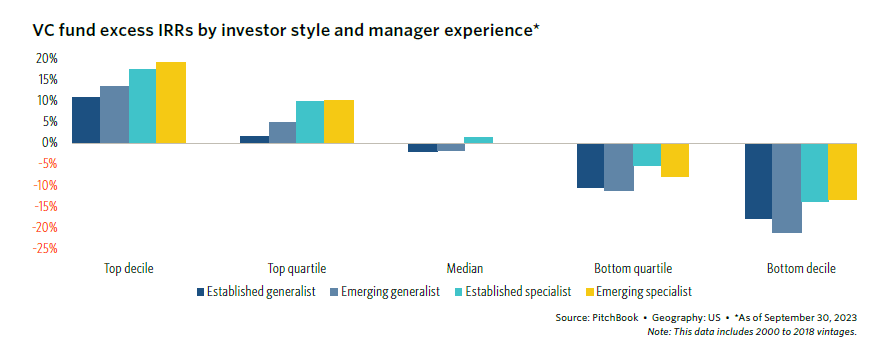
Although there is no data for median IRRs generated by emerging specialists, the top decile and top quartile information is more relevant given the VC power law.
Pitchbook notes that specialists outperform generalists in both categories (emerging and established), citing that specialization provides a sourcing perspective. Startup Founders are more likely to pick a specialist VC firm as their networks and value-add appear more relevant.
Other arguments explaining superior returns by emerging managers include:
- Smaller check sizes: Smaller funds can generate higher returns more easily due to more favorable math.
- More attention to fewer investments: Emerging managers can provide more focused attention to their portfolio companies.
- Alignment with Founders: Many emerging managers have experience as Angels or operators, giving them a unique perspective to understand and support founders.
- Agility and flexibility: Emerging managers can often move quickly on opportunities and adapt to market changes.
- “GP-Thesis Fit”: Allocate CEO Samir Kaji points to emerging VC fund managers’ focus and leaning into their strengths being strongest when they raise their first fund(s)
Going into each of these points would exceed this article’s objective. In the next section, I analyze what elite LPs say about emerging VC fund managers.
Why Emerging VC Fund Managers Struggle To Raise Money
Raising capital for a first-time VC fund is a formidable challenge, as emerging managers often face skepticism from potential Investors due to a lack of proven track record. The journey of Fika Ventures, as shared by co-founder TX Zhuo, vividly illustrates the obstacles new fund managers must overcome to secure commitments from LPs.
Raising Fund I: Obstacles To Overcome
Raising a first VC fund is a challenge many emerging VC fund managers underestimate. Several obstacles must be overcome to raise even a sub-$100 million fund.
Lack of track record: Without a proven history of successful investments and returns, it’s difficult for emerging VC fund managers to demonstrate their ability to generate alpha for LPs.
LP constraints and preferences: Some institutional LPs have internal rules that prevent them from investing in first-time funds, preferring to wait for second or later funds. Besides, many emerging managers aim for smaller fund sizes, which can be less attractive to larger LPs looking to deploy significant capital that will move the needle for their funds.
Smaller networks: Emerging VC fund managers may have less extensive networks than established firms, making it harder to secure warm introductions to potential LPs. Even emerging managers who “spin out” from an existing VC firm may lack sufficient depth, as they leave after a few years and have rarely helped raise more than one fund.
Market saturation: The number of VC firms has increased significantly over the years, making it more challenging for new entrants to differentiate themselves.
Resource constraints: Emerging managers often have limited resources for fundraising activities, including travel and marketing expenses. Francesco Perticarari recently shared his last 30 days closing a first pre-seed and seed deeptech fund, highlighting these difficulties.
The fundraising environment has been particularly challenging in 2022 and 2023, with interest rates affecting LPs’ appetite for venture capital investments, especially for new managers. Emerging VC fund managers engaged in fundraising during a troubled economic environment must surpass additional challenges:
- Longer fundraising cycles: Raising a first fund can take longer, requiring more persistence and potentially creating cash flow issues for the managers. From six to twelve months during boom times, fundraising can extend to 18 to 24 months in slower markets
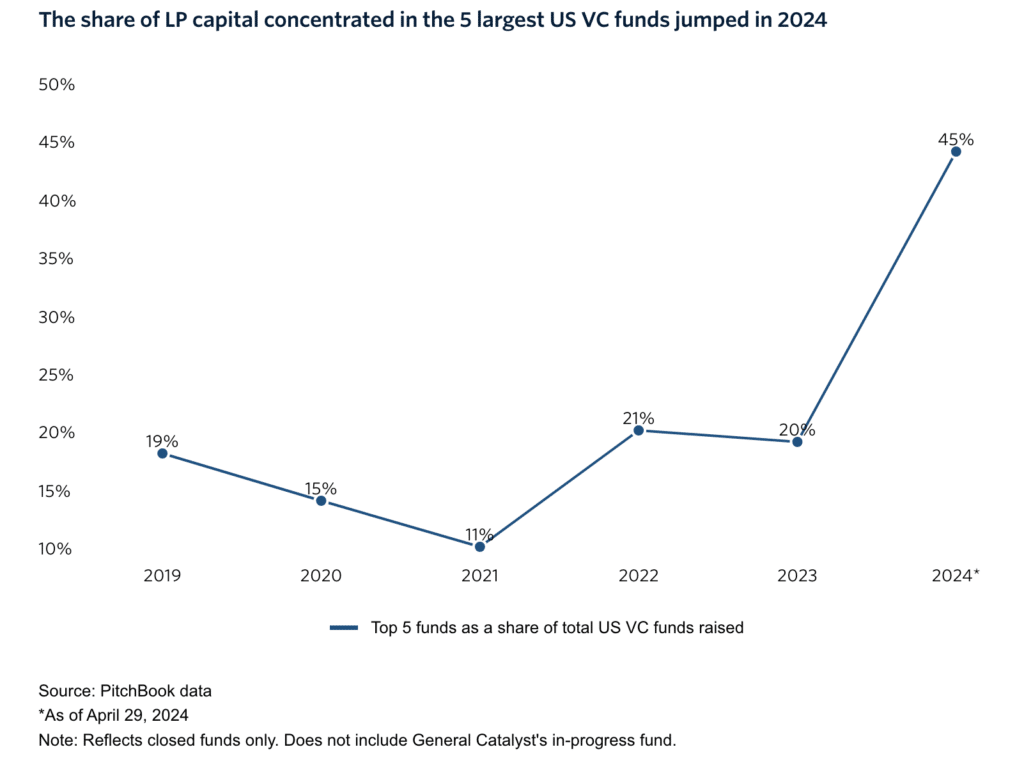
- Flight-to-Quality: Established firms with strong track records are often favored during uncertain economic times, as LPs engage in a “flight to quality.” A recent illustration is that two firms, General Catalyst and Andreessen Horowitz, represented 44% of all LP capital allocated in the first months of 2024
Pitchbook recently shared data on LP concentration on the top 5 US VC funds showing that while the frothy 2021 was characterized by more dispersion, the market has gradually returned to flight to quality.
These difficulties explain why emerging managers who successfully raise their first fund often take hundreds of meetings with prospective LPs before closing, as Fika Ventures’ TX Zhuo explained in a Venture Unlocked episode.
Case Study: Fika Ventures
Fika Ventures is a boutique seed fund in Los Angeles investing in data, AI, and automation technologies.
Raising the first fund for Fika Ventures was an arduous process, as TX Zhuo recounts with a mix of humor and candor. Zhuo and his team pitched to around 700 investors and secured 105 commitments, ultimately closing a $41 million fund. Initially, Zhuo felt embarrassed about these statistics, but he said that he now views the experience as a valuable trial by fire, providing him with insights into the startup Founder’s journey of raising capital.
The initial fundraising journey was filled with moments of doubt and perseverance. Zhuo recalls that after their first 100 pitches, they had only secured $4 million. However, Zhuo and his co-Founder committed to a rigorous schedule, making at least eight LP calls daily over eight months.
We understood that it was going to be very tough in the early days. We realized we had to persevere.
TX Zhuo – FIKA Ventures (source: Venture Unlocked)
Despite the gruelling process, Zhuo views these efforts as essential stepping stones to their current success. The willingness to persevere and the steadfast commitment to their fundraising goals enabled Fika Ventures to close their first fund.
These stats are not unique to Fika. Most emerging VC fund managers shared similar stories when raising their first fund. Harlem Capital’s former partner, John Henry, once declared that they had 250+ meetings with prospective LPs to raise their first fund while screening 750+ potential investment opportunities and making over ten investments from the fund.
Another difficulty for all VC GPs is that they need to get the ball rolling for their fund while raising money for the next. I detailed the tiresome VC cycle in the article below.

Criteria LPs Use to Evaluate Emerging VC Fund Managers
In recent years, VC LPs have joined the podcast bandwagon and started sharing more about their selection process. In what follows, I’ve drawn from such interviews and my own experience (I helped raise three funds and made several LP investments over the years) to explain how the best Limited Partners evaluate emerging VC funds managers.
Beezer Clarkson is a well-known VC LP at Sapphire Partners, a division of VC firm Sapphire Ventures. 80% of emerging VC fund managers Sapphire Partners backed over 2012-2014 have become established managers—defined as raising their fund IV and beyond. In 2023, Sapphire Partners launched a dedicated emerging manager program with CalSTRS, a large LP in Venture Capital funds.
Clarkson co-hosts a podcast, Origins, where she talks to other LPs about VC fund selection. However, I used another podcast interview, where she was in the hot seat, to highlight how she evaluates emerging VC fund managers. Speaking with Aleph’s Michael Eisenberg, Beezer Clarkson made the following points about her selection process of emerging VC fund managers.
1. Understanding the “Why” Behind the GP’s Initiative
Beezer Clarkson places a significant emphasis on understanding the motivations and vision of General Partners launching their first fund. She focuses on why a GP feels compelled to establish a VC firm, and uncovers the motives fueling their investment decisions.
Who are you as a person that led you to want to do this?
Beezer Clarkson – Sapphire Partners
Clarkson believes that a compelling narrative and a clear, authentic vision are crucial for a GP’s success. She values a strong alignment between the GP’s personal journey and the strategic direction of the fund. This alignment helps build a firm that resonates with both LPs and entrepreneurs—the “GP-Founder fit,” as she calls it (see below).
Such focus on the “why” is the mark of great GPs, too. I wrote several articles highlighting that elite VCs drill into Founders’ drivers behind their ventures. I proposed the promotion-prevention framework to help VCs determine whether entrepreneurs they evaluate have what it takes. Read the article below for more on this approach.

2. Repeatable Investment Processes
Clarkson stresses the importance of a repeatable and consistent investment process at the VC firm’s level, involving rigorous underwriting standards with clear financial targets for different stages.
For instance, Clarkson says she is looking for VC firms underwriting a Series A fund to a 3x net return and a seed fund to a 5x net return.
The structured approach helps GPs sift through a large volume of deal flow to identify high-potential opportunities and allocate their time optimally. This process involves adhering to explicit and implicit evaluation criteria that guide decision-making from initial screening to final investment. I detailed these criteria in the two articles below.


3. Portfolio Construction
A significant part of Clarkson’s evaluation revolves around the GP’s approach to portfolio construction. She examines the fund’s market focus, desired check sizes, ownership targets, and the intended role (lead vs. co-Investor).
Clarkson emphasizes the need for realistic and well-thought-out portfolio construction plans that align with the GP’s vision and capabilities. She scrutinizes whether the GP’s strategy is feasible given its resources and market conditions.
There are a lot of things that are flags, they will make it harder. They are not guaranteed fails, but they are going to make success more challenging.
Beezer Clarkson – Sapphire Partners
One significant flag is flawed portfolio construction. GPs fail to model their return projections or use unrealistic assumptions, ending up with portfolio math that doesn’t align with the investment goals. Clarkson mentions several metrics she uses to stress-test fundraising GPs:
- Given check sizes and ownership targets, how many billion-dollar exits are necessary to make the projected returns?
- What percentage of “unicorn real estate” does the fund plan to own to achieve target returns?
- How many portfolio companies will each GP supervise?
Clarkson compares these metrics with best-in-class players and other GPs in Sapphire’s portfolio to assess their probability rate.
4. GP-Founder Fit and Sourcing
Clarkson places a high value on the relationship between GPs and Founders. She believes that the ability of GPs to attract and build strong relationships with top-tier entrepreneurs is crucial for long-term success.
How are you constructing this firm to attract the best entrepreneurs? That’s really the most important part, the GP-founder fit.
Beezer Clarkson – Sapphire Partners
She looks at the GP’s sourcing strategies and ability to identify and invest in high-potential companies early.
Clarkson values GPs who have a unique perspective or insight into emerging trends and markets, which allows them to source deals that others might overlook.
5. GP Team Composition & Dynamics
The composition and dynamics of the GP team are also critical in Clarkson’s evaluation process.
Poor team dynamics and a lack of complementary skills within the GP team can hinder effective decision-making and support for portfolio companies.
Clarkson looks for teams that complement each other in terms of skills, experience, and perspectives. This includes a balance between emotional intelligence (EQ) and intellectual capabilities (IQ), which is how Sapphire Partners constructed their own team at Sapphire to evaluate VC fund managers.
Having more diversity of thought produces better results. But you don’t need to look like the people you invest in; go forth and find the best people.
Beezer Clarkson – Sapphire Partners
Clarkson underscores that beyond social responsibility, diversity can enhance financial performance. She points out that diversity of thought leads to better decision-making.
She notes that her firm, Sapphire Partners, has a diverse base of General Partners, with around 60-70% being women or people of color. This diversity is not a result of a direct mandate but rather the outcome of their open and consistent investment process. By maintaining a wide aperture in their evaluation criteria, they naturally attract a broad range of talented GPs who bring different perspectives and approaches to investing.
Clarkson’s approach aligns with broader trends in the industry that suggest diverse teams are more likely to outperform. As I demonstrated in the article below, team diversity at LP and GP levels has produced better returns historically.

How About Track Record?
Track record, a VC firm’s historical performance, is a crucial criterion LPs use to allocate capital. The primary measure of a track record is the fund’s ability to deliver returns that outperform market benchmarks, typically measured by metrics such as internal rate of return (IRR) and multiple on invested capital (MOIC).
Despite the adage that past performance is not a guarantee of future success, there is substantial evidence to suggest persistence among top-quartile funds. Research shows that VC funds in the top quartile are more likely to remain in the top quartile in subsequent fund cycles.
This persistence can be attributed to the repeatable processes and experienced teams that have demonstrated their ability to identify and capitalize on high-growth opportunities. I shared sources and analyses in my article on the VC power law.
You can see the track record developing after a Fund IV, where both LPs and entrepreneurs keep coming back to the highest performing VC firms.
Beezer Clarkson – Sapphire Partners
By their nature, first-time funds lack a track record, posing a significant challenge for LPs. Even investing in a second fund from emerging VC fund managers is tricky because there is often insufficient data from the first fund to draw definitive conclusions about its performance.
However, there are mitigating factors that LPs consider when evaluating first-time funds.
First, not all first-time funds are managed by novice teams. Emerging VC fund managers sometimes spin out from established firms to create new entities. These managers bring a wealth of experience and a proven ability to manage investments, which can provide LPs with some level of assurance despite the lack of a track record for the new fund.
Another approach LPs take is to evaluate how well the GPs of a new firm know each other and have worked together in the past. A history of team members co-investing as Angels or working together in other professional capacities can serve as a proxy for a track record.
Conclusion: tl;dr
The rise of emerging VC fund managers—General Partners (GPs) raising their first, second, or third institutional funds—has marked a significant shift in the market. While emerging managers often outperform established ones, they face greater volatility and fundraising obstacles.
Elite Limited Partners (LPs) have shared their criteria for selecting these managers, focusing on the “why” behind the GP’s initiative, repeatable investment processes, portfolio construction, GP-founder fit, sourcing, and team dynamics. Their approach is holistic, combining rigorous financial analysis with a deep understanding of the human and strategic elements that drive a GP’s success.
Understanding these dynamics and aligning with LPs’ expectations can help emerging VC fund managers attract the necessary investments to succeed.