The Ultimate Guide To VC Investment Committee Memos (With Downloadable Template)

Investment Committee Memos (IC Memos or Deal Memos) are the backbone of Venture Capital decision-making. Yet, even though examples from top firms have circulated online for years, they remain difficult for the untrained eye to understand, and even harder to emulate. Too many newer Investors treat the memo as a defensive document: a place to list risks, hedge their position, and protect themselves if the company goes south. The result is an IC Memo that describes an opportunity without building conviction.
It’s not a harmless writing flaw. When Investment Committee Memos fail to make a balanced argument, IC members struggle to make sound decisions. Firms risk leaving a fund returner on the table, making an error of omission (passing on a rare 100x opportunity) that is the asset class’s capital sin. Weak IC Memos also leave behind a poor decision trail, which matters not only internally – follow-on and bridge commitments become harder to assess – but also when LPs diligence a firm’s decision-making processes.
The best VC firms approach the exercise differently. Their Investment Committee Memos don’t ignore risk, but they don’t obsess over it either. They identify the main uncertainties, then explain why those risks are acceptable and what evidence supports that view. The real art of the IC memo lies in its Risks & Mitigants section: the ability to show, with data and reasoning, why the VC firm can be comfortable underwriting uncertainty. In examples from teams such as Sequoia and Bessemer Venture Partners, that comfort often comes from expert input, analogies to adjacent markets, or sensitivity scenarios that clarify both upside and downside.
I have written IC memos since 2008, studied hundreds of them over the years, and trained dozens of VC professionals worldwide in the craft of writing them. The clearest lesson from that work is that effective Investment Committee Memos come from mindset, not structure. Under extreme uncertainty, elite VCs don’t default to caution but build a conviction argument. Instead of focusing on potential losses, they lay out realistic paths to exceptional outcomes, explain what needs to happen to produce the best-case scenario, describe the metrics to follow post-investment, and identify value-add actions to take in the first 100 days.
This guide breaks down how strong Investment Committee Memos are built, where newer Investors tend to go wrong, and how to write one that helps IC members make better decisions. It also includes a downloadable VC Investment Memo Template you can adapt to your own firm.
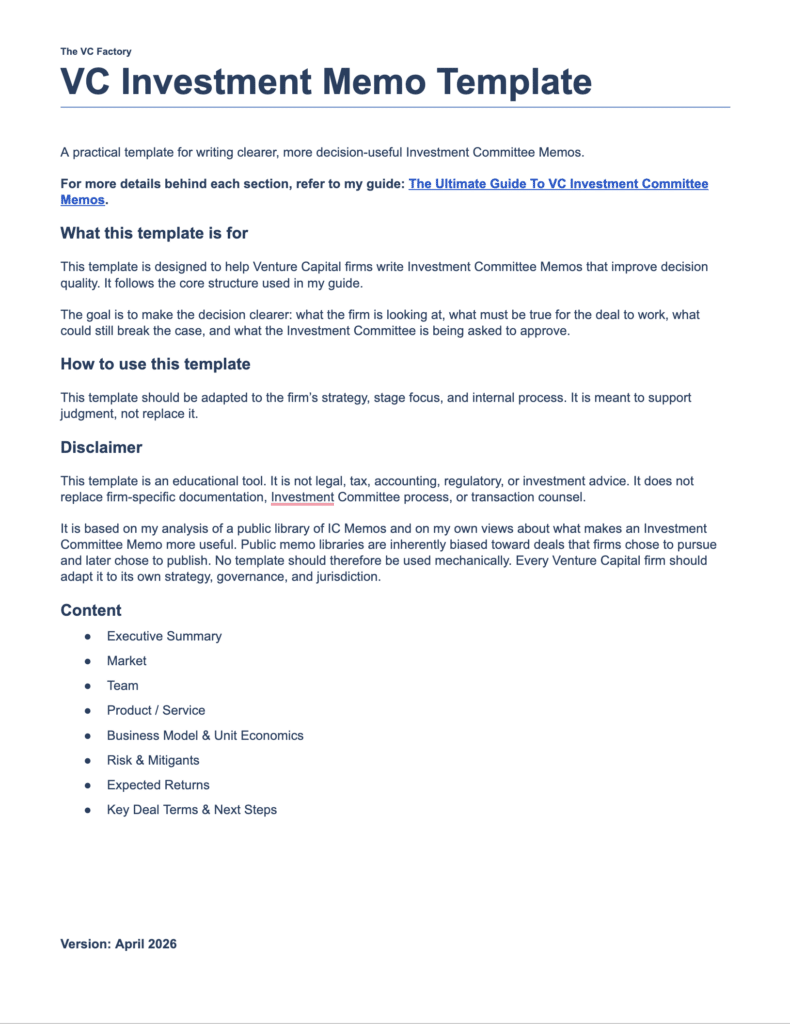
Download The VC Investment Memo Template Here
You’ll be asked to enter your email, and you’ll join 12,000 VCs & Founders who read our weekly newsletter. Nothing else, and you can unsubscribe at any time (but if you need this template, I bet you won’t).
Structure of Elite Investment Committee Memos
1. Executive Summary
Investment Committee Members are busy and routinely review several IC Memos per week. This first section must work fast.
The Executive Summary is where a Deal Memo answers the Investment Committee’s first and most practical question: what are we being asked to approve, on what terms, and why is this opportunity worth underwriting?
IC Members must first establish whether the investment opportunity aligns with the VC firm’s investment thesis, before they even consider whether this startup will prove to be the outlier that returns the fund.
A strong Executive Summary combines three things: the Deal Header, the Investment Thesis, and the Recommendation. That’s the sequence in which most IC Members process a Deal Memo: first, identify the transaction; then, decide what must be true to produce outlier outcome; and finally, decide whether to approve it.
If this section is vague, the rest of the Investment Committee Memo has to work twice as hard to convince members of the Investment Committee to vote for the deal presented. In many cases, you’ve already lost the argument.
Deal Header
The Deal Header is the IC Memo’s most factual section. It tells the Investment Committee what the company under review does, what industry vertical it operates in, what round is being raised, how much capital the firm may invest, at what valuation, through which security, with what ownership target, and in what role.
The best Deal Headers are compact and easy to scan. They resemble a term sheet summary. I won’t detail every line of the Deal Header, only the few that VC professionals writing IC Memos most often get wrong. Refer to the VC Investment Memo Template for more guidance on each block.
Company Activity
Explaining in a few precise words what the company actually does is much harder than it sounds. Yet, it’s one of the most important parts of a good Deal Memo. When the description is not precise enough, IC Members start the meeting with the wrong mental model, and the discussion drifts.
I’ve been in meetings where people spend ten minutes thinking the company sells payment terminals when it really sells loyalty software, or thinking it’s a SaaS application when it’s actually an API product, or assuming the code is proprietary when it’s open source.
A strong IC Memo removes that ambiguity immediately. It defines the company’s activity in language that a non-expert can understand at once.
Security
The nature of the security the firm will invest in matters because it changes the economics and the downside.
I’ve written guides on the following: Preferred Shares, SAFEs, and tranched structures. Too few VC professionals today understand the ramifications of preferred instruments or the cons of using SAFEs. These articles go back to the reasons they were invented and how to use them properly.
Ownership Target
Make sure the ownership percentage is calculated on a fully diluted basis, including any outstanding employee ownership plans.
Investment Thesis
The Investment Thesis is where the IC Memo explains what the Investor needs to believe for the deal to work.
In practice, this means defining the few claims that matter most: why the market can become large enough, why the company can build an enduring advantage, and why this team can execute well enough to capture the opportunity.
The strongest Investment Committee Memos keep the Investment Thesis narrow. Three sharp claims are usually enough. Each one should be specific enough that an IC Member could disagree with it.
If the investment thesis reads like generic Venture Capital lingo about a large market, a strong team, and fast growth, it’s too weak to help the Investment Committee make a decision. A strong Deal Memo states what must be true, why that belief is reasonable, and what evidence makes it credible.
Recommendation
Outlier returns in VC are built on conviction, not defensive politics. If you’re here, you have conviction. Otherwise, you’re wasting your and the IC Members’ time.
An IC Memo is usually not written to recommend a pass. In most cases, it’s a sponsoring Investor’s document. Its role is to state the investment case, surface the main risks, and make the approval ask explicit.
Our internal data shows that consensus vs. non-consensus doesn’t matter at all. Presence of conviction is what matters.
Pat Grady – Sequoia (Source: Uncapped)
As I highlighted in my article on the rules and culture elite VC firms put in place for their IC Committees, strong support from one partner supersedes lukewarm support from multiple partners.
The recommendation should be short and direct, and make the choice explicit. A useful recommendation states the decision, the key economics, and the few conditions that still matter, such as one remaining diligence item, final partner alignment, or a milestone-based structure.
Example From Elite Investment Committee Memos
The Bright Health memo from Bessemer Venture Partners is a strong example. You’ll note it’s not in the same order or format as in my VC Investment Memo Template, which is fine. I prefer the table format and order in the template because they are easier to scan quickly.

In the first paragraph, the memo recommends a tranched $28.8 million investment, states the total round size, valuation, intended milestones before the next financing, co-lead structure, and post-financing ownership.
The next paragraph explains why the team has conviction, pointing to weeks of diligence, industry calls, time spent with the launch partner, and an external actuarial review.
Finally, the paragraph concludes by laying out the three pillars of the investment thesis, which are repeated in the Introduction section that follows: “The investment thesis here is simple – huge market, great team, and a strong initial health plan product with many expansion opportunities.”
I run in-person workshops on drafting elite IC Memos and designing optimal IC processes every month. These are free sessions accessible only by invitation. Add your name to the list here
After the Executive Summary, I organized the VC Investment Memo Template according to how Investors make decisions. VCs often pick the best team to pursue a new market opportunity, which is why the Market section comes first, followed by the Team section. One way to assess the Team’s quality is to evaluate its product, which comes in third. Startup teams often pivot, so focusing on the product from the start of the IC Memo may not be relevant.
However, this order doesn’t have to be rigid. Investment Committee Memos from elite VC firms mentioned in this article don’t offer a consistent order, even when they come from the same VC firm.
2. Market
The Market section of an IC Memo makes one point: this is a market our firm must invest in.
The TAM Trap: Size vs Opportunity
Many Deal Memos confuse Market Size with Market Opportunity. They throw a large TAM on the page, then move on.
That’s not enough to convince an experienced Investment Committee. A large headline number often conceals a lack of understanding about the market. Read my article on TAM SAM SOM to understand how to use this framework effectively.
Besides, this approach doesn’t serve nascent markets well. Elite VC firms often invest in markets that are not yet fully formed, where big opportunities lie.
For example, Union Square Ventures’ Fred Wilson was among the first in the Bitcoin/cryptocurrency market. Crypto’s TAM was either huge (if you treated it as a subsegment of financial transactions in fiat currencies) or minuscule (if you viewed it as just a speculative asset). Wilson saw the opportunity. (Full case study here).
A strong Market section does not merely say the market is big. It explains:
- Dynamics: why this is a market where a new company can break in
- Timing: why now is the right moment
- Demand: what unmet need or structural shift creates the opening
The Deal Memo must explain whether the company is benefiting from a disruption, a change in customer behavior, a regulatory shift, a new cost curve, or a weakness in incumbents.
Go-To-Market Strategy (GTM)
Distribution is how startups win. A product can be excellent and still fail if the company has no path to the first users. Top-quality Investment Committee Memos offer an honest evaluation of how Founders propose to enter the market.
I covered what elite VCs look for in terms of GTM in a previous article. Here, I want to emphasize how best to present the GTM analysis in a Deal Memo.
The IC Memo should highlight whether the Founders identified a beachhead – a promising market segment for the product or service. Your due diligence should determine whether the early adopters are the right ones, and how the Founders envision moving to the next beachhead.
The goal is not to find the biggest market, but to target the lowest-hanging fruit that is large enough to provide proof, generate revenue, and build momentum. It’s the path from market opportunity to market capture.
Read more about beachheads and specific case studies to better understand how to present them in your IC Memo.
Competition
The best Market sections also place the startup’s key success factors within its competitive environment. Generic competitor grids are useless; they don’t convey who’s winning, and why.
If there are incumbents, explain why they are vulnerable. Are they too slow, too expensive, or do their economics force them into the wrong customer segment? Sometimes they are too tied to an old distribution model. A strong Deal Memo makes the dynamics explicit.
Also, before arguing that the company’s key advantage is being first to market or leveraging network effects, read the articles I referenced on these topics. They rarely occur in reality.
One common mistake VCs writing Investment Committee Memos make is failing to consider the customer’s point of view. When they describe competitors, they focus on companies in the same product category and compare their features. Unsurprisingly, the Deal Memo shows that the startup under consideration has more features than its nearest competitors.
Yet, from the customer’s point of view, a product in another category may be good enough, it’s “doing the job” fine. Or, indeed, doing nothing is an acceptable solution. Startup cemeteries are full of great products that nobody wants, like a $700 juicer.
I find Clay Christensen’s Jobs To Be Done (JTBD) theory especially useful to avoid this trap. The idea is simple: customers do not buy a product in the abstract. They “hire it to do a specific job.” The JTBD framework helps clarify potential unmet needs, identify real substitutes, and understand why a startup may enter a market that looks uncrowded on paper yet remains overserved in practice.
The McDonald’s Case Study
While it’s not about a startup, Christensen’s McDonald’s milkshake case study makes the point vividly.
McDonald’s wanted to increase its milkshake sales and used its classic marketing playbook: it profiled milkshake buyers, invited them to focus groups, asked what they wanted improved, and then changed the product accordingly.
But sales didn’t move.
Asked to help, Christensen’s team observed customers in context and discovered that many morning buyers were “hiring” the milkshake for a very specific job: making a long, boring commute more bearable, keeping them occupied while driving, and keeping them full until 10am.
From that point of view, the real competitors were not only other milkshakes. They were donuts, bagels, bananas, and even Snickers bars. That changed the Market Opportunity entirely. The market was far larger than the milkshake category itself, because the real competition came from all the alternatives customers could hire to do the same job.
Example From Elite Investment Committee Memos
The Yelp Deal Memo from Bessemer Venture Partners is one of the best examples in my IC Memo library.

It doesn’t stop at saying local advertising is large. It explains why the market is available. At the time, yellow pages publishers still dominated local merchant advertising, and very little of that spend had moved online. It was about to change, driven by the momentum of the online ad industry.
Yet the leading online ad platforms were a poor fit for many local businesses because their customers were geographically constrained, and most transactions still occurred over the phone rather than through a website.
What makes the IC Memo stand out is that it shows a large market, an incumbent weakness, and a structural reason why a new company could break in. Like other excellent Investment Committee Memos, Yelp’s market section shows why customers were desperate for a solution – a promising sign of potential product-market fit.
3. Team
The Team section of an IC Memo makes one point: in this market where we must invest, this is the best team to win.
Most Team sections in Investment Committee Memos are too flattering and not useful enough. They read like short LinkedIn profiles. That’s not the job. You must show a tight fit between the team and the execution challenge.
In other words, why are these people not just excellent professionals in general, but the right people to exploit the market opportunity described before?
Listing the qualities that VCs look for in Founding teams would take a whole separate article. In fact, I already wrote one on this topic. It presents the five characteristics most VCs seek:
Ability. This is not talent or competence in the abstract. It should be tied to the business’s execution challenge. Does this team have the technical depth, product judgment, sales ability, regulatory understanding, or operational discipline that this market specifically requires?
Industry Experience. This matters because it reduces the risk that the startup is solving a fictional problem. Founders who know a market from the inside usually understand customer pain points, incumbent weaknesses, and buying behavior more deeply than outsiders.
Passion. Investors often use this word loosely, but what matters in practice is sustained intensity. Building a startup takes years of uncertainty, repetition, and pressure. A good Team section should therefore show more than enthusiasm. It should show that the Founders are deeply committed to the problem, serious enough to keep refining the product, recruiting talent, and pushing through setbacks without losing focus.
Teamwork. The IC Memo’s Team section should show whether the Founders’ skills are complementary, whether they trust one another, and whether they can disagree productively. Companies do not fail only because the market is hard or the product is weak. They also fail because the team cracks under pressure.
Entrepreneurial Experience. Prior startup experience can be a real advantage because it shortens the learning curve. Founders who have built before usually understand product-market fit, fundraising, hiring, and scaling more concretely. Still, this criterion should not be reduced to résumé prestige. What matters is whether prior entrepreneurial experience gives this team better judgment for the specific decisions ahead.
Most VC firms have a list of specific characteristics for Founding Teams. Sequoia looks for the “quirky kids“, Andreessen Horowitz for the Founder-CEO, Softbank Vision Fund for charisma and leadership, and Founders Fund for long-term visionaries.
Whatever is on your list, make sure you explain the team’s strength against the market’s context. A good Team section shows that this market needs Founders who can do A, B, and C, and here is the evidence that this team can do so. It’s much more persuasive than simply saying the team is exceptional.
Example From Elite Investment Committee Memos
The Twitch IC Memo from Bessemer Venture Partners illustrates well what Team sections must do.
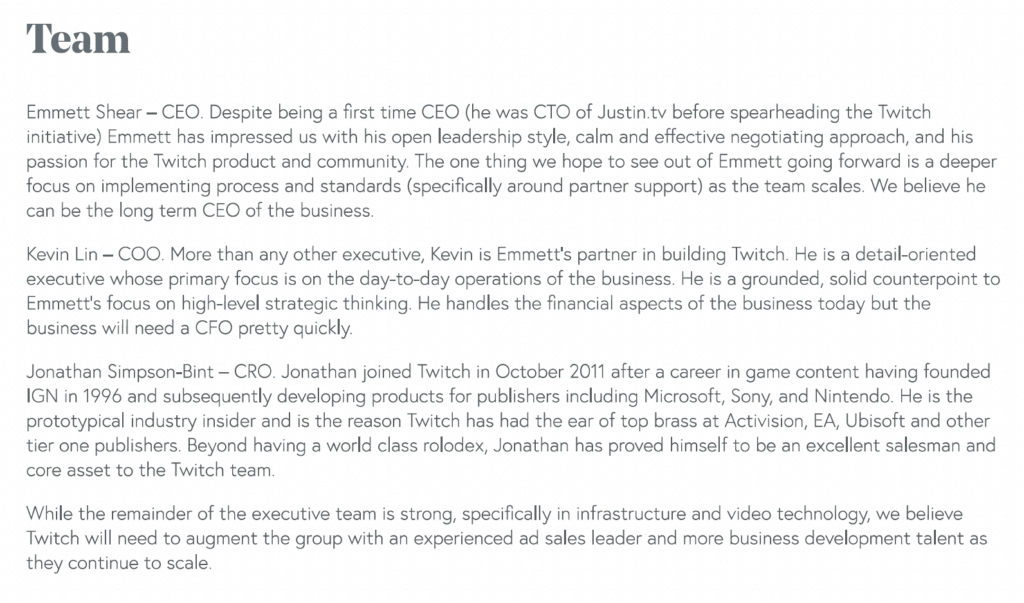
What makes it strong is that it does not present the team as talented in the abstract. It shows why their previous experience matters for the market challenges ahead.
Emmett Shear and Kevin Lin had already built Justin.tv, which gave them direct experience with live video infrastructure, user behavior, and the operational challenges of real-time online broadcasting. The memo then adds another layer: Jonathan Simpson-Bint’s background in gaming media and publisher relationships. That mattered because winning in live game streaming required credibility with the gaming ecosystem itself.
Strong Team sections bridge the gap from what the Founders and early executives did to what this market now requires. They explain why this team is unusually well-positioned to exploit this specific opportunity.
How About Incomplete Teams?
Early-stage VC firms often have to evaluate a Founding Team that is not yet complete. The easy decision is to pass, but it may come with dire consequences, as Benchmark found out after missing a 10,000x return from Google’s Series A.
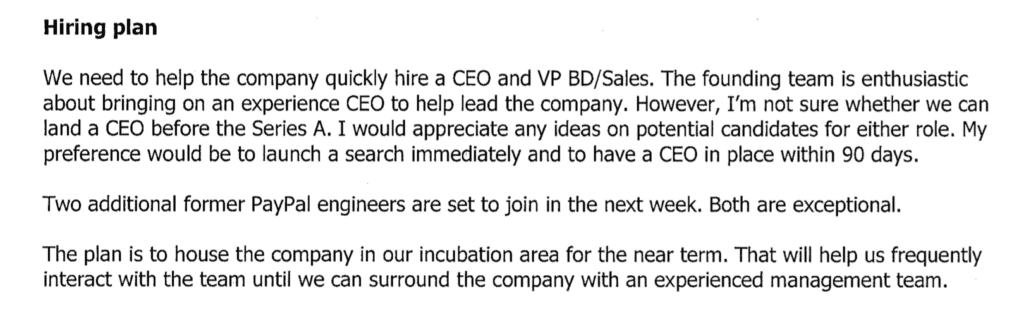
Sequoia’s YouTube IC Memo shows what a strong Investment Committee Memo does in that situation. Sequoia saw that YouTube needed to quickly hire a CEO and a VP of Business Development / Sales. But instead of treating that gap as a reason to pass, the deal memo framed it as a problem to solve and tied the solution to a two-stage, milestone-based financing structure.
Another power move is to ask the Investment Committee Members for help in identifying a CEO. This is how elite VC firms win; they don’t wait for the investment to close to add value. It requires a particular culture that few firms possess, which is why I offer a workshop on IC Rules & Dynamics to VC firms in my network.
4. Product/Service
The main point the Product/Service section makes is that there is some evidence that the market actually needs it.
Many IC Memos drift into feature description. Instead, the Product/Service section should demonstrate how it answers the user’s need described in the Market section.
How does it solve a painful problem better than alternatives? What is unusually effective, simple, fast, or compelling about this product or service? You should first explain what the product or service does, and only after cover how it works.
An added dimension is how the product or service helps customers win. Successful products do one of three things for those who buy them:
- Increase revenue
- Decrease costs
- Resolve a roadblock
Read my article on how experienced VCs read pitch decks for more details on each dimension.
Traction
The Traction section belongs here because it provides evidence of a market for the product or service. That “proof” can take different forms depending on the startup’s stage: revenue, retention, usage frequency, customer references, repeat purchase, waitlists, partnerships, or even unusually strong engagement in a narrow early cohort.
What matters is not volume alone. Some of the best Traction sections in Investment Committee Memos are persuasive because they show that users are doing something unexpectedly intense. That usually means the team has found a real nerve.
In the words of Benchmark’s co-Founder Andy Rachleff, who coined the phrase “Product-Market Fit”, traction shows that people are desperate for a solution that doesn’t have a good enough alternative.
Read this article on product-market fit with case studies on how elite VC firms such as Lighspeed Ventures evaluate PMF.
Example From Elite Investment Committee Memos
The Snapchat seed memo is a very clean example. It first explains what the product is in plain language, then moves almost immediately to the evidence that the product is needed.
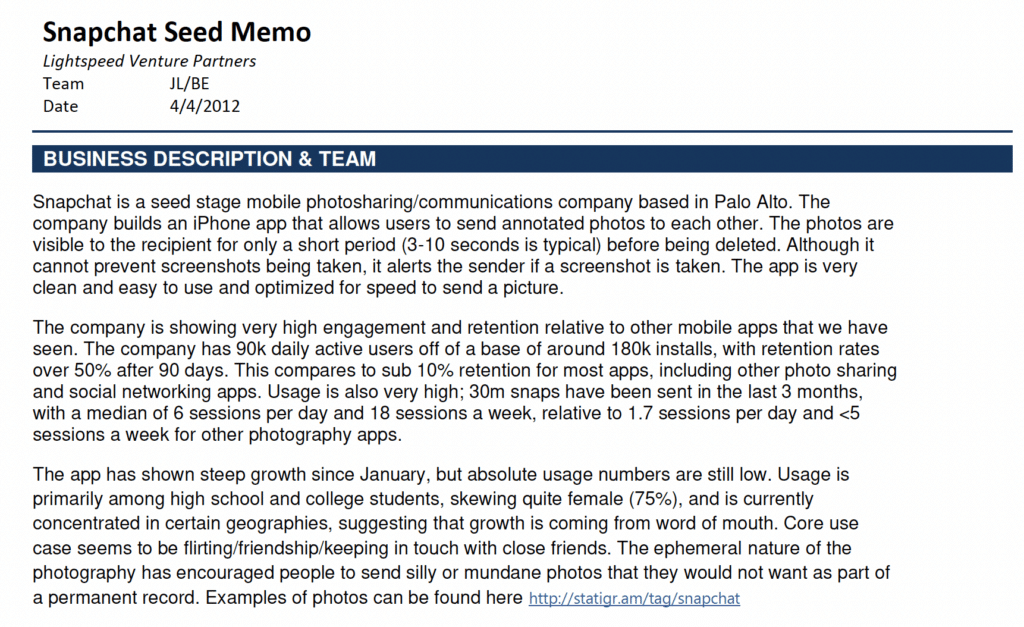
The memo highlights unusually strong engagement, retention, and session frequency relative to other mobile apps, then links that behavior to a very specific user use case.
This Product section works because it shows the Investment Committee that users have already built a habit around it.
5. Business Model & Unit Economics
Your job for the Business Model & Unit Economics section of an IC Memo is not only to show how the startup makes money, but also to evaluate whether this is the right business model, and how the economics improve as it scales.
Too many Deal Memos write “subscription” or “take rate” and call it a day. The Investment Committee needs to understand the revenue engine. What exactly is being sold? To whom? At what price? With what gross margin profile? What are the key variable costs? What does retention look like, if retention matters? How about payback? Which assumptions matter most, and which one could break the model?
A common mistake is to define and measure scalability incorrectly. A company is not scalable just because it grows quickly. It is scalable if revenue can grow faster than costs over time.
Strong Investment Committee Memos do one more thing. They identify the two or three variables that matter most. That makes the later Risks section much better, because the Investment Committee can now see exactly what needs to be monitored after investment.
Nailing this section requires a solid understanding of startup financials and unit economics analysis.
My article on startup financials explains how experienced VCs build and present startup financials. You’ll learn how to structure a cash flow–driven financial model (monthly, cash-in/cash-out, clear drivers), understand and articulate unit economics, burn, runway, and break-even, determine a coherent funding need and timeline, and use the model to run sensitivity analyses on key business drivers to assess risk and capital requirements.
This article on unit economics explains how senior Venture Capitalists use metrics such as MRR, churn, LTV, CAC, and payback period to pressure-test the Business Model, compare growth with profitability, and identify the few assumptions that really determine whether the company can become sustainably profitable.
Example From Elite Investment Committee Memos
The Shopify IC Memo from Bessemer Venture Partners first explains the Business Model: the company earns recurring monthly subscription revenue from merchants and also captures a small share of their sales through transaction-based fees.
From there, the Deal Memo shows why the economics can improve as the business scales: merchants grow, some move into higher-priced plans, and revenue per customer increases over time.
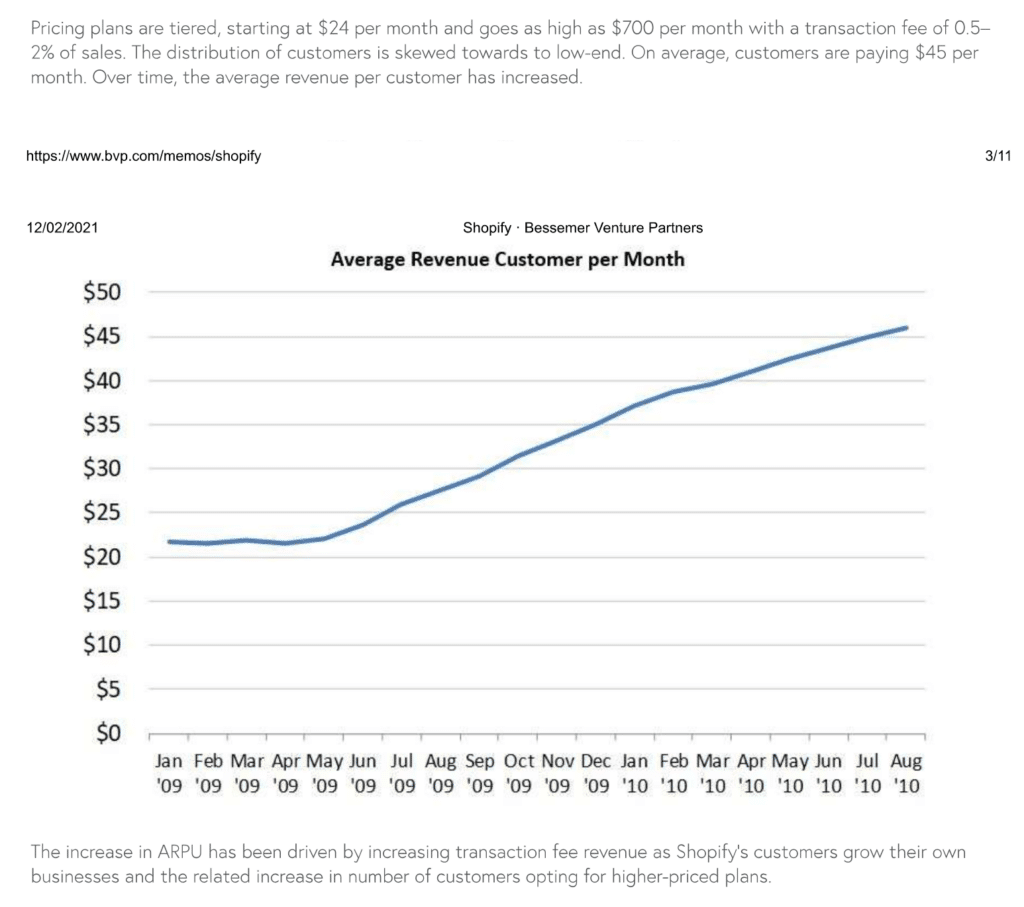
Another section addresses customer acquisition and retention, where the Deal Memo explains why the math works despite churn.
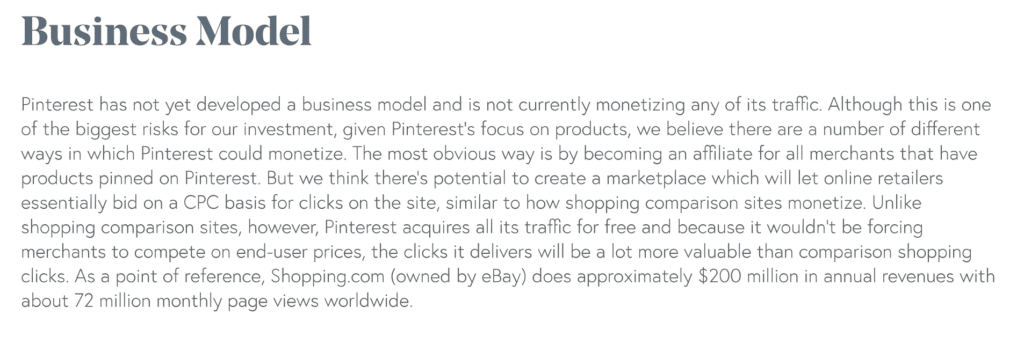
However, sometimes the Business Model is not yet fully clear, especially in the earliest stages. The IC Memo should address the issue by outlining the most plausible paths to monetization.
In those situations, analogies can be useful. They help the Investment Committee see how a startup with a new product or behavior might still capture value by resembling other businesses in the way it monetizes attention, transactions, or customer demand.
6. Risks & Mitigants
The Risks & Mitigants section of the IC Memo is the hardest part to draft correctly, because Investors must strike a balance between fear of the unknown and irrational exuberance.
The main point of this section is that the risks are real but acceptable.
Newer VCs often treat this section like a legal disclaimer. They list every potential risk and say they want to be thorough. In reality, they disguise intolerance for uncertainty as analysis.
Strong Investment Committee Memos do something else. They identify the two or three risks that actually matter, explain why those risks could break the case, and then show why the sponsoring Investor is comfortable underwriting them.
Elite VCs accept unknowns and understand they are part and parcel of power-law outcomes.
They don’t sugarcoat issues, but instead explain:
- what must happen for the company to make its plan
- what evidence already supports that view
- what could still go wrong
In other words, they distinguish between manageable uncertainty and fatal weakness.
The Characteristics of Strong Mitigants
A mitigant is not a wish. It is not “the team is strong” or “the market is large.”
It is a concrete, evidence-based argument explaining why the VC firm can live with the identified risk, or what needs to happen for the risk to disappear.
Mitigants may rely on expert diligence, unusually strong customer behavior, a pricing advantage, a distribution edge, a regulatory buffer, specific market dynamics, or a sensitivity analysis that shows the downside is survivable.
This section should also make the post-investment implications explicit. If the business model depends on churn improvement, say so. If the company will need to prove CAC efficiency before the next round, say so. If one regulatory decision could change the economics, flag it.
A strong Deal Memo identifies the variables the firm will need to monitor after investment and, ideally, the first value-add actions to reduce those risks.
Example From Elite Investment Committee Memos
My favorite illustration of how top VC firms approach mitigation is Sequoia’s Deal Memo on YouTube. It’s a useful example because it makes the key unknowns explicit and shows how the deal team intends to reduce them. I’ve used it to train dozens of VCs.
The IC Memo shows how Power-Law Masters think, how they approach risk, and why mindset drives alpha in Venture Capital. It’s clear about what the deal team knows vs. what remains uncertain, and it provides a path to reduce that uncertainty.
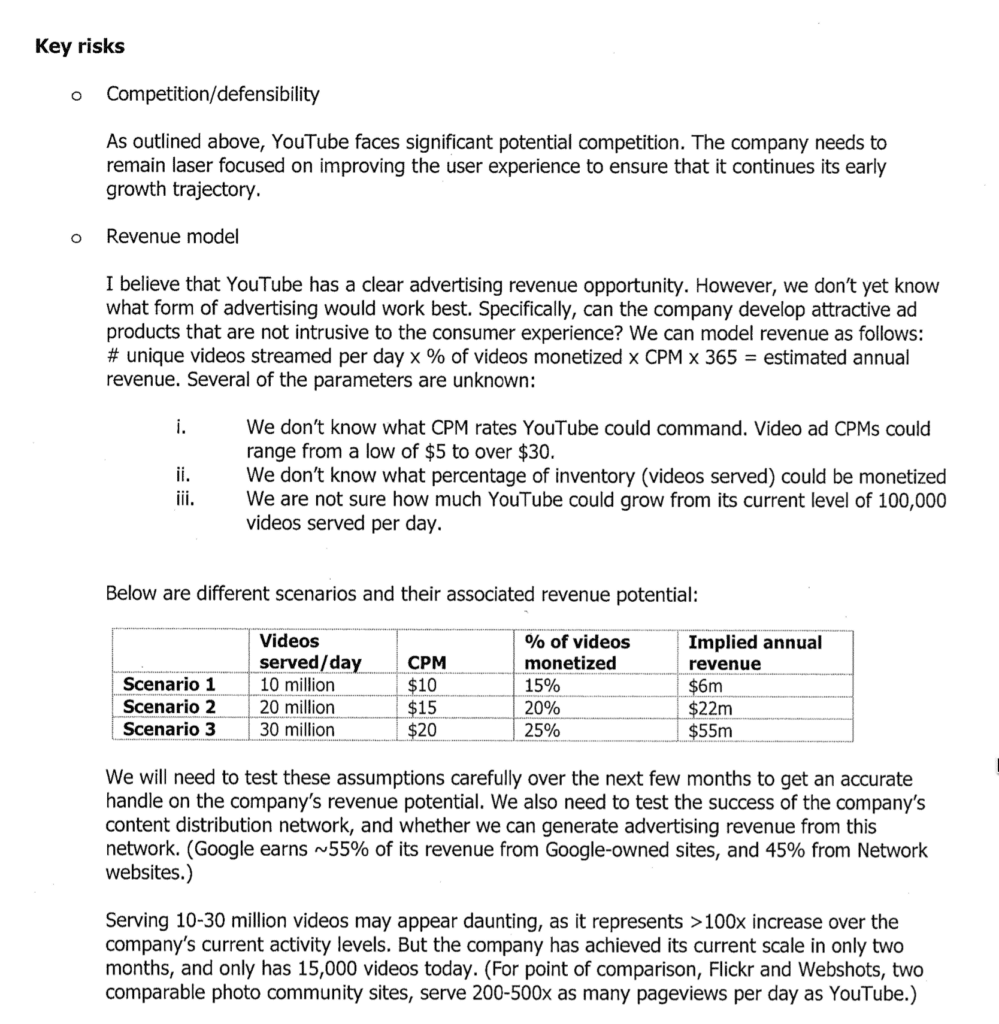
The discussion of the revenue model is the most instructive part.
Sequoia’s Roelof Botha says plainly that YouTube has a clear advertising opportunity, but that several parameters remain unknown: the CPMs the company can command, the share of videos that can be monetized, and the pace at which usage can scale.
Instead of hiding that uncertainty, the IC Memo lays out several scenarios, giving Investment Committee members a way to reason about both the upside and the downside.
The document also shows what needs to happen after the investment. Botha writes that these assumptions must be tested over the next few months, including the viability of the content distribution network and the company’s ability to generate advertising revenue from it. Great Deal Memos help set up the right post-investment reporting metrics.
Finally, YouTube’s IC Memo offers points of comparison from successful startups in adjacent spaces, which helps further bound the scenarios laid out earlier.
Conclusion: tl;dr
As Apple marks its 50th year, Sequoia has released Don Valentine’s original 1977 memo for the firm’s investment in Apple Computer. Valentine was Sequoia’s Founder, one of the defining early Venture Capitalists in Silicon Valley.
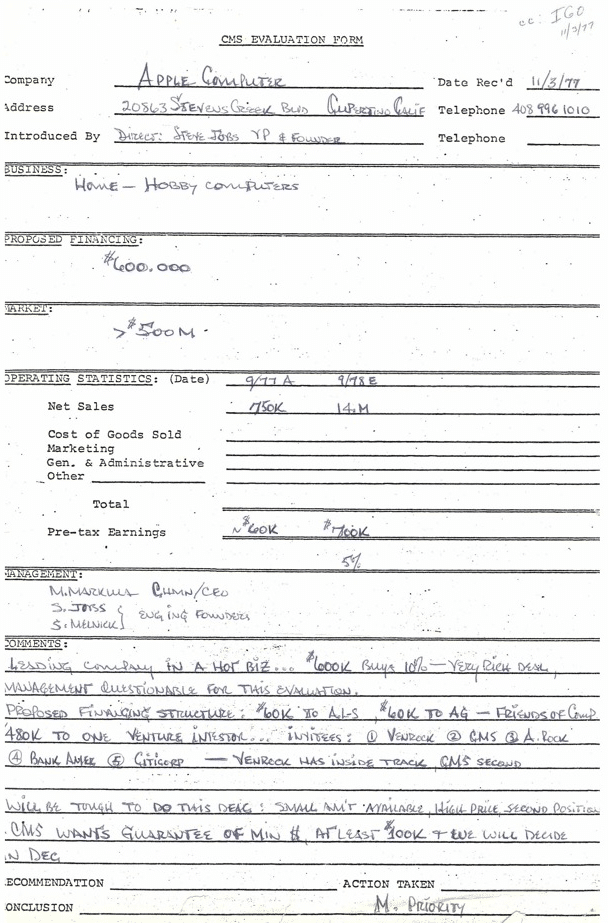
Don Valentine proposed a $600,000 investment for 10% of Apple, whose market value exceeds $3,500,000,000,000 today.
It’s a fitting way to end this guide because it shows both how much Venture Capital has changed and how little the core questions have. Valentine’s memo is short, rough, and far less structured than a modern IC Memo. Yet the essentials are already there: what the company does, how much capital it wants, what market it serves, what the operating numbers look like, who runs it, and why the deal may still be difficult to close. The format evolved, but the underlying judgment didn’t.
Strong Investment Committee Memos don’t win because of their format, but because they help the Investment Committee make a better decision:
- The Executive Summary shows conviction
- The Market section shows why this is a market the firm must care about, and how the company can enter it through the right beachhead
- The Team section explains why these Founders are suited to that market
- The Product or Service section shows evidence that the market actually needs what the company is building
- The Business Model & Unit Economics section explains how the startup makes money and why the economics can improve as it scales
- The Risks & Mitigants section makes uncertainty explicit, then shows why it is still acceptable to underwrite
I wrote this guide because too many Investors still approach the Deal Memo as a defensive artifact. It’s the wrong mindset. A good IC Memo is a conviction document. It recognizes the uncertainty, identifies what must be true for the best-case scenario to pan out, what evidence already supports that view, what could still break the case, and what the firm will need to monitor after investing.
The purpose of the downloadable VC Investment Memo Template is to help you draft documents that produce better Investment Committee discussions, better decision trails, and avoid missing the odd outlier that’ll make the power-law work for your firm.