5 Questions LPs Should Ask Before Investing In A VC Fund
I recently spoke with a group of family offices and endowments about the questions LPs should ask before investing in a Venture Capital fund. Some participants had invested in VC before, either directly in startups or through VC funds, but most had not.
The central question was: How should an LP evaluate a Venture Capital fund before making a commitment that may last more than ten years?
Most experts’ answers online cover investment thesis, team track record, portfolio construction, references, and the fund terms. These criteria tell an LP whether the fund’s strategy makes sense and whether the GP understands the job.
However, they don’t offer an insight into the fund’s potential to generate outlier performance.
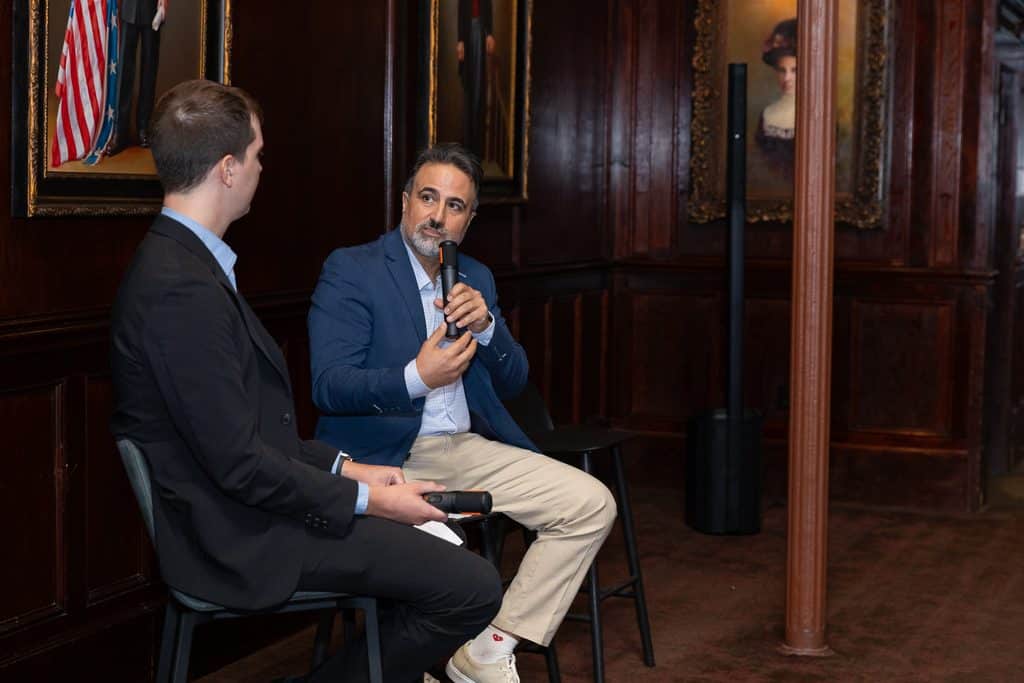
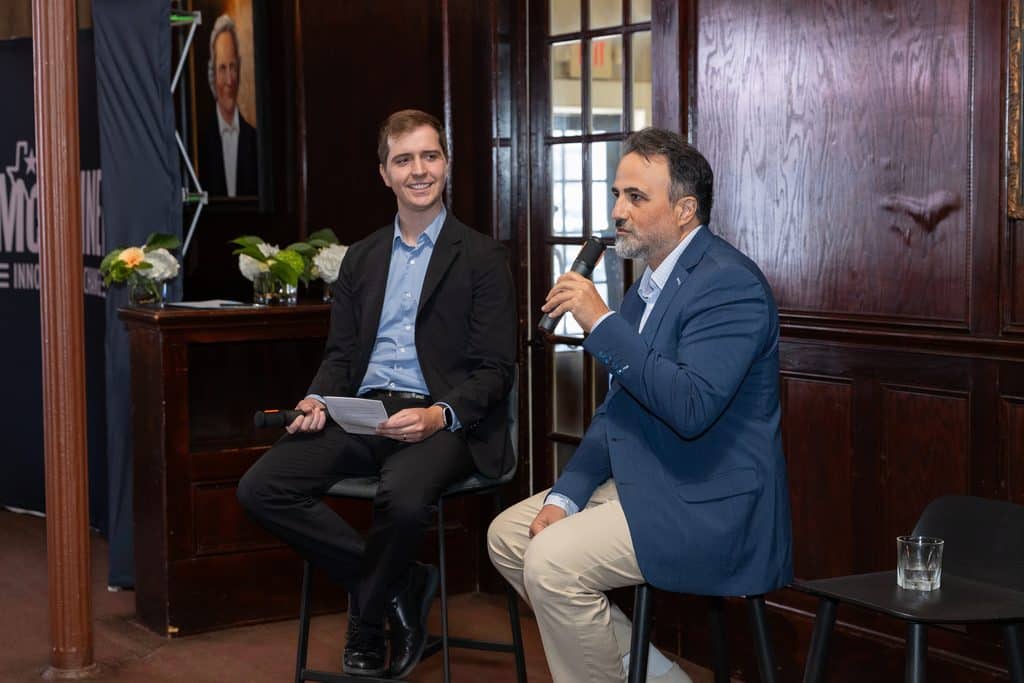
That was the topic of my fireside chat at the luncheon organized by the McKinney Economic Development Corporation, a local government agency whose Innovation Fund has provided non-dilutive capital to more than 50 startups since 2020.
The five questions below examine elements that may explain why some GPs repeatedly outperform their peers. They draw on Mindset-Based Investing, the capital allocation framework I developed after a decade analyzing how the best VCs made investment decisions.
The 5 Questions LPs Should Ask
#1. Should I Allocate To Venture Capital?
For much of the post-2008 era, Venture Capital felt like a no-brainer to many LPs. Interest rates were close to zero, capital was abundant, and the possibility of exceptional returns made a ten-year lockup easier to accept.
That has changed.
First, interest rates have risen considerably. The effective federal funds rate, the overnight benchmark guided by the Federal Reserve, rose from 0.08% in February 2022 to 5.33% in August 2023. It remained there for a year and stands above 3.50% today. This means Investors can now find opportunities targeting net returns of 7-10% with a more acceptable risk profile than Venture Capital, whose trailing 10-year net performance is 10-12% according to various sources.
In parallel, VC-backed companies also stay private longer. A recent analysis led by Stanford GSB found that, among companies in the 2020–2022 unicorn cohort with five full years of follow-up, 20% had exited by year five, compared with 52–54% in earlier cohorts. That leaves more potential value tied up in private markets and makes the timing of fund distributions less predictable.
Average is bad in VC. Even above average is sometimes not good enough.
Peter walker – Carta (read more)
Average or even median performance cannot justify that trade. A Venture Capital allocation only makes sense if the manager is capable of delivering top-decile performance.
That makes manager selection the central problem. Among the c. 1,000 VC funds launched each year in the U.S., only a handful will deliver true alpha — a phenomenon I called the “Super Power Law.”
LPs who want exposure to the Venture Capital asset class should therefore ask themselves what criteria increase the odds of selecting the future outliers. First among these, whether they should allocate capital to experienced VC firms or new ones.
#2. What Is The Best Path To VC For My Objectives?
Like the family offices, endowments, and HNWIs present at McKinney, many first-time Investors in Venture Capital select diverse paths to get exposure. Some mix them. The spectrum is wide, from angel investing in pre-seed rounds to buying public tech stocks.
Before choosing a route to VC, Investors should take a step back and ask themselves: what do I want from this investment? Financial performance is an obvious answer. But some LPs also want to understand new technologies, spot threats to their family business, or build relationships with the people funding the next generation of companies. Those objectives lead to different paths.
- Exposure to technology: diversify from other asset classes in the overall portfolio, such as non-tech stocks, bonds, and real estate
- Financial performance: seek higher returns for a small portion of assets, even though the risk and illiquidity levels are higher
- Strategic intelligence: understand new technologies, identify opportunities, or spot threats to an existing business
- Learning: develop a better understanding of how startups grow and how Venture Capitalists make decisions
- Relationships and participation: meet GPs and Founders, exchange ideas, and potentially contribute experience or contacts
- Supporting a mission: help finance a particular technology, region, or group of entrepreneurs.
These objectives can coexist. What matters is being clear about which ones justify the commitment. The path also depends on how much risk an Investor is willing to take and how close they want to be to GPs and Founders. I’ve mapped the main possibilities below.
What follows is a framework for comparing those routes, not investment advice or a recommendation to invest.
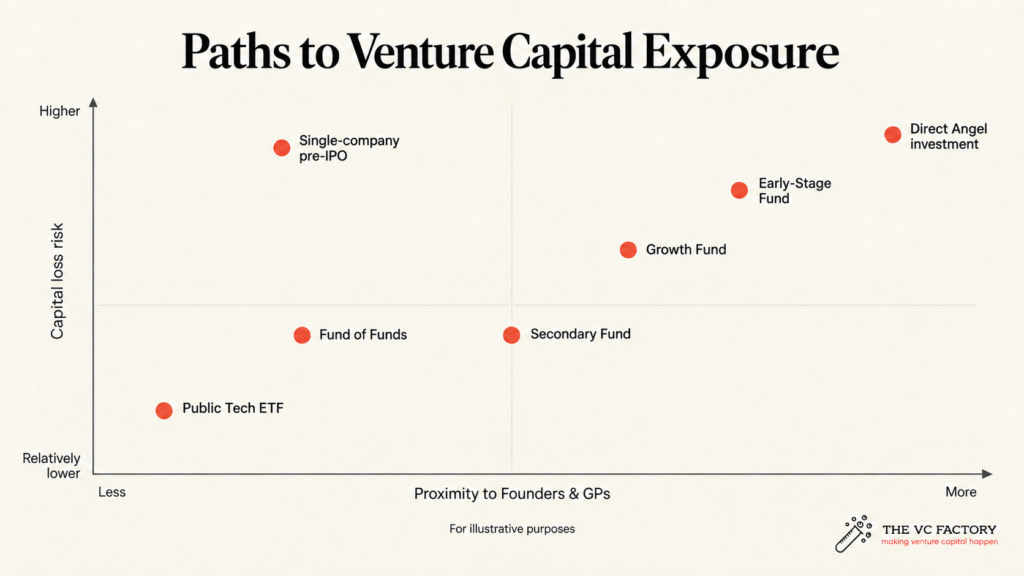
- Public Tech ETF: a basket of listed technology companies. It spreads exposure across businesses and is easy to trade, but offers little personal interaction with their leaders. An individual tech stock is a more concentrated bet
- Single-company pre-IPO: an investment in one private company, directly or through a vehicle holding its shares. The business may be established, but concentration and entry price still matter. Buying shares does not necessarily create a relationship with the Founder
- Fund of Funds: a fund that invests in other funds. It delegates manager selection and spreads exposure across portfolios, with an additional layer of fees. It also puts another intermediary between the Investor and the startups. Allocator One is one such fund
- Secondary Fund: a fund buying existing company shares or fund interests from other Investors. Buying a more mature portfolio can reduce some uncertainty and shorten the remaining wait for distributions. I place it further left because the relationship generally centers on the secondary manager rather than the underlying GPs and Founders
- Growth Fund: a fund backing companies that already have an established business and need capital to expand. There is less uncertainty about whether the product has a market, although valuation and execution remain significant risks. Interaction with Founders is possible, but usually mediated by the GP
- Early-Stage Fund: a fund backing younger companies whose products and markets are still taking shape. Failures are more common, making selection and portfolio construction particularly important. I place it further right because GPs may welcome LPs who can help their Founders, make introductions, or co-invest
- Direct Angel investment: a direct investment in a young startup. It can offer the closest relationship with the Founder and the greatest opportunity to contribute. It also leaves the Angel responsible for selection, due diligence, and building a portfolio that can absorb failures.
Each path presents its pros and cons, which is why the Investor’s objectives must be clear before they choose one, or a combination of several.
The rest of this essay focuses on the “early-stage fund” route, which is what most people have in mind when they mention VC for its high returns. The next question becomes: should I back an established firm or an Emerging Manager?
#3. Invest In Emerging Managers Or Established Funds?
At the root of this common quandary for LPs lies a dichotomy between access and selection.
An established firm offers a track record, recognizable portfolio companies, and an investment team whose work can be examined over time. Another underrated allocation driver is that you won’t look stupid if you backed a top firm that didn’t deliver for the fund you invested in.
However, the return requirement discussed above is even more acute. You’ll need top-quartile, and probably top-decile performance among established managers to justify the risk and illiquidity. Few funds are eligible, and the recent stretch at the top makes it unlikely that a multi-billion-dollar franchise delivers the kinds of returns they achieved historically.
Names such as Sequoia, Benchmark, Thrive Capital, and Founders Fund naturally come to mind. But getting an allocation in these most sought-after funds is almost impossible. Elite VC firms pick their LPs, not the other way round.
For instance, Sequoia’s LP base was famously, until recently, composed of 70% non-profits and 30% pension and sovereign funds, with no “rich family office.” Most firms also favor long-term relationships rather than first-time LPs.
We’re not in the business of making rich people richer.
Doug Leone – Sequoia (Source: pear vc)
Then there’s check size. Even an introduction to an established top-decile fund manager may not help if the commitment is too small for the vehicle. An extreme example: Sequoia reportedly sought a $250 million minimum commitment for its 2018 global growth fund. That was a specific fund, not a minimum across Sequoia, but it shows how far institutional fundraising can sit from an individual LP’s budget. Many of the multi-billion-dollar VC firms launched in recent years have similar requirements.
Emerging Managers pose a different problem: selection. They are looking for LPs, and smaller funds can accommodate smaller commitments. Some will become the outstanding performers everyone wants access to later. But which ones?
That is the Emerging VC Conundrum I explore in Emerging VCs: Selection Through Mindset. The best new funds can outperform established managers, while many others produce returns that do not justify the risk. The track record that would help distinguish them takes years to emerge. I developed Mindset-Based Investing to supplement traditional diligence at precisely that stage, by examining how GPs think, learn, and make decisions.
Some LPs try to bridge the two through spinouts: experienced Investors leaving established firms to launch their own. They bring prior investments, relationships, and sometimes a team that has already worked together.
In my report, I describe how strongly some LPs favor spinouts from Tier 1 firms. One fund-of-funds manager told me they would only consider Sequoia spinouts.
I understand the appeal. There’s more evidence to examine than with someone starting from scratch. But the selection work remains: did the GP originate and champion those investments, and will Founders still send opportunities after they leave? The previous firm’s name gets the conversation going, but I still want to understand what the GP can build without it.
#4. What Should I Ask a VC Fund Manager I Meet For The First Time?
Most LPs start the conversation with the GP’s investment thesis and track record. While both matter, they don’t produce alpha returns per se.
The problem is that the track record becomes most reliable too late. Harris et al. found that 45.1% of VCs whose previous fund eventually ranked in the top quartile repeated that outcome. Using only the information available when the next fund was raised, that figure fell to 33.5%, and to 30.4% for post-2000 funds. This remains above the 25% base rate, but far from the reliable selection rule many LPs think it is.
An investment thesis can also look stronger than it is. Many GPs deliver a rehearsed answer full of market trends and buzzwords. I listen for two things: why this thesis, and why this GP? A solid GP-Thesis Fit often relies on a specific insight borne of lived experience.
Who are you as a person that led you to want to do this?
Beezer Clarkson, Sapphire Partners
That question moves the conversation from credentials to meaning. Financial reward alone rarely sustains a GP through years of fundraising, uncertainty, and rejection. The strongest managers want to prove an idea, test themselves, change who gets funded, or build something that matters. That deeper motivation explains their resilience when the market turns.
My goal at the end of the first meeting with an Emerging GP is to answer one question: Are they trying to win? I listen for a promotion focus, a skew towards gain and growth that is at the root of success in the power-law asset class that is Venture Capital.
I try to evaluate whether they confront their ideas with the market, revise their assumptions when the evidence contradicts them, stay the course when signals are unclear, and whether their conviction rests on first principles. I listed a few of these questions in my report on Emerging GP selection.
Case in point: Martin Tobias, a successful entrepreneur who invested in dozens of VC funds before launching his own, impressed me when he candidly recognized that out of the 12 unicorns in his portfolio, half were due to luck, but the other half proved that his investment strategy was on point.
Many VCs, and even many people outside of it, suffer from self-serving bias: their successes are their own, but they attribute their failures to others or external circumstances. It hinders their ability to learn, an underrated trait in entrepreneurs and GPs. That’s why, as I say in the video below, I like to ask GPs about their failures and see how they explain them.
Source: Ignite LP: The Hidden Decision Framework Powering Elite VCs with Aram Attar | Ep252
You can read more about the Bill Gurley / Google case study here
#5. What Top Mistakes Do First-Time LPs Make?
There are many mistakes to choose from, but I’ll pick three that are less often mentioned and that rely on mindset, not technical points.
Deal Flow
The first one is expecting to get good at selecting managers very quickly. After five or ten meetings, a first-time LP may already have a favorite. But being the best GP in that small group says little about whether the manager could become an outlier among hundreds of others.
It reminds me of Angel investing. The first few startups an Angel meets rarely provide enough perspective to know what exceptional looks like. Selecting Emerging GPs takes time, many conversations, and a basis for comparison. A strong sourcing process can accelerate that work, provided there is a good reason to believe it brings better managers to the table.
You first need to build a sense of what “great” actually looks like.
Peter Walker – Carta
Peter Walker made the same point in our conversation about Emerging Managers: developing a basis for comparison takes time. My own experience reflects that. In the first few months after I decided to invest in emerging VC funds, I spoke with about 80 Emerging Managers, followed up with 20, and eventually backed 1.
LPs can accelerate that process by building a superior deal flow engine, as top GPs do when they build their referral networks. However, beware of external stamps of approval and avoid what I’ve called “proxy due diligence.” You still have to do the work and run your own audit.
When I rely on another LP’s stamp of approval, part of my due diligence is understanding how they reached their decision. For example, when I talked with Michael Ströck of Allocator One, one of the most active anchor LPs in Funds I and II, I clicked with several of their criteria.
Michael told me that he looks for a thesis grounded in the GP’s lived experience, a habit of thinking from first principles, and the agency to act rather than complain about circumstances. Those criteria resonated with my own research and gave me confidence to look at the managers they back — and I ended up investing in Allocator One myself.
The average VC is a herd animal.
Jessica Livingston – Y Combinator
Fear Of Missing Out
The second mistake first-time LPs make is FOMO. A renowned LP commits, the fund is nearly full, and suddenly the decision feels urgent. The manager has not necessarily become more compelling. Other people’s enthusiasm has made passing feel more uncomfortable. Social proof overrides other considerations.
The fear of missing out is a pervasive phenomenon in Venture Capital. First, humans are wired to pay attention to others’ opinions. It’s how we’ve survived in the wild. Second, there’s something about the asymmetry of cost to outcome in VC, and the power-law nature of the asset class, that makes missing a potential outlier hurt. Great Founders, like great GPs, are good at exploiting FOMO.
I’ve fallen for it myself, despite spending years studying these biases. My first commitment was to a charismatic first-time GP who was very good at convincing potential LPs that the $10 million anchor ticket was around the corner. In this case, I decided to ignore my intuition that other things didn’t make sense. Last I heard, the GP burned through the cash to attend posh LP events and hasn’t raised the fund.
Impatience
The third mistake is being short-sighted and leaving the market when returns take longer than expected. As I said at McKinney, building great companies takes time. An LP can understand illiquidity on paper and still struggle with several years without distributions.
Investors who commit to VC as an asset class must build patience into their decision to invest. A personal need for cash will not make a portfolio company ready for acquisition or IPO. And as I explored in my article on VC funds’ DPI, early distributions are not correlated with long-term performance.
The single most underrated attribute in this business is patience.
Ilya Strebulaev – Stanford GSB (Source: His awesome newsletter)
The most damaging consequence of impatience is leaving the asset class after a few disappointing years. A striking case study is how CalPERS, the largest public pension plan in the U.S., returned a meager 0.49% from its VC investments when other pension funds and endowments made a fortune, in part because they left the market after the dot-com bubble burst.
Conclusion: An Angel Club For LPs?
Family offices, endowments, corporates, and UHNWIs planning to invest in Venture Capital should ask themselves five questions, starting with why Venture Capital belongs in their portfolio and which path fits the objective.
Then comes the question of access versus selection: getting into an established fund or identifying an Emerging Manager who could generate top-decile performance. In either case, understanding how a VC thinks is crucial. So does recognizing one’s own limits: selection takes practice, FOMO clouds judgment, and returns require patience.
There is a lot to learn, and doing all of it alone takes time. That brings me to an idea I have been exploring for some time now: an Angel club for LPs investing in VC funds.
The principle is simple. A group of Investors could share sourcing and diligence, meet GPs, compare their reasoning, and invest when convinced. I would bring the managers I am considering for my own portfolio, based on my Mindset-Based Investing framework — then invite others to challenge my conclusions.
Of course, a club could reproduce the same social proof and FOMO described above. Its value would depend on how openly members question each other and how much independent work supports their decisions. Agreement should never become a substitute for diligence.
The idea is still taking shape. I am interested in conversations with LPs who would enjoy building such a circle: meeting managers, learning from one another, and developing their own judgment over time.
Get in touch if you’re interested in the idea. Only serious LPs will be considered (no GPs or Founders, please).